Event reviews,  FEATURES,  Readers' Swims

What Do You Think About When Swimming?

Swimmer, coach and copywriter Gert Hardeman completed the 6km event at Vidösternsimmet in Sweden. He shares what went through his head.

People often ask what I think about during a 6km swim. I’d love to say I slip into a mindless, blissful flow state for more than two hours. The truth is that my mind is busy almost the entire time.

Nerves and anxiety

The day before the start, and in the hours leading up to the swim, I feel insecure and nervous. Will I make it? There are tendencies to withdraw. Physically, I have a few things that sometimes get in my way. But that insecure anticipation is simply part of the experience. Fortunately, the excitement for this swimming adventure prevails. Exciting, challenging and a new experience.

The liberating starting gun sounds and we are off. The funny thing is that all the nerves disappear after the first few strokes. I know what I have to do for the first few hundred meters. I am swimming with my girlfriend, and we made a starting plan together beforehand: we opt to swim on the outside, away from the crowds, or the washing machine as it is called in swimmer jargon.

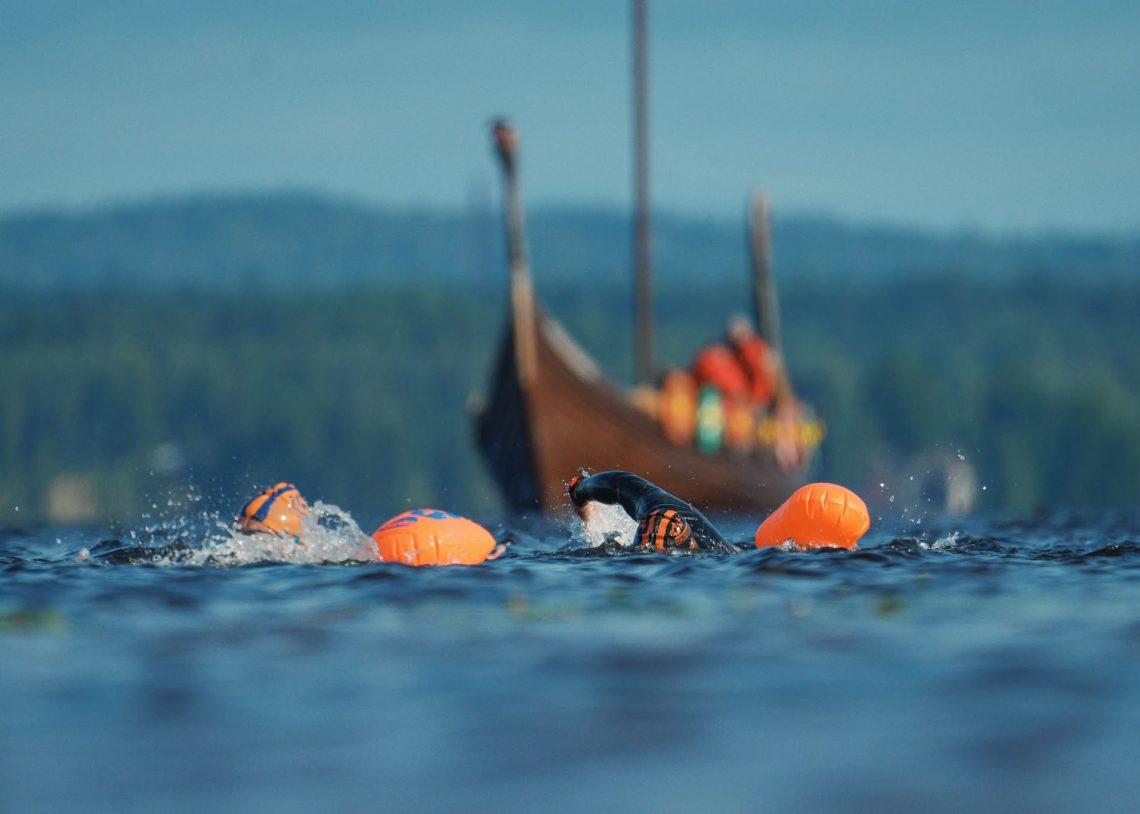
Stroke by stroke. Breathing in and breathing out. Getting into a comfortable rhythm. The water is pitch black, so you can’t see any of the underwater life. Because of the darkness, you get into your head sooner. You have no distraction from water plants, coral or fish. In Lake Vidöstern, you are left alone with your thoughts.

I breathe mainly to the right and my girlfriend to the left. We keep an eye on each other. That provides stability and feels nice and familiar. We are doing this together.

Staying on task

I think about my tasks, such as checking every six strokes to see if I can spot the yellow buoys that mark the route every 750 meters. Where do I need to go? The buoys sometimes seem to mysteriously disappear after just a few strokes. My swimming buoy (tow float) is slipping, so I have to stop to tighten the strap around my waist.

We exchange updates on how things are going and decide not to navigate too close to the buoys yet, but to swim a little further from the shore. Closer to the shore, the waves are more unpredictable, making it harder to glide on a long stroke and relax.

Sometimes I get the blissful feeling that I am floating. Then I surf along on a little wave like a bodysurfer. Free propulsion that costs no energy.

But other times, it feels like I’m not making any progress. Then it’s a struggle, physically and mentally. I think: how on earth am I going to keep this up for kilometres?

From my experience as a triathlon coach, I know that this is not a helpful thought. Yet it surfaces. As a coach, I consider it important to talk to athletes about their inner dialogue during training and races. Which voices do you hear? How do you talk to yourself? Which voice do you let win?

Even now, in the Swedish lake, I think about my why of swimming. What does it give me? How does it enrich my life? I enjoy swimming outdoors in open water, the nature, the freedom, the Zen feeling of consciously breathing in and out. I swim because it makes me happier, more joyful and lighter. Gravity and the heaviness of life lessen while moving in the water. These thoughts keep me moving.

Which voices do you listen to?

At the same time, the different voices in my head are demanding attention. Pushing them away is pointless.

In tougher conditions or with a heavier body, you might think: I will never make it to the finish. But how do you know if the remaining kilometres will be just as hard? And is the fatigue in your shoulders and arms temporary, or are there unused reserves of energy hidden somewhere?

I also know that despite that heavy feeling in my body, I can simply keep swimming if I trust the movement and myself.

There isn’t one single strategy to free yourself from unhelpful thoughts. The source of helpful thoughts is abundant. At any moment of hardship or adversity, you can ask: what thought will help me right now?

When the little voices telling me ‘I’m struggling’, ‘I won’t make it’, and ‘I have to stop now’ emerge, I look for lifelines that bring me back to swimming. Sometimes I focus on the stroke or even a phase of the stroke, such as tilting my pelvis or pushing my hand away from my hips. A mantra also helps: push, push, push. Or long, long, long.

If a negative thought keeps circling under my swim cap, I count my strokes. Counting and cadence can push away worrying and put you in a pleasant flow.

Focusing on my breathing is also a helpful tool. Exhaling, in particular, can be a delight: pursed lips and making bubbles. That gives me a playful feeling. If my arms become heavy, I can adjust my stroke and consciously apply less pressure. I can also direct my attention to a part of my body that feels light and relaxed or absent. Dancing toes, for example. I swim on with the delightful thought that I am dancing barefoot in the grass.

Waves and headwind? Every swimmer struggles with that. No disaster: my job is to shorten my front and back strokes, reduce the pressure on the pull, and feel if I can make use of the waves.

What helps me is being very aware of the uniquely beautiful surroundings I am in: the trees, the wooden Swedish cottages. What a view. And when I look into my girlfriend’s swimming goggles, I feel like a lucky person.

Don’t mind the bad

Unhelpful thoughts can really get in your way. They tend to grow stronger and bigger if you keep paying attention to them. But ignoring them doesn’t help, by the way. Instead, what might work is not minding that you are occasionally negative during a performance.  This can leave space for positive thoughts.

For example, while swimming, fond memories surface. A wave of gratitude can wash over me. I’m grateful that I can simply swim here with my conditions and limitations. Grateful that I can do this together with my love.

At various moments in my life, I have been afraid that I would no longer be able to swim. After shoulder surgery, there were moments when I feared I might never swim again. Yet when I returned to the water, my muscle memory took over and I simply swam front crawl. I was as happy as a child.

It’s a mental thing

Where I feared I wouldn’t be able to handle it physically, swimming longer distances turns out to be mainly a mental thing. How do you deal with the thoughts and feelings that arise? Which voice do you pay attention to, and in what way? How can you feed yourself with helpful thoughts and feelings?

As the kilometres pass, I realise that swimming is not an escape from my thoughts but a conversation with them. Some voices make the journey harder; others help me move forward. The trick is knowing which ones to follow.

Here. Now. I am swimming in a Swedish lake with my partner. Free. Stroke by stroke.

Images: Alin Popescu @ Vidösternsimmet 2026, Värnamo, Sweden

Find out more about Vidösternsimmet

Read how Outdoor Swimmer founder Simon Griffiths got on in the 2019 edition of the event.

Stay up to date with The Dip, our free weekly outdoor swimming newsletter.

I started Outdoor Swimmer in 2011 (initially as H2Open Magazine) as an outlet for my passion for swimming outdoors. I've been a swimmer and outdoor swimmer for as long as I remember. Swimming has made a huge difference to my life and I want to share its joys and benefits with as many people as possible. I am also the author of Swim Wild & Free: A Practical Guide to Swimming Outdoors 365 a Year, I provide one-to-one support to swimmers through Swim Mentoring and I'm the creator of the Renaissance Swimmer project.