

Swimming with wildlife: wonder, responsibility and the fear factor
Swimming with wildlife is not a right, it’s a privilege, one that depends on healthy ecosystems, responsible operators, informed swimmers, and the continued protection of wild places, says SwimQuest co-founder Alice Todd
Shadows passed beneath us, vast and unhurried. A squadron of manta rays gliding through the blue, wings flexing as if the ocean itself were breathing. I stopped swimming. Around me, everyone else did too. We lay suspended, guests in a world that felt ancient and immense.
Manta rays have been gliding through our oceans for around 20 million years. Set against our own roughly 300,000-year history, their presence offers a humbling sense of perspective. And, if you’ve ever swum alongside a turtle and met its sagacious gaze, you can feel that depth of time. Marine turtles have existed for more than 200 million years, tracing their origins back to the Triassic period when dinosaurs roamed the Earth.
Encounters like this stay with you forever. They are why many of us travel to swim – not to clock up mileage, to be amazed by, connected to, and deeply present in the natural world. But they also carry responsibility. When animals don’t flee from us, the burden is on us to behave well – to move slowly, keep our distance, and leave quietly.
Swimming places us at eye level with wildlife, sharing the same medium. It strips away noise and distraction in a way few other experiences can. But it also removes the barriers that usually keep humans and animals apart, which is why responsibility matters so much.
Galápagos: sheer spectacle
Nowhere has shaped my understanding of responsible wildlife swimming more than the Galápagos Islands. When we first began researching trips here, it was immediately clear that swimming in the Galápagos requires a very different approach. These islands are not just rich in wildlife; they are a living laboratory, governed by strict conservation laws designed to protect species found nowhere else on Earth.
SwimQuest guide Guy Metcalf recalls his experience swimming there last season: “We drifted as a group beneath the giant towers of Kicker Rock. I had never seen so much life beneath the waves. Fish, turtles, hammerhead sharks and eagle rays – it was quite overwhelming. What struck me most wasn’t just the closeness of the encounters, but the absence of fear. The wildlife didn’t flinch or change course. It moved as though we were simply part of the seascape.”
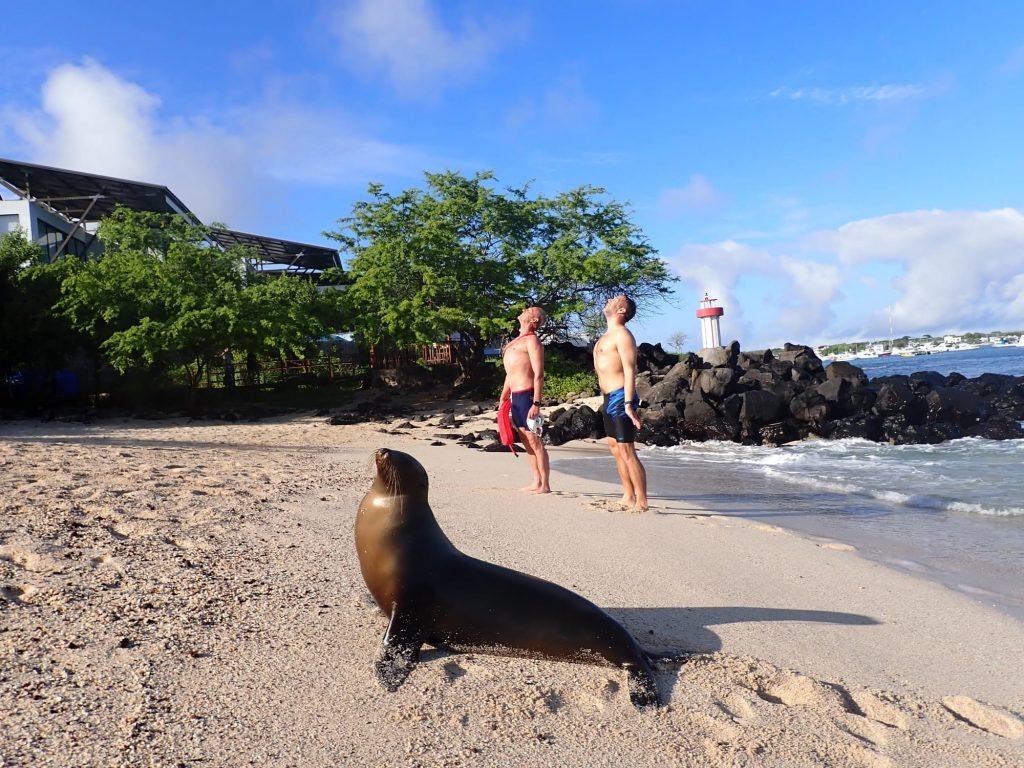
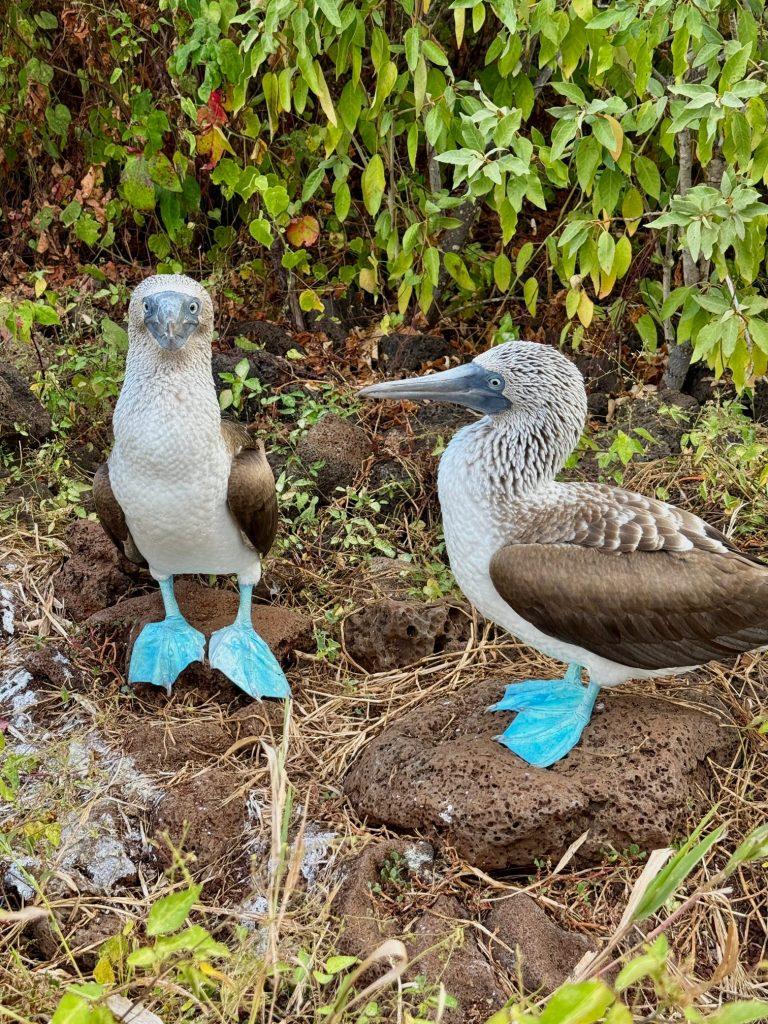
Regulations around swimming here are stricter than in any of our other destinations. Working closely with our local TourCert partner, we apply for permission to swim in specific locations at set times, and, much like following trails on land – we also follow designated ‘routes’ in the sea. Paola Arboleda explains: “Galápagos wildlife isn’t fearless by accident. The animals evolved without natural land predators and are protected by strict conservation rules, so they’ve never learned to fear humans. What feels like closeness is actually the result of respect, distance, and long-term protection.”
As a result, swims are often governed by time rather than distance. Guest Becki Finch describes one extraordinary moment: “Whilst you understandably are not allowed to approach them, they are allowed to approach you. I had a mother sea lion decide to suckle her baby right in front of me, only two metres away. It was simply mindblowing. I feel so lucky and honoured to have experienced that.”
Why responsible tourism can help
Swimming with wildlife is not a right, it’s a privilege, one that depends on healthy ecosystems, responsible operators, informed swimmers, and the continued protection of wild places.
I have long been fascinated by dugongs – gentle marine mammals from the order Sirenia, widely thought to have inspired ancient mermaid and siren legends. Slowmoving and herbivorous, they can grow to around three metres long, often surfacing quietly to breathe or rising upright in the water in a behaviour known as a “tail stand.” When we set up our Philippines tour in Northern Palawan I was really excited to work alongside Dirk Fahrenbach founder of a local dugong protection programme to include a swimming with dugongs experience in the itinerary. Dirk explains: “Our area has the biggest dugong population in the country, and it needs protection. Tourism is one of the best options we have to protect them.”
At first, it can sound counter-intuitive that tourism could help endangered wildlife. But when carefully designed and properly managed, it can become a powerful conservation tool rather than a threat.
First, presence creates value. When local communities earn a livelihood from protecting wildlife, living animals become worth more than hunted or displaced ones. Responsible tourism can provide a sustainable alternative to practices that damage seagrass beds, the dugongs’ primary food source – or to pressures that once pushed populations into decline.
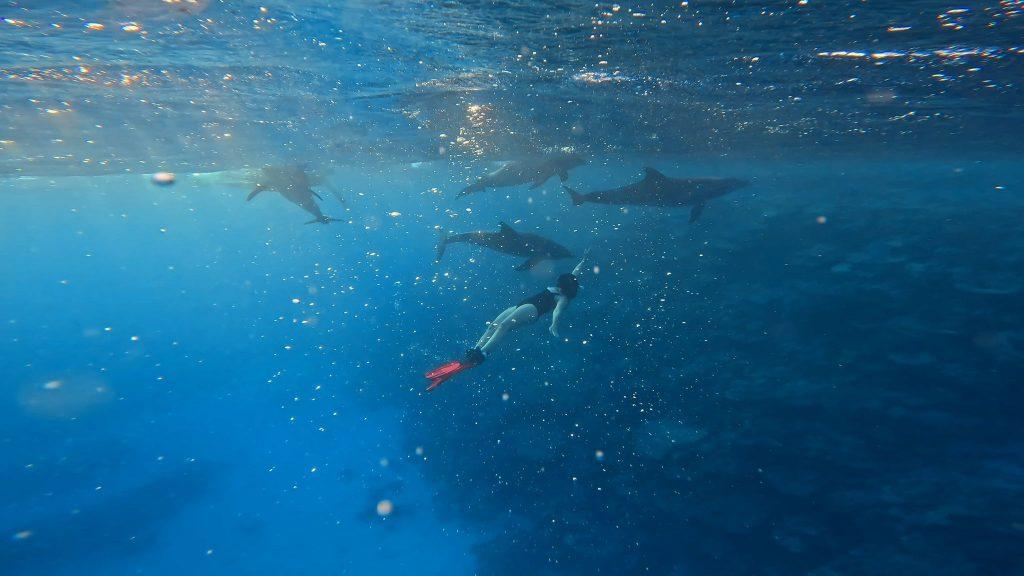
Tourism also supports active protection. Income from guided swimming experiences helps fund monitoring, education and enforcement. Local operators are often the first to notice changes in animal behaviour or habitat health, and their livelihoods depend on keeping these ecosystems intact.
Tourism also builds advocacy. People who have quietly shared the water with a dugong don’t forget it. Such encounters turn abstract conservation issues into something personal, and visitors often become ambassadors for these animals long after they return home.
Finally, well-run tourism sets boundaries and norms. By limiting numbers, enforcing codes of conduct and modelling calm, respectful behaviour in the water, responsible operators prevent the kind of chaotic encounters that cause stress to animals and degrade habitats.
In short, tourism helps when it slows people down, educates them, and gives both wildlife and local communities a reason to thrive together. When done with care, swimming holidays offer one of the most profound ways to connect with the natural world.
From tropical reefs to Arctic waters
Of course, wildlife encounters don’t only happen in warm, far-flung destinations. In colder waters, swimming through kelp forests in the Arctic Circle can feel just as awe inspiring. “One of my favourite wildlife encounters was with a group in the Lofoten Islands,” says SwimQuest co-founder John Coningham Rolls. “We were just finishing a swim and coming into an inlet, when we spotted an otter lounging on its back staring at us all – as if to say, what are you doing here? We got out of the water to enjoy some hot soup on the beach and lay on our backs watching sea eagles circle overhead. Nature at its finest. You have to pinch yourself sometimes.”.
The fear factor – including the ‘s’ word
For all the beauty of swimming with wildlife, it’s important to say out loud that it can also feel scary. Even confident swimmers can find themselves unnerved by the unfamiliar: deep water, waves, the vastness of the big blue beneath you – and the sudden realisation that you are sharing space with creatures far larger, and far more at home in this element, than yourself.
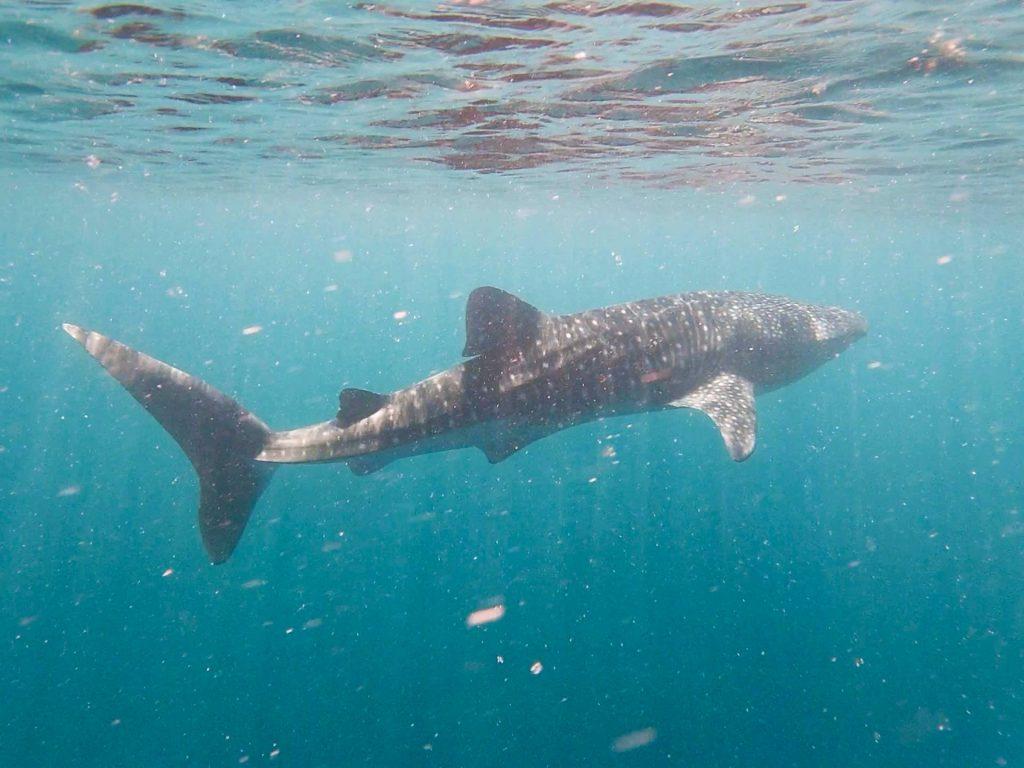
A common and understandable fear for swimmers is sharks. I think it’s important that we talk about it. There are around 500 recognised shark species worldwide, ranging from tiny, harmless catsharks to large pelagic predators. Only a very small handful have ever been implicated in rare unprovoked incidents with humans. For most swimmers, seeing a shark is not a threat, but a reminder of the ocean’s richness and an honour to witness wildlife in its natural home.
In the Maldives, for example, the atolls act like natural funnels, channelling nutrientrich currents that attract huge blooms of plankton – and with them, an extraordinary diversity of marine life. Nurse sharks, often known as ‘sleeper sharks’ because of their calm, docile manner, are a particular favourite among our swimmers. These gentle creatures are very calm and slow moving, which allows swimmers and scuba divers to get incredibly close. This in turn means you have the most wonderful experience of being right next to such friendly giants.
Boat manager Jules Latrille explains: “Nurse sharks are such an interesting species. They’re very engaging, which allows us to observe their behaviour, beautiful markings and unusual shape up close.”
One guest, Alison, describes how transformative her first experience swimming with sharks felt:
“When I first got in the water with the sharks I remember just smiling and laughing, because I couldn’t quite believe what I was doing. I wasn’t nervous – I was too overwhelmed by what I was seeing. I had total confidence in the guides and crew. To be in the water with sharks, rays and beautiful fish was a total privilege. Every time I think back to that holiday I smile and feel proud of myself. I’d do it all again tomorrow.”
Fear often arrives not because something is wrong, but because something is new. Our brains are wired to be alert in environments we can’t fully control. In the open ocean, we lose the comforting reference points of pool walls and lane ropes, and it’s natural to feel a flicker of vulnerability.
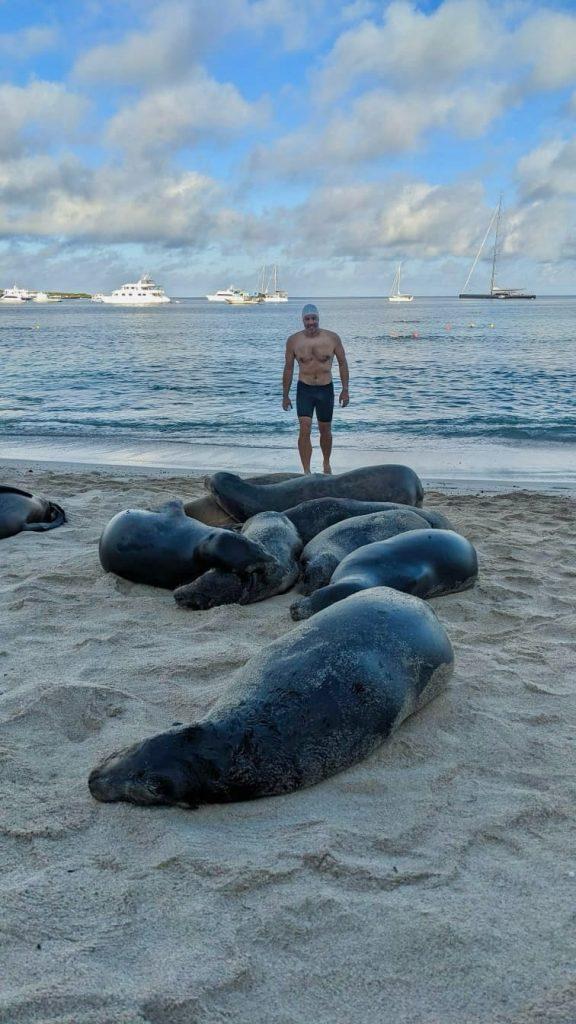
What helps is understanding that swimming with wildlife is about calm systems: clear briefings, expert local guides, safety support, and a culture where stopping, floating, or getting out early is always an option. Often, the most powerful moments happen when we do less – when we slow our stroke, soften our gaze, and simply observe.
As Becki Finch recalls from the Galápagos: “I always thought I would be scared to be in the water with sharks, but it was amazing. They were so graceful, not aggressive at all. I was just in awe.”
Overcoming fear is about being supported enough to meet the ocean with curiosity rather than tension – and learning, swim by swim, that feeling small is not failure. It means we are doing it right.
A shift in mindset
Perhaps the most meaningful outcome of wildlife-focused swim holidays is the shift in mindset I see time and again. Many swimmers arrive hoping simply to see wildlife. They leave thinking about how to protect it.
We do share fascinating talks on our trips. I will always remember a manta ray seminar given by our dive partners in the Maldives after an unforgettable encounter. But, ultimately, advocacy doesn’t come from a presentation. It comes from experience. As the old saying goes, it is better to see something once than to hear about it a thousand times.
Once you’ve floated above the kaleidoscope of a coral reef, caught a seal staring at you with liquid curiosity, melted into the emerald world of a kelp forest, danced with dolphins, or been dwarfed by a whale shark, conservation stops being abstract; it becomes deeply personal.
These moments offer a grounding reminder that we are part of nature, not apart from it. That lesson travels home with you long after the swim ends: beneath the surface, the ocean is calm, complex, and quietly teeming with life. We could learn a great deal from moving through the world with the same attentiveness.
Fancy exploring with SwimQuest? Visit swimquest.uk.com. Follow Alice at substack.com/@alicetodd

Outdoor Swimmer
Outdoor Swimmer is the magazine for outdoor swimmers by outdoor swimmers. We write about fabulous wild swimming locations, amazing swim challenges, swim training advice and swimming gear reviews.