Handcuffed swimmers
EXTRA,  FEATURES,  October 2025,  Premium

Manacled men

Register to get free articles

No spam Unsubscribe anytime

Want unlimited access? View Plans

Already have an account? Sign in


A recent record event builds on the lengthy history of swimming while handcuffed. Words by Elaine K Howley

On 9 September 2025, New York swimmer Michael Moreau completed a 45.9-kilometer swim around Manhattan Island. While swims circumnavigating the island have become almost commonplace – the New York Open Water swimming organisation supports dozens of swims around the island each summer – Moreau’s was noteworthy because he completed the loop while handcuffed.

This wasn’t Moreau’s first foray into handcuffed swimming; on 27 May 2025, he swam a straight-armed breaststroke while handcuffed for 21.54 kilometers in 9 hours and 54 minutes in Hawaii, setting the Guinness World Record for the longest distance swum in handcuffs in the process. The record had been previously held by Shehab Allam of Egypt, who’d completed an 11.649-kilometer handcuffed swim in the United Arab Emirates in 2022. And before that, Cerizzi Paolo Eros of Italy set the standard when he crossed the Straits of Messenia, a distance of 3,163 meters, on 23 September 2011.

But the history of handcuffed swimming goes back much further and features a range of quirky characters.

The original stunt man

Growing up in New York City at the dawn of the 20th century, Henry “Buster” Elinosky, the brother of International Marathon Swimming Hall of Fame inductee and first woman to swim around Manhattan, Ida Elinosky, may have taken a page out of Harry Houdini’s many manacled, underwater escape stunts when he undertook several long-distance, handcuffed swimming events.

Starting in 1913 when he was just 19 years old, Elinosky swam for over 14 hours “with his wrists handcuffed and his ankles bound with rope” in a bid to swim from lower Manhattan to Sandy Hook, New Jersey, the Bangor Daily News reported.

Henry “Buster” Elinosky

He also attempted a stunt billed as 33 miles by the New York Times in July 1914 from the Battery in Lower Manhattan to Swinburn Island, back to the Battery, and then to Bay Ridge, Brooklyn. That swim was called off due to unfavorable weather conditions after Elinosky covered some 15 miles.

He followed up with a nearly-deadly swim through Hell Gate with hands bound while bound to two other men. In a 1916 edition, Information Quarterly estimated Elinosky dragged nearly 325 pounds worth of dead weight as he navigated the notoriously dangerous waterway. Though the 1.5-mile swim was deemed a success, no doubt Elinosky’s accomplices were hesitant to join another adventure.

“This style of swimming is, by the way, accomplished by what is known as porpoiseing,” the St. Louis Globe-Democrat reported in July 1914.

The king of cuffs

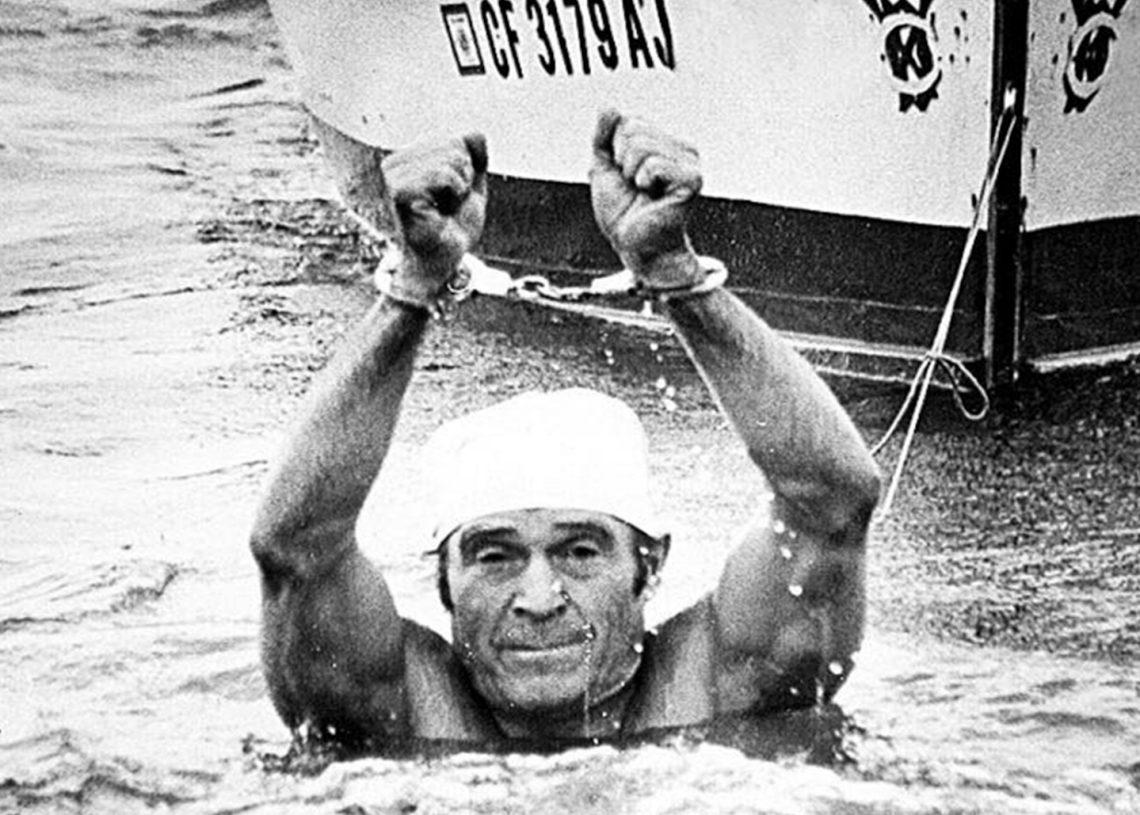
While swimming in handcuffs isn’t solely the domain of men – Ida Elinosky, Claire Farry, and Charlotte “Lottie” Schoemmell are just three of the several women who’ve staged handcuffed swimming stunts down the ages – perhaps the best-known athlete to ever spend time swimming while handcuffed is bodybuilder and fitness guru Jack LaLanne (pictured top).

In 1955 at age 41, Jack LaLanne swam from Alcatraz to Pier 43 in San Francisco while wearing handcuffs and towing a 1,000-pound boat to promote the benefits of weight-lifting. Later that same summer, 38-year-old Jose Cortinas, a Cuban swimmer living in Los Angeles, sought to one-up LaLanne’s manacled accomplishment by tying his feet together as well as he made his way from Alcatraz to San Francisco’s Fisherman’s Wharf.

But LaLanne regained his crown as the king of cuffs when on his 70th birthday in 1984 he swam 1.5 miles from the Queen’s Way Bridge to the Long Beach Harbor in California while handcuffed, shackled, and towing 70 boats filled with 70 people. On his 80th birthday, he towed 80 boats while handcuffed and shackled. Buoyancy is a beautiful bounty.

Roper rescue

But not all instances of handcuffed swims have been for attention-seeking stunts. In one case, a life depended on one man’s ability to swim while shackled.

It was February 1911 – the height of tropical Australia’s wet season – when policeman William Francis Johns was policing the Roper River region. The Library & Archives of the Northern Territory report that at the time, “frontier violence between Aboriginal people and pastoralists was frequent.”

Constable Johns had received reports of thefts from a hut on Hodgson Downs Station and set out to investigate. He eventually arrested four Aboriginal men, including a man named Ayaiga, known locally as Neighbour.

“With the prisoners in neck chains they began the 32-kilometer trek back to Roper Bar,” the Library & Archives reports. The Northern Territory Times and Gazette further noted that the prisoners were forced to walk the distance while manacled.

When the party arrived at a tributary of the swollen Roper River near the police station, the prisoners crossed first. “The blacks reached the further bank in safety, but the trooper’s horse was caught in a swirling eddy and turned over, and before he could clear himself, Trooper Johns was kicked on the head, rendered unconscious, and would most certainly have been drowned had not Neighbour thrown a coil or two of chain around his neck and raced down the stream until he was in a position to plunge in and seize the senseless body of the captor and struggled with him to the bank,” The Times and Gazette reported.

News of the daring rescue raced around the world and in 1912, King George V awarded Ayaiga the Albert Medal, the British Empire’s highest award for saving life. Only 27 Australians ever received the medal, which was discontinued in 1971. Ayaiga was the only indigenous recipient.

Stay up to date with The Dip, our free weekly outdoor swimming newsletter.

Outdoor Swimmer is the magazine for outdoor swimmers by outdoor swimmers. We write about fabulous wild swimming locations, amazing swim challenges, swim training advice and swimming gear reviews.