

Riding the Tide: Swim London’s Speedy 10K
A strong current turns Swim London’s 10km down the tidal Thames into a surprisingly speedy adventure. Simon Griffiths gave it a try!
I could get hooked on current-assisted swims. A week after crossing the Hellespont, I took part in Swim London, a 10km swim down the Thames from Kew to Putney.
These two swims couldn’t be more different. But they have one thing in common: a current that gives you a much faster swim than you could do in still water.
It is only once in London, however, that you truly get to feel the speed. The riverbanks, navigation buoys, landmarks and bridges all go flying by. It makes you wonder if you have suddenly become superhuman.
Just take a look at the finish times, which range from under 90 minutes to a little over two and a half hours. Compare this to finish times at the Great North 10km swim, a lapped course on still water, which range from just over two hours to six.
The current not only helps everyone swim faster but it also closes the gap between slower and faster swimmers. This makes the Swim London 10km achievable for a wide range of swimmers, despite it sounding intimidating.
Liquidity sculpture
The Swim London 10km starts at the striking Liquidity Sculpture in Brentford, where the River Brent joins the Thames. It’s a memorable and easy-to-find starting point for the swim, with safe access to the river. Across the water, you can see the glasshouses of Kew Gardens above the trees.
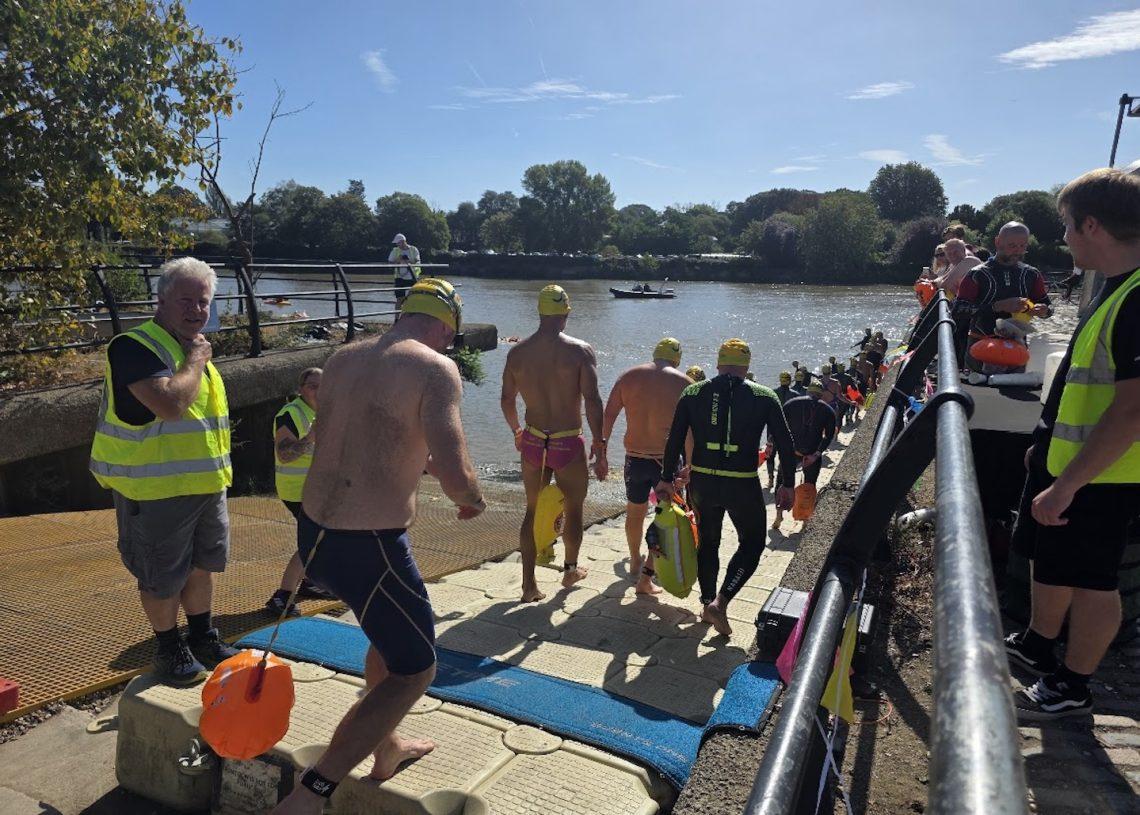
This is the tidal Thames, and the swim is coordinated to start shortly after high tide, when the current begins accelerating towards the sea. You notice its pull as soon as you enter the water. I had barely got into a swimming rhythm by the time I arrived at Kew Bridge, which is just visible from the start nearly a kilometre downstream. This first stretch feels wild, with the trees on Brentford Ait hanging over the water and not a building in sight.
Past Kew Bridge the river turns urban. Kew Railway Bridge and Chiswick Bridge follow soon after. The speed that you pass these landmarks is exhilarating, but you need to be savvy to get the fastest line.
River closure
Generally, the current flows strongest towards the middle of the river and on the outside of the bends. While the river is closed to boat traffic, the safety team encouraged us to stay towards the right bank. However, at one point, I noticed that even a few metres’ difference in position can affect your speed.
Somewhere around Chiswick Bridge, I spotted two swimmers on my left. I recognised one of the tow floats as belonging to a swimmer I’d passed earlier on, and now they were overtaking me. I edged towards them and then gradually moved in front again.
From then on, I tried to stay as close to the centre line as the safety kayakers would allow and managed to stay ahead of those other two swimmers – a clear demonstration that getting your line right is as important as your swimming speed.
A quick meander
The river meanders on in wide sweeping turns. You might not think the direction makes much difference, but it does, for two reasons. The first is the sun, which causes a little glare off the water when the river flows southeast. Not so much to be blinding, but something to be aware of when you choose your goggles.
Second is the wind. While mostly the river was calm, it became noticeably choppy in places because of the interaction between current and wind. If you do this swim, it’s something to keep in mind and prepare for.
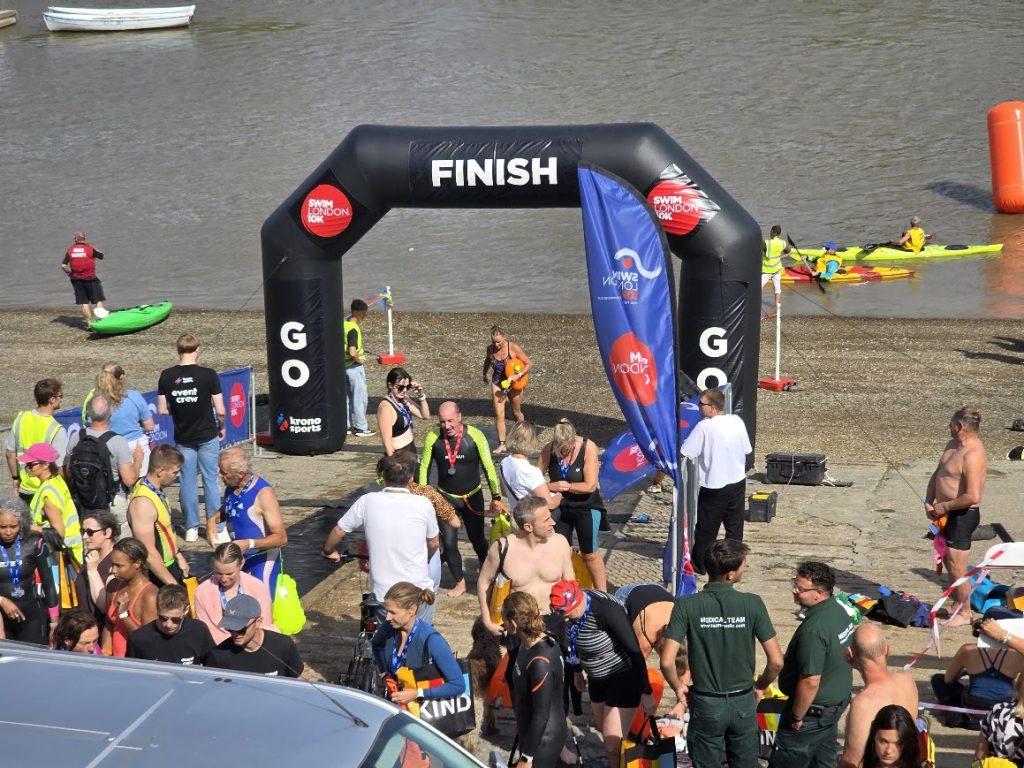
Eventually Hammersmith Bridge, which is about a mile from the end, comes into view. The river is much wider here, and I wondered if the current had slowed or whether I was tiring. I was looking out for Craven Cottage on the left as I knew the finish was just a few hundred metres from there, and it took longer than expected to arrive. At this point, I suddenly got cramp in my left leg and had a momentary panic that I wouldn’t make it, even though I was in sight of the finish. Then I remembered the current and realised I’d get there even if I floated on my back. This relaxed me enough to swim the final strokes to the end.
Fast but not easy
A current-assisted 10km is definitely easier than one in still water, but don’t assume that makes this event easy. It is still a significant swim, and you need to be prepared for it. Not only do you need to be able to swim for up to 2.5 hours, you need to stay alert throughout to keep the best line and avoid obstacles. The red river navigation buoys can be hard to see, and you approach them fast.
Still, this is a very achievable swim: fun, fast and friendly. I recommend adding it to your list for next year.
Event practicalities
Website: swim.london
Distances: 5km and 10km
Getting there: Lots of public transport options. I used a Forest Bike (e-bike).
Post-swim celebration: Imperial Boathouse on Putney Embankment. Worth staying for, and swimmers could use the showers, too.

Simon Griffiths
I started Outdoor Swimmer in 2011 (initially as H2Open Magazine) as an outlet for my passion for swimming outdoors. I've been a swimmer and outdoor swimmer for as long as I remember. Swimming has made a huge difference to my life and I want to share its joys and benefits with as many people as possible. I am also the author of Swim Wild & Free: A Practical Guide to Swimming Outdoors 365 a Year, I provide one-to-one support to swimmers through Swim Mentoring and I'm the creator of the Renaissance Swimmer project.