

Extraordinary seaweeds
Seaweeds are beautiful, resilient and vital to our survival. In an extract from Extraordinary Seaweeds, Professor Juliet Brodie explores their role in marine ecosystems and environmental change
The seaweeds are in trouble. Kelp forests are disappearing or being degraded at an alarming rate – twice as fast as corals reefs and greater than four times that of rainforests. Having survived massive upheavals since they first evolved over a billion years ago, seaweeds are now profoundly impacted by multiple human-induced stressors: overharvesting, destructive fishing methods, pollution, increasing numbers of invasive species, a rise in pests and diseases in farmed seaweeds, plus ocean sprawl, are all adversely affecting the seaweeds.
The biggest threat of all is the climate crisis. Rising seawater temperatures and marine heatwaves are pushing seaweeds to their thermal limits. In Tanzania, for example, an increase in seawater temperature from 31°C (88°F) in the 1990s to 38°C (100°F) today is forcing seaweed farming into deeper, cooler waters. Melting ice sheets and glaciers are impacting seaweeds through scouring, clouding of the seawater and decreasing salinity. Increasing temperatures causing changes in ocean circulation patterns account for massive strandings of rafting Sargassum on Caribbean, Gulf of Mexico and West African beaches – disastrous for both fishing and local tourism. Ocean acidification from rising carbon dioxide emissions is making calcified coralline seaweed skeletons more brittle, while the warming of the seas is driving a distinct shift in seaweed distribution patterns towards the poles with declines in their equatorial edges.
The profiles in this chapter show the very real impact of some of these huge challenges, here are two to give you a flavour.
Northern maerl – living rocks
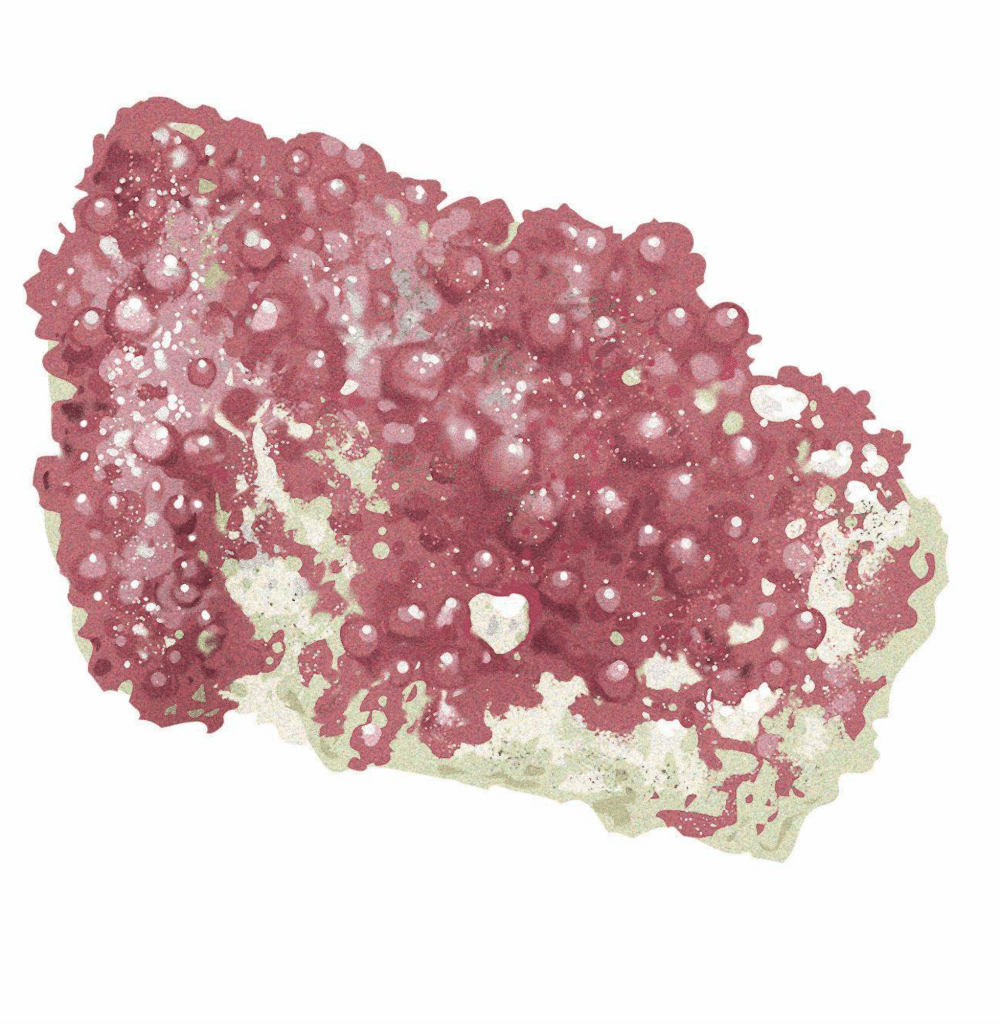
Scientific Name: Lithothamnion glaciale
Distribution: North Atlantic; north-east Atlantic: British Isles to Arctic Russia, including the Faroe Islands, Iceland and the western Baltic; north-west Atlantic: Cape Cod to Arctic Canada and Greenland
Habitat: 0.5–10m (11/2–33ft) depth
Size: Encrusting form on rock: 20cm (8in); as a nodule: 4–5cm (1½–2in) in width
Colour: Deep pink to light red with a violet tinge
Imagine a little free-living chalky-pink alga that resembles a rock or a hedgehog-shaped coral. This is a rhodolith. Then visualise a layer that looks like lumpy pink paint on a rock. These are two forms of the same species – the red calcified coralline alga, northern maerl. Rhodoliths are free-living in the sense that, unlike many seaweeds, they don’t need to anchor themselves to a substrate, such as a pebble or a mollusc, or the seabed. Instead, they are active coastal ecosystem engineers in assemblages resting on but not attached to the seabed, creating structurally complex habitats known as maerl beds.
This is because northern maerl and its relatives – at least 91 lithothamnion species and well over 1,000 coralline algae – are calcified. Their chalky skeletons create a structure that provides protection against wave action and predators, and may also limit the damaging effects of ultraviolet light. Maerl beds provide chemical settlement cues for planktonic larvae, and their physical structure provides organisms with shelter from strong currents and the sun. These habitats support an astonishing wealth of diversity that includes rare and endemic species such as the encrusting red seaweed Cruoria cruoriiformis and Cladophora rhodolithicola, a filamentous green seaweed just 1 centimetre (½in) high that clings to the maerl by rhizoids. Maerl beds are also important nurseries for commercially important species such as scallops and juvenile cod. Indeed, maerl beds are so vital to biodiversity that they have statutory protection in the UK and Europe. In tropical seas, their close relatives help to stabilise coral reefs by cementing carbonate fragments into massive reef structures. Rhodoliths can be long lived and slow growing.
For example, they might grow just 1 millimetre a year but live for over a hundred years, which also means that their skeletons provide a record of environmental conditions. In colder waters, their lifespan may be even longer. In north west Iceland, rhodoliths found at a depth of around 10 metres (33ft) were estimated to grow about 1.25 millimetres over a decade. However, despite being a non-renewable resource, maerl beds continue to be mined for fertiliser and damaged by trawling. They are also sensitive to environmental change: from the rising sea temperature to increased ocean acidification, which may corrode and weaken their skeletons, ultimately leading to loss of a beautifully complex habitat. But there is hope for northern maerl, which appears tougher and more resistant to climate change than its southern counterparts.
Devil’s tongue weed – the global traveller
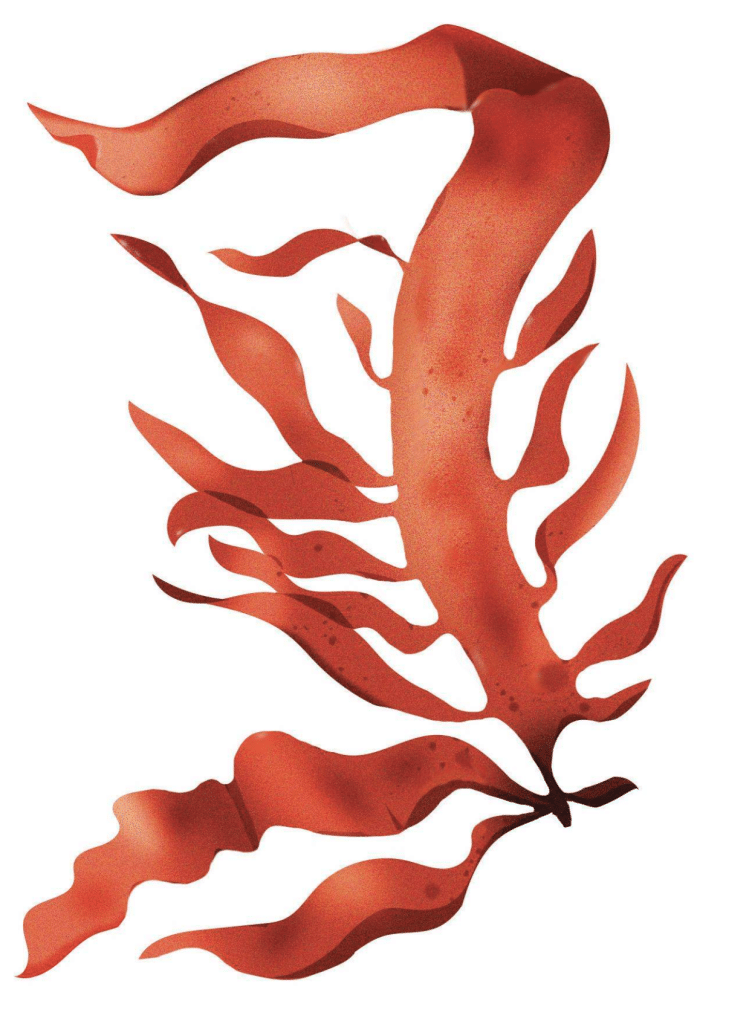
Scientific Name: Grateloupia turuturu
Distribution: Indigenous range: north-west Pacific, centred around Japan and Korea; non-indigenous range includes the North Atlantic, parts of the South Atlantic, the US Pacific coast, Australia and New Zealand
Habitat: On rock, boulders, cobbles, shells and on the lower shore in rock pools and damp places; also grows on harbour walls and ships’ hulls; to 7m (23ft) depth
Size: Typically to 1m (3ft) in height
Colour: Light red to brownish-red or crimson
On Friday 11 March, 2011, a huge earthquake struck off the east coast of Japan and triggered a tsunami that impacted 2,000 kilometres (1,242 miles) of coastline with some waves reaching up to almost 40 metres (130ft) in height. The Great Tōhoku earthquake and tsunami, as it became known, was devastating to life, the environment and infrastructure. Just over a year later, in June 2012, debris from the event began to arrive on the US coastline, including 84 seaweed species, of which 13 are known globally as invasive species.
Among these was the devil’s tongue weed, a notorious coloniser. Devil’s tongue weed is lance-shaped with proliferations from the blade that are slightly undulating, like a flame or a red tongue. Pick it up and it will feel thick and firm, but also slippery and mucilaginous (although it won’t leave your hands covered in slime). It has travelled and settled in many parts of the world, but what makes it such a good invader? It needs an efficient mode of transport – and in this instance spores can be carried in the shells of juvenile oysters that are moved around as part of the oyster trade or on the hulls of ships. Once it settles, devil’s tongue weed is able to reproduce fast and can tolerate a wide range of conditions, including waters of low salinity, allowing it to establish a population very rapidly. There is also evidence that earthquakes and tsunamis coupled with ocean currents can transport seaweeds and other organisms from one part of the world to the other, and this adds another dimension to the understanding of invasive species. Perhaps it is also an explanation for why some seaweed species have large gaps in their distribution, as they are swept past potential habitats by the force of the current.
So, does an invasion of devil’s tongue weed impact the diversity in the habitat where it settles? There is some evidence that it can compete with indigenous seaweeds as it can grow fast and large, but any effect tends to be in localised pockets, and it does not appear to be such a threat as once feared. In spite of all this and its alarming name, devil’s tongue weed is an important seaweed species with many positive benefits: it has potential antioxidant and other bioactive properties, making it of interest to pharmaceutical industries, and it is also enjoyed in Japan and Korea as a highly nutritious food.

Outdoor Swimmer
Outdoor Swimmer is the magazine for outdoor swimmers by outdoor swimmers. We write about fabulous wild swimming locations, amazing swim challenges, swim training advice and swimming gear reviews.