

What’s better – swimming 30km in a river or 30km in the sea?
Ben Lane did some thinking and devised a plan to swim and compare 30km by river and 30km by sea. As always in life, not everything went to plan or, indeed, swimmingly!
Einstein’s Gedankenexperimente – thought experiments – were the key to many of his theories. He used visualisation and deep thinking to explore complex problems. One of his most famous imagined him chasing a beam of light to understand the constancy of its speed. Now, I’m no Einstein. But dreaming up new swimming challenges is my secret passion. Earlier this year, in one of those wild moments of overthinking, an idea surfaced – two swims, identical in distance but over different ‘terrain’ – one by river, one by sea. The thought refused to leave me alone. It rattled around and soon became an obsession. And once that happens, there’s no going back.
So, the plan formed: 30km by river and 30km by sea. The goal? To understand what each environment demands, then to experience both. Thinking time was over – now it was time to get to work.
Planning the impossible
Swimming a very long way is never simple. It’s physically demanding, mentally draining, and the preparation is a sport in itself. Add in two swims in two countries and the planning becomes an endurance event before you’ve even dipped a toe in the water.
Earlier in 2025, I spoke with Lluis, the effervescent organiser of the UltraEbre Swim Marathon – a spectacular 30km event on the River Ebro, about 90 minutes’ drivetime south of Barcelona. Lluis’s calm confidence helped steady my nerves. We agreed: this would be the first part of the challenge – 30km by river.
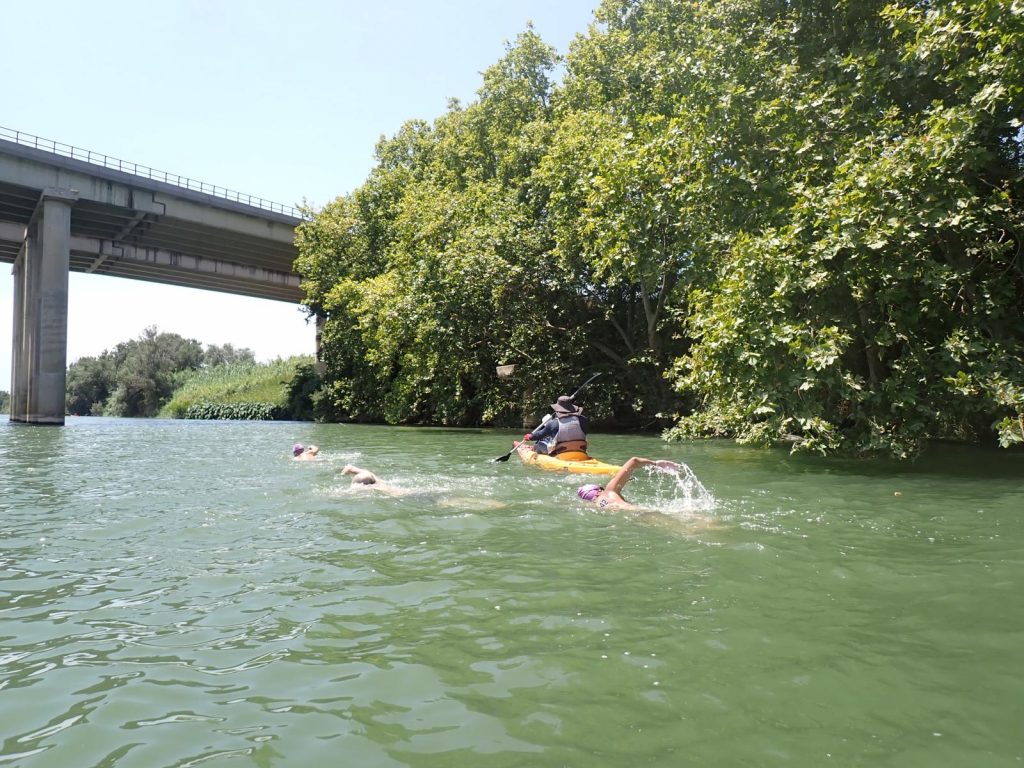
I’d read plenty about the UltraEbre event, part of a European marathon swim series including races in France and Norway. A Belgian national champion and loyal supporter, Olivier Delfosse, describes UltraEbre beautifully: “The early kilometres are fast – the river gives you a gift. But near the delta, the water grows heavier, the wind can ruffle the surface, and you feel you are not moving.”
Another regular, Ruffo Paolini – who has swum UltraEbre four times – puts it succinctly: “The delight is simple: you do the boring work; you show up; you tackle a river that’s never the same twice. And then, somewhere in the last 10 km – when it hurts, when you’re sure you’re not moving – you keep going anyway. That’s the part you carry home.”
Gear, mindset and the element of trust
Like any endurance sport, gear matters. Over 30 kilometres, your body will be pushed, pulled, and tested in every way. The right kit doesn’t just help performance – it helps you feel comfortable and at ease in the water. That sense of belonging is something you can’t overstate. French open water and ice swimmer Guillaume Le Loher says, “the hardest part isn’t the swim – it’s everything you do before it. When race day comes, I remind myself of all the training, the travel, the sacrifices. Once you’re in the water, you can’t overthink. You trust your preparation. Sometimes it’s easy; sometimes it’s painful. But you’ve already done the hard part – now enjoy the swim.”
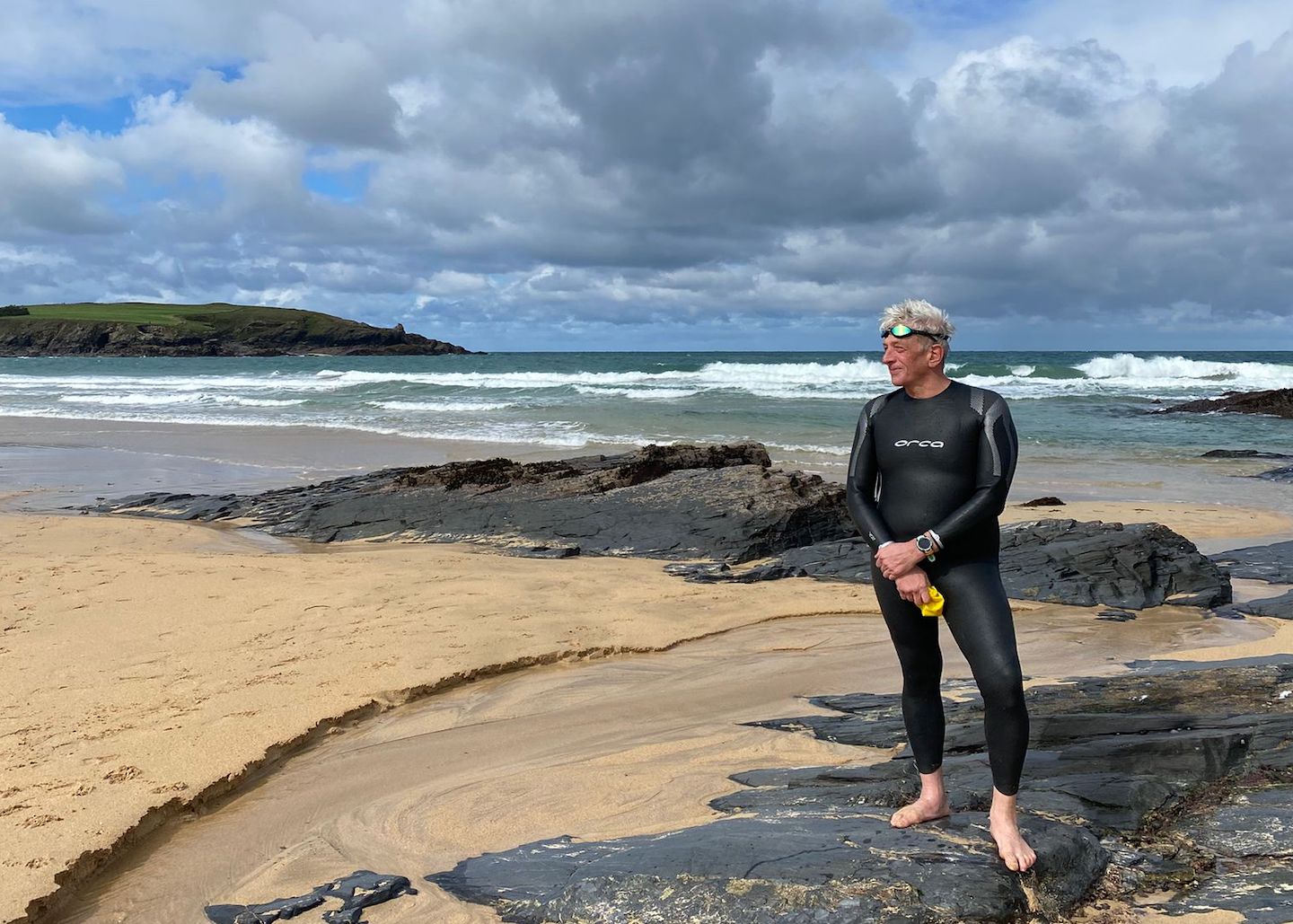
That advice – trust your preparation – stuck with me. It’s why I’ve long believed in Orca gear and the team behind it (and no, this isn’t a plug). This is genuine praise of a team that has supported many of my swims, and many other swimmers as well as triathletes and surfers, with genuine enthusiasm. When I shared my plan for two 30km swims, the Orca team immediately came aboard – offering both encouragement and practical insight drawn from years helping athletes push their limits.
In open water, unpredictability is the rule. Wetsuit use in races depends on the delicate balance of water and air temperature. When they’re not allowed, comfort and efficiency come down to what you wear next. Orca’s compressive swimsuits have been a revelation: sleek, hydrodynamic, and so close-fitting they feel like a second skin, allowing you to move naturally, distraction-free, no matter how long you’re out there.
For longer efforts, the Orca Racing Jammer has become a go-to companion. It’s World Aquatics-approved and, more importantly, tested by swimmers who know what seven hours in open water feels like. Every detail seems designed to help you hold form when everything else starts to fade.
The UltraEbre strips things back to the essentials. Wetsuits aren’t permitted because the water often climbs above 26°C, and race numbers must be visible on your arms and shoulders. That leaves just two options: jammers or swimskins.
At that point, it’s not about what makes you faster – it’s about what makes you feel free and connected to the river. That, to me, is what open water swimming is all about: simplicity. You, the water, the horizon. The right gear doesn’t intrude on that, it enables it.
The river swim
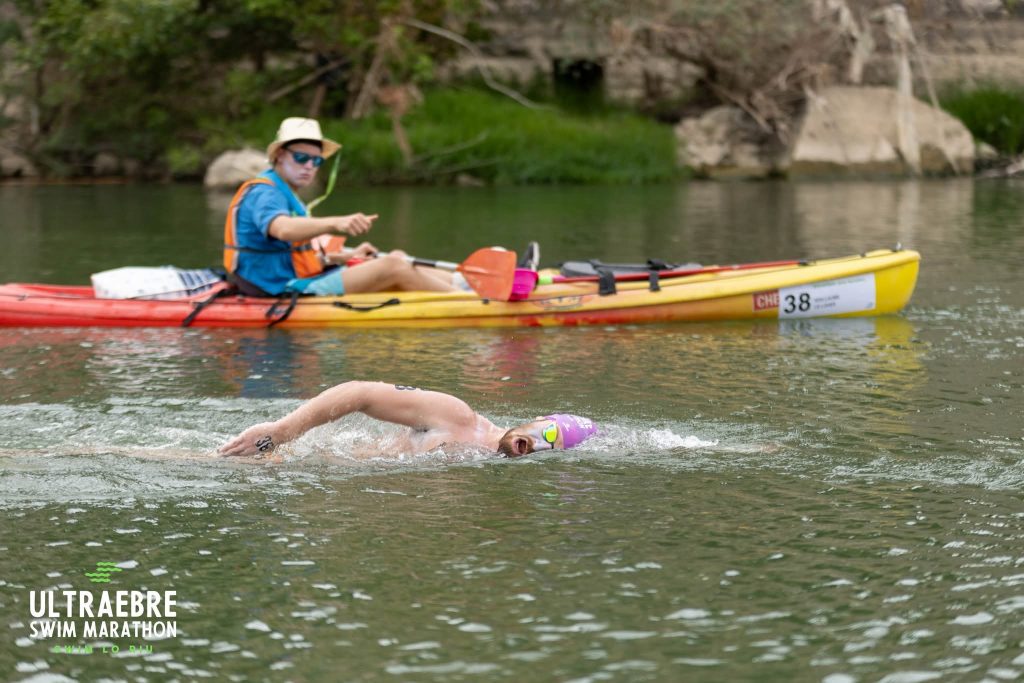
Eventually, training complete and gear dialled in, you find yourself at the start. The early morning sun creeps over the water. There’s a hum of last-minute adjustments, the buzz of nerves. Then, the signal – and you’re off. You believe the hard part – the thinking – is done. But it’s not. A long river swim like the UltraEbre demands a different kind of focus once you’re in the water. It’s not just physical – it’s mental endurance. You monitor every ache, every cramp, every shift in current. You watch your pace to make the cut-off times. You remember to eat and drink. You keep an eye on your support kayaker – they’re in it with you. And when you reach the final 10 kilometres, after a deceptively smooth first 20, you discover what the river really has to teach you.
Two-time UltraEbre winner and endurance coach José Javier Montón Cruz describes his approach: “I divide the marathon into sections – that structure keeps me from thinking about 30 kilometres all at once. I also study who will be there; I have a strategy. But once the swim begins, it’s rhythm. You respect the river, stay relaxed, make good decisions. The river is kind early and demanding later, so I expect a psychological dip. I don’t try to win the whole swim – I just win the next section. If you stay long, keep your line, and don’t panic about speed, you come through it.” And yes – I came through it. But only just. I finished last, and for that I was grateful. Seven hours in the river, counting every stroke, just a couple of minutes behind the penultimate swimmer. At the finish, I couldn’t lift myself out of the water. When I finally stood, my body wanted to fold back down again. I was an empty shell – exhausted, hollowed out – but somewhere deep inside a small voice said, it’s done. Let the glow begin.
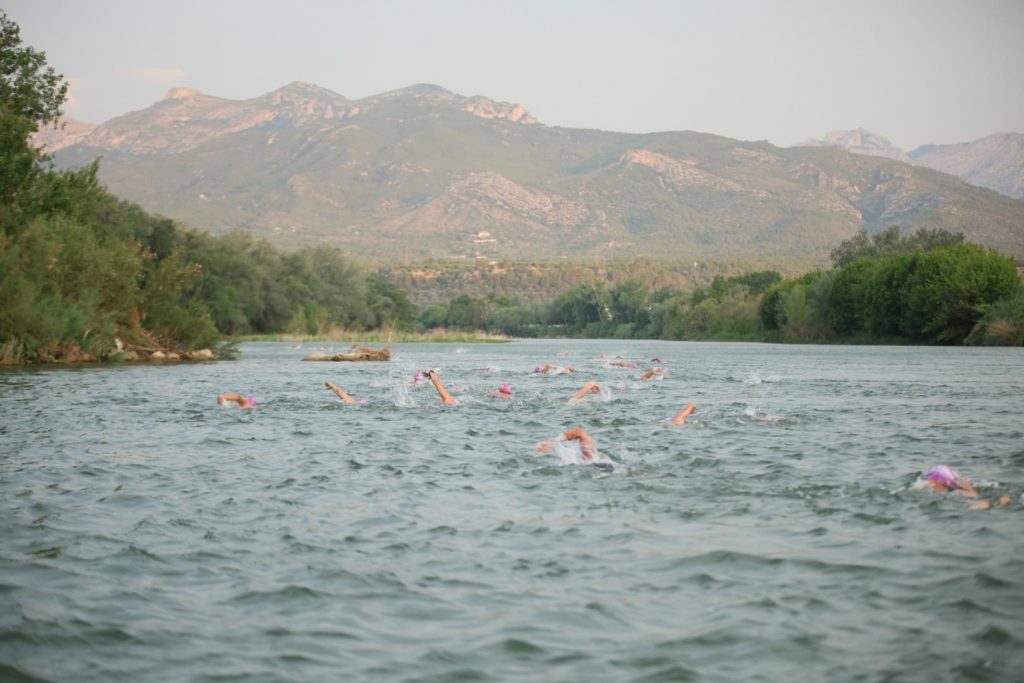
Lluis was there at the end, steady as ever, guiding me to the feeding station where I promptly consumed what felt like my body weight in Spanish snacks. Recovery, river-style.
Olivier sums up the feeling well: “You never know what will happen out there. That’s the beauty. You prepare so well you have no fear – only the question: Can I catch the guy in front? And if not, can I still make my best rhythm? That’s the win I can control.”
He pauses, then grins. “Also, there is family and the support crew at the finish. That feeling never gets old.” The journey for me though is only halfway through – I still needed to tackle the sea section, another 30kms, another swim and I suspected this would be even harder, and I was right, this element did not go to plan.

Outdoor Swimmer
Outdoor Swimmer is the magazine for outdoor swimmers by outdoor swimmers. We write about fabulous wild swimming locations, amazing swim challenges, swim training advice and swimming gear reviews.