

How and why should I practise kicking?
I wear a wetsuit and barely kick my legs when I swim in open water but I’ve been told I need to do more kicking with a float in training. Why?
In long-distance freestyle swimming, most of your propulsion comes from your arms. If you wear a wetsuit, this helps your legs to float, keeping them behind your body and therefore not causing too much drag. For some swimmers, the best thing to do with your legs in this scenario is as little as possible. Kicking will use a lot of energy for very little extra speed. If you have poor kicking technique, it may even slow you down.
But that’s not to say your legs are useless. If you have good kicking technique, then a gentle and well-timed two-beat kick or six-beat flutter helps your balance and rotation. With the right timing you get a full-body connection that helps power you through the water. This becomes more important when not wearing a wetsuit.
Notice the “if”. You need good kicking technique and good timing to make kicking worthwhile.
The questions therefore are: can doing isolated kicking exercises help you develop this and are there any other benefits to doing kicking training?
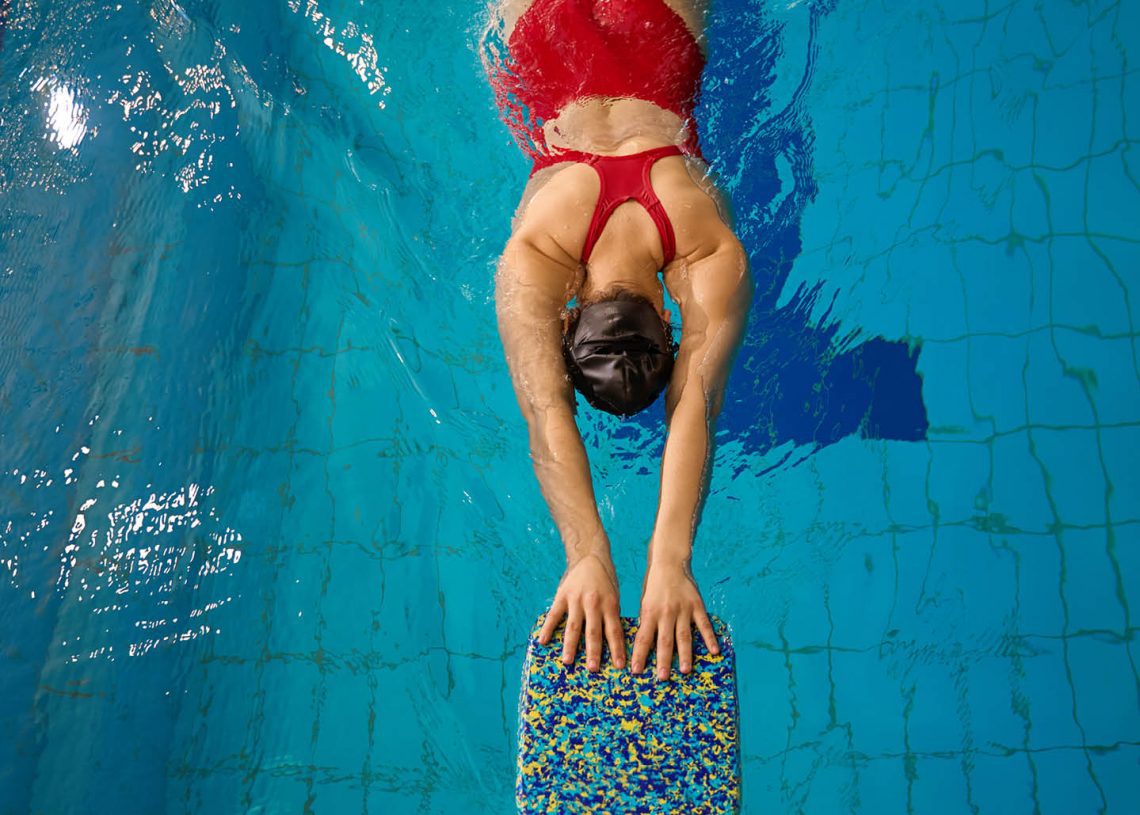
I’ve worked with some coaches who argue that kicking with a float has little benefit. Swimming is a whole-body activity and isolating one action is counterproductive. Kicking is only effective if coordinated with the rest of your body. Working on kick timing, in combination with my arms rather than in isolation, made a big difference to my swimming. Moreover, when you swim, you rotate from side to side. When you kick with a float, you remain horizontal on the water. Another problem with kicking with a float is that it puts you in an unnatural swimming position. Lifting your head and looking forward pushes your legs down and strains your neck.
All good points, but there’s more to this.
I once trained under another coach who insisted we did 400m of kicking with floats straight after our warmup in every single training session. I asked him why. He said kicking uses big muscles and working them hard gives you a great cardiovascular workout. His thinking was that kicking helped you build fitness fast. He may have been on to something. In the six months I trained with him, I improved my 400m freestyle time by nearly 40 seconds, although I don’t attribute that solely to the kicking.
From a general fitness point of view, isolated kicking works your hip flexors and glutes, both of which can become weak if you spend a lot of time sitting. Kicking can also help with ankle mobility and flexibility, which also benefits your swimming. Using fins can boost these benefits but may also induce cramp.
So should you do more kicking with a float in training? On balance, I’d say yes, but with some caveats. Make sure you drive your kick from hips rather than your knee. Think of it more as a straight leg swing rather than kicking a ball. Your leg will bend naturally anyway. Then remember that you don’t need to take high intensity kicking into your full-stroke long-distance swimming. If you have any neck issues, then be extra careful. Consider using a snorkel so you can keep your head in a neutral position. Finally, don’t go over the top. Ten to 20% of your training time spent on kicking is plenty.
What do you want to know about outdoor swimming? Send us your questions and we’ll do our best to answer: info@outdoorswimmer.com. We love hearing from you.

Simon Griffiths
I started Outdoor Swimmer in 2011 (initially as H2Open Magazine) as an outlet for my passion for swimming outdoors. I've been a swimmer and outdoor swimmer for as long as I remember. Swimming has made a huge difference to my life and I want to share its joys and benefits with as many people as possible. I am also the author of Swim Wild & Free: A Practical Guide to Swimming Outdoors 365 a Year, I provide one-to-one support to swimmers through Swim Mentoring and I'm the creator of the Renaissance Swimmer project.