

Florida Springs revisited
With over 700 springs in central and north Florida, there is an abundance of publicly accessible swim spots to fill a swimming holiday, as Susanne Masters discovers
Florida’s springs offer paradise.
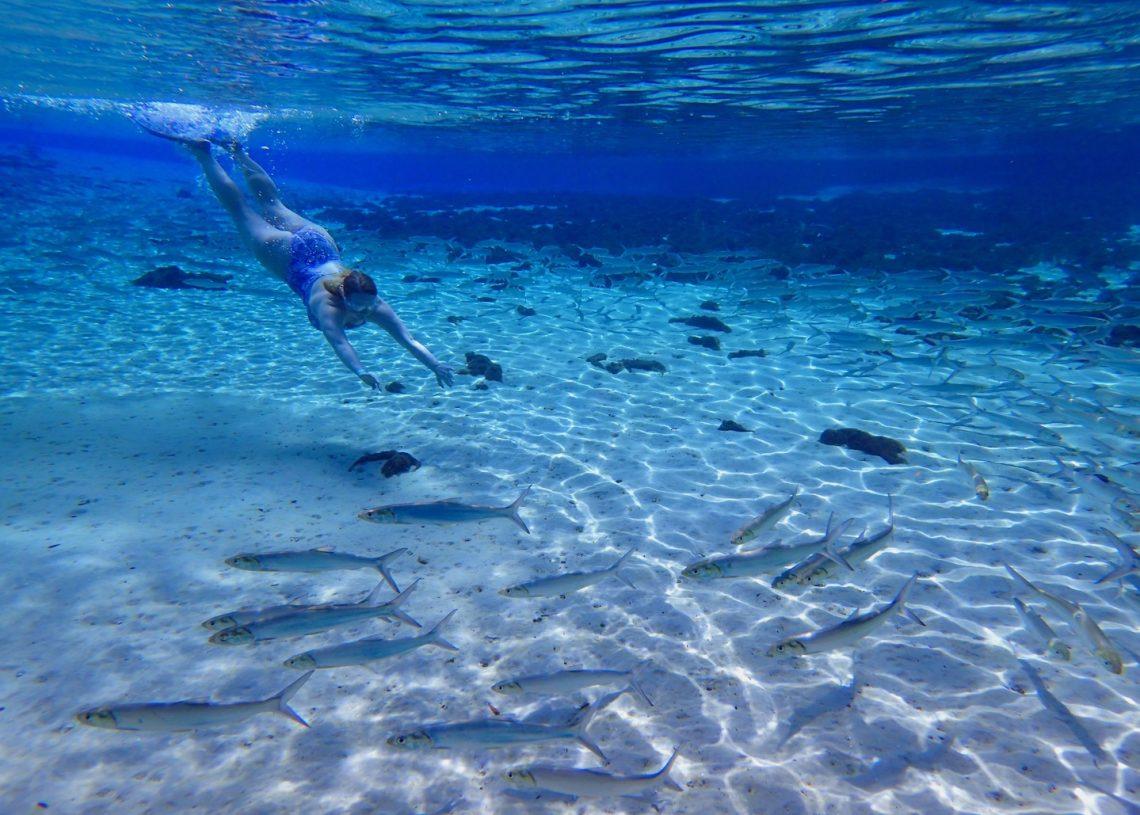
Welling up from the Floridian aquifer, spring heads and spring runs flowing from them are turquoise-tinted by the limestone bedrock and most are a steady temperature of 21 degrees throughout the year. With over 700 springs in central and north Florida, there is an abundance of publicly accessible swim spots to fill a swimming holiday. Since first swimming in Florida’s springs I’ve returned many times, still finding new delights and always leaving with plans to swim-explore further next time.
Mermaid encounters
In its 1950s heyday, Weeki Wachee Springs State Park was the most popular tourist site in the US. It still offers a unique musical show with wild turtles and Florida gar (Lepisosteus platyrhincus), a prehistoric fish distinctive for its length and speckled markings, swimming alongside professional mermaids. From subterranean seating, watching through a wall of windows, the audience sees performers inside the spring head.
Downstream of the upwelling water there is a swimming area for park visitors. With a flow rate over 65 million gallons of water per day, it is a first magnitude spring, offering the phenomenal visibility
of swimming in water freshly filtered through rock.
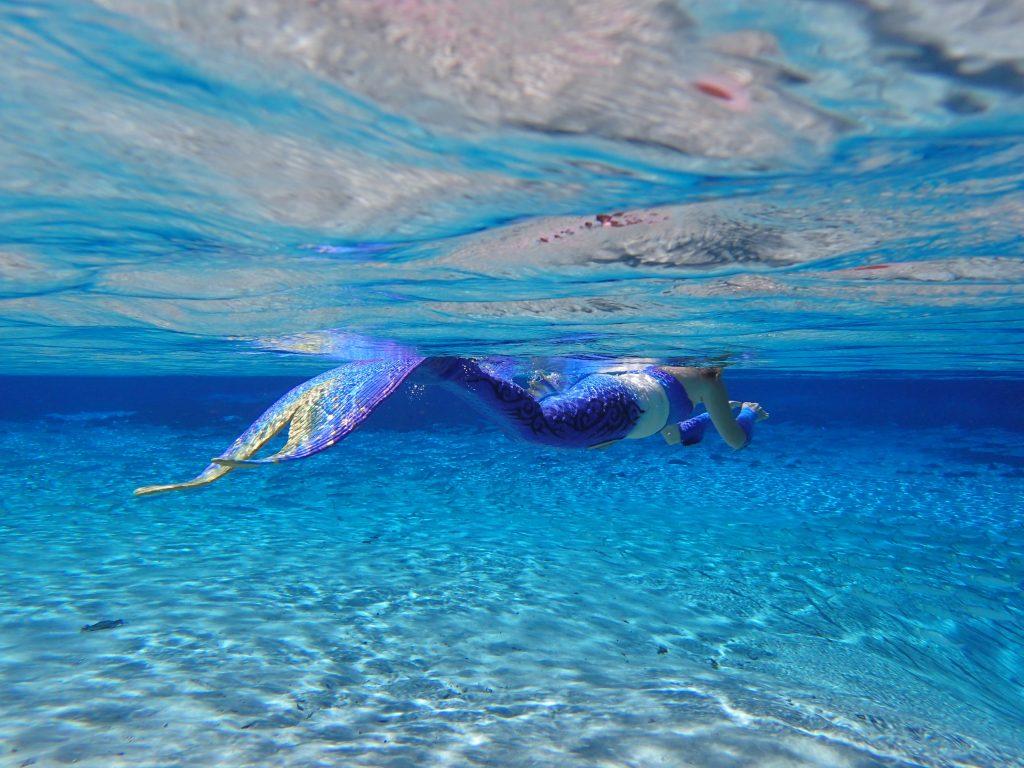
I first saw a free-range mermaid in Silver Glen Springs. Her metallic tail matched the shimmer of the shoal of ladyfish (Elops saurus) circling around the head spring. An underwater arena of gleaming white sand makes the water brightly lit here, which is conducive to great photos and accidental sunburn. At Ruth B Kirby Gilchrist Blue Springs State Park, I met a group of mermaids. They were looking out for each other while taking turns to practise free dives in the deep area over the spring vent. Meeting mermaids is an occasional experience in Florida’s springs.
Manatees and other wildlife
Florida Fish and Wildlife Conservation Commission (FWC) specifies in its guidelines on watching manatees that you should not touch or chase them. This became a dilemma for me at Wakulla Springs, when a young manatee swam towards me and reached out, trying to touch me with its flippers. What if they are touching you? I finned backwards, not wanting to turn around and hit it with my fins, and fairly soon it returned to its mother.
It may seem odd to swimmers with a habit of swimming across boundaries on ‘cheeky’ or ‘ninja’ swims to stay within a designated swimming area, when a whole river beckons. In Florida, don’t. Restrictions on entering water and surrounding areas can be for the safety of people as well as wildlife. Downstream of Wakulla Springs, traffic on Wakulla River is limited to a guided boat tour. Its banks are wild and undisturbed by people, alongside turtles basking in the sun are baby alligators and their mothers. Not a place for people to swim.
I’ve never encountered an alligator while swimming, but I stick to daytime swims in areas where swimming and tubing, floating downstream on inflatables, are allowed. On paddleboards and canoes in wilder areas where swimming and tubing are restricted, I’ve seen alligators hauled out by the water’s edge. The FWC advises people to be aware of their surroundings, swim in designated swimming areas, and avoid swimming in areas where there may be large alligators, or at night when they are most active.
Access by paddle
Florida’s public access rights to navigable rivers and forest cover on untamed land mean that some swimming spots, surrounded by private land or thick vegetation, are reached by canoe or stand-up-paddleboarding.
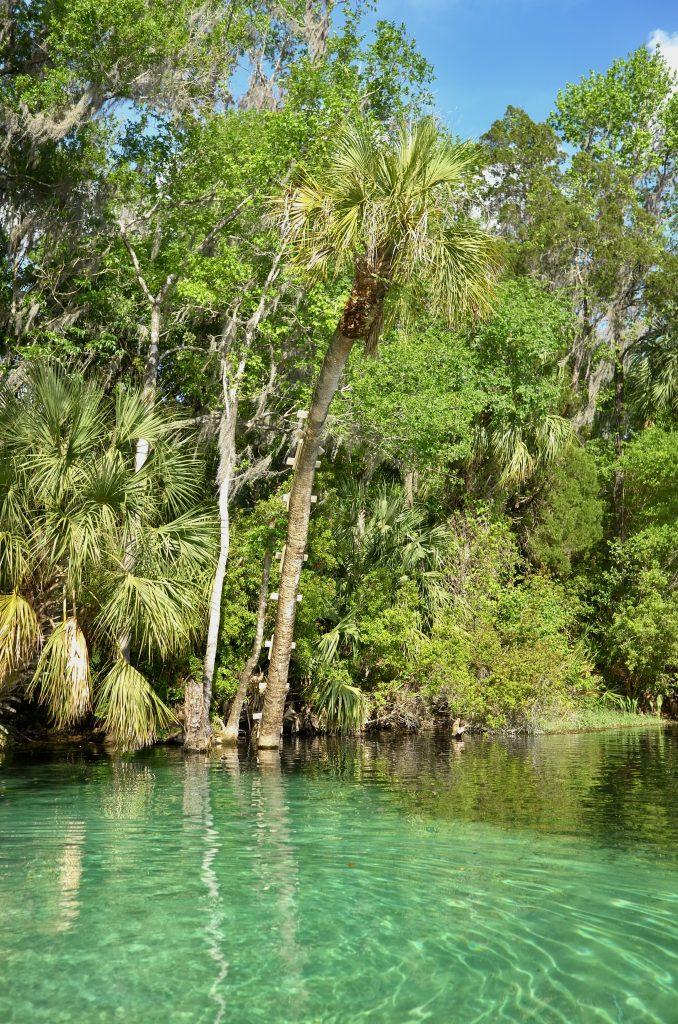
Of the many picturesque settings for a swim on Rainbow River the jumping palm tree (pictured below left) has the most tropical feel. Head north from the canoe launch at KP Hole Park, past the islands and as the river swings west there is a palm tree leaning over the water with steps nailed on it, an invitation to climb up and splash land. Remember to check the water is deep enough for you and clear of submerged objects, as conditions in the river vary.
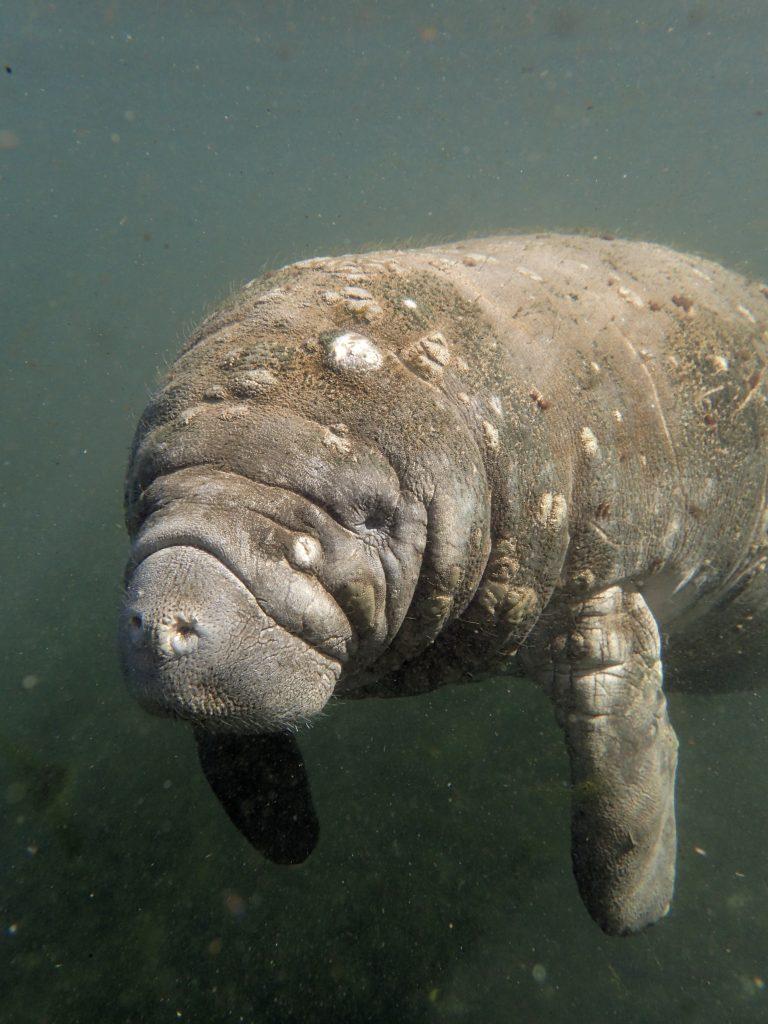
Three Sisters Spring is overlooked by a platform that allows people to look down and watch the manatees that often gather there. For swimming, the spring is reached by launching in Kings Bay and paddling through the canal network and up the spring run. It’s within Crystal River National Wildlife Refuge, which was established to protect manatees by preserving the undeveloped spring area.
On the Chassahowitzka River downstream of the canoe launch, find Baird Creek, one of the river’s tributaries, and follow the channel until it becomes so shallow you can no longer paddle. A short distance on foot upstream its source is revealed: the Crack, a turquoise pool around a slash in the creek-bed where water wells up.
Back on the Chassahowitzka, go upstream of the canoe launch to Seven Sisters Spring. Here shallow water is dramatically spotted with plunge pools. On quiet days enjoy the ambience of soaking while surrounded by palm forest. It’s a popular spot for swimming through tunnels in the bedrock. Swimming underwater with restricted exits is risky. So, if you are tempted, wait for someone local who is familiar with the routes to show you how it’s done.
Sunken pools surrounded by forest
Alongside the tannic-dark water of the Suwannee River is a smattering of spring-fed swimming spots. Royal Park has a platform for jumping in. Those who prefer not to jump can enter from steps down at the water’s edge. Nearby Troy Springs offers the unusual view of a sunken ship, the Madison, which was scuttled to keep it out of the hands of Union troops during the Civil War. When I swam there, dozens of turtles cruised and hovered over the ship’s remains, and Florida gar lurked along the edge where turquoise spring water met dark river water.
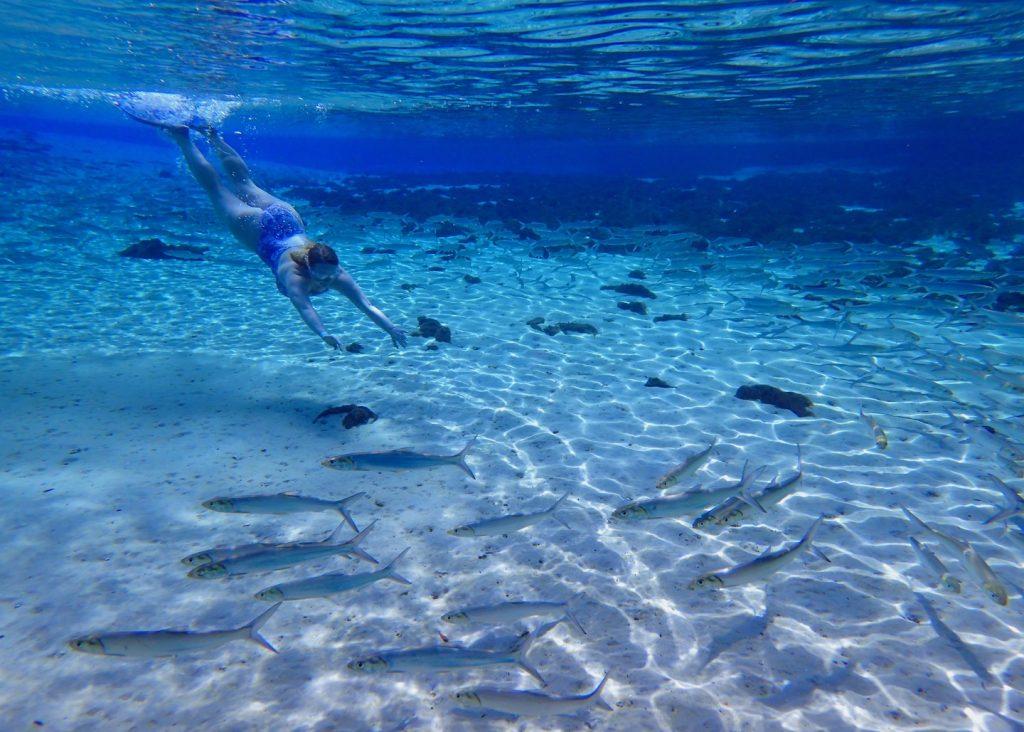
At Wes Skiles State Park, Orange Grove Sink and Peacock Springs are sunken pools surrounded by forest. Swim slowly to avoid bumping into submerged boulders, and enjoy the peaceful ambience of thispair of lesser-known swimming spots.
Biodiversity hotspot
Florida is entirely within the North American Coastal Plain biodiversity hotspot, a place of globally significant biological richness that is threatened. One threat is degradation of the Floridian aquifer that supplies springs with their water. Abstraction to supply bottled and piped water is reducing flow rates of springs, and excessive nitrogen leaching into the water from agricultural practices and septic tanks causes algal growth to swamp aquatic plants.
While on land, be conservative with your water use. While in the water, avoid trampling vegetation, and don’t chase wildlife. In these clear waters you can have great views from a distance and often it will come to swim around you.
Planning your swimming holiday in Florida Springs
• January, February, March and April are after the hurricane season and cool enough to deter summer crowds.
• Orlando is the nearest international airport.
• Many state parks and some private sites with springs have camping facilities, and cabins available for rental onsite.
• FWC advice on alligators
• Accessibility is good in many state parks with handrails and step entry into water. Additionally, De Leon Springs, Fanning Springs, Ichetucknee Head Spring, Manatee Springs and Ponce de Leon have chair lifts into the water. Wakulla Springs has an amphibious mobility assist vehicle available on request. Check details at floridastateparks.org/experiencesamenities

Susanne Masters
Susanne is an ethnobiologist who swims and writes. Her book Wild Waters is a guide to aquatic wildlife around Britain and Ireland, and she is an Expert for National Geographic Expeditions. She has written features for BBC publications, the New York Times, and the Guardian. Her academic research is on wildlife trade, and she is a member of IUCN Species Survival Commission specialist groups on Sustainable Uses and Livelihoods, and Orchids. A member of The Association of Foragers, Susanne swims for fun as well as foraging. Highlights include sparkle swims (with bioluminescence), ice cracking dips, and swimming from Asia to Europe across the Bosphorus. She posts swims and aquatic thoughts on Instagram.