


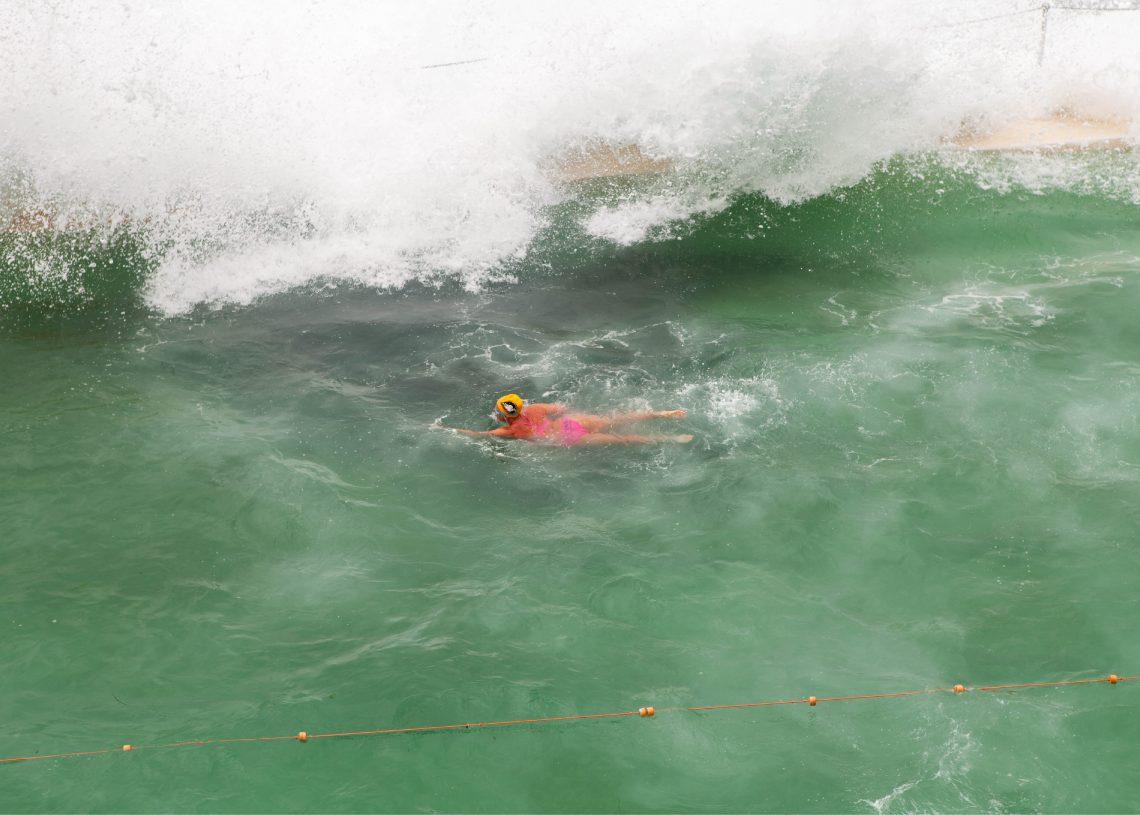
How to get ready for swimming in rough water
It’s a mental as much as a physical thing, says Simon Griffiths
In my 20s, I lived in West Africa for three years. Whenever I had the opportunity, I swam in the Atlantic. My favourite days were those with an offshore breeze and waves of between about 0.5m and a metre high.
These were the best conditions for body surfing. The waves rolled towards the beach in neat rows. As they started to break, the wind whisked spray from the crests. Catching the wave at the right moment meant an exhilarating ride to the beach, aquaplaning on my hand and chest, water arcing either side of my face.
But often the wind blew from the sea creating messy conditions, chop on top of waves. This made body surfing tricky or impossible. Yet I still wanted to swim, so I swam parallel to the beach, just beyond the breakers, or sometimes in the white water, letting the waves push and pull me as they desired.
I wasn’t training. I was just messing around in the sea, having fun. But years later, I realised this experience had given a solid grounding for swimming events in the sea or any time conditions get a little rough.
Go and play
When swimming in rough water, expect some or all of the following to happen:
- You turn to breathe and get a mouthful of water
- You lift your head to sight and get smacked in the face by a wave
- Your recovering arm gets bashed by a wave that messes up your stroke
- You catch air or foam instead of water
- You can’t find your usual swimming rhythm
- You feel like you’re not getting anywhere
The way to deal with these things is to relax, stay calm and keep swimming. But don’t be a rag doll. Hold your core for stability and to help you cut through the water. If you miss a breath, you just have to hold your breath until your next stroke. If you don’t see what you’re looking for when you sight, keep trying until you do. If your stroke doesn’t connect, try again.
But that’s just in theory. In practice, you don’t want to overthink it. You need to swim and stay in the moment. Ideally, your responses should almost be on autopilot.
The way to achieve this is to swim a lot in a wide range of conditions. A fun way to do this is simply to go and play in the waves. Swim in and out, left and right. Dive under them. Try to swim over them. Surf them. Let yourself be knocked around by them. Experiment.
Here are some things to try:
- When swimming parallel to incoming waves, first breathe towards them, then away from them. Which do you find easier?
- Can you adjust the rhythm of your stroke to the pattern of the waves?
- What works best for you: short speedy strokes or long powerful ones? Does it vary depending on the conditions?
- Pay attention to your hands. Does lifting them higher make any difference?
As you practice, you should find that swimming in rough water becomes intuitive. Instead of resenting or fearing the waves, you’ll enjoy them. Instead of fighting the water, you’ll feel at one with it.
Can you practice for rough water in the pool?
You may have come across attempts to simulate swimming in rough water in the pool. I’ve seen coaches put their swimmers into two rows, either side of a lane, and asking them to use kick-boards to churn up the water. Swimmers then take it in turns to swim down the middle through the churned-up water.
I can see this might be fun (although it doesn’t appeal to me) and if you have no access to natural rough water, it may be better than nothing.
However, your time in the pool is probably better spent refining your technique and building your fitness. Good technique in the pool carries through to the open water, even when the waves are doing their best to mess it up.
Up your mental game
As well as training your body to manage rough water, you can prepare your mind. With practice, the two develop together, but see if you can do the following too:
- See rough water as a challenge, not a threat. It’s an opportunity to test your swimming skills against nature.
- Stay in the moment. If you find your mind asking “when will this end”, divert your attention to your breath or catch or something to focus on now rather than thinking ahead.
- Be the calm at the centre of the storm. Let the water rage while you glide calmly through it.
- Be grateful you have the opportunity to be where you are. Not everyone can do this.
Stay safe
Rough water increases the risks involved in swimming. Here are a few things to think about to stay safe.
- Stay close to your fellow swimmers and check you can see them every few seconds. It’s easier to get separated in rough water and harder to find people.
- Stay away from reefs and other hard objects. The sea will throw you about. You don’t want to be dragged across a barnacle encrusted rock.
- Take extra care getting into and out of the water. On a beach, waves can knock you over or slam pebbles into your toes. Watch the waves and pick your moment.
- When body surfing, a breaking wave can tumble you over and push you under. Hold your breath. In a few seconds, the wave will leave you behind and you can surface – but watch out for the next wave.

Simon Griffiths
I started Outdoor Swimmer in 2011 (initially as H2Open Magazine) as an outlet for my passion for swimming outdoors. I've been a swimmer and outdoor swimmer for as long as I remember. Swimming has made a huge difference to my life and I want to share its joys and benefits with as many people as possible. I am also the author of Swim Wild & Free: A Practical Guide to Swimming Outdoors 365 a Year, I provide one-to-one support to swimmers through Swim Mentoring and I'm the creator of the Renaissance Swimmer project.