Myth busting: “Everything in the southern hemisphere water wants to eat me!”
Register to get free articles
Want unlimited access? View Plans
Already have an account? Sign in
Great whites, blue-ringed octopus and reef-dwelling cone snails: marine biologist, writer and broadcaster Dr Helen Scales introduces us some of the most deadly creatures in the southern hemisphere – and explains why they’re not all out to get you!
I find it weird that I know people who think I’m crazy for wanting to swim with sharks. They know me and my love of the ocean, they’ve heard me bang on about the fact that sharks have good reasons to be way more scared of us than we are of them.
Humans kill hundreds of millions of sharks every year for their meat and fins, and on average there are ten tragic, fatal shark bites on humans each year. You are far more likely to succumb while taking a selfie, popping a champagne cork in your face or a coconut falling on your head while you nap under a palm tree.
A lot of surfers and swimmers who have survived shark bites didn’t rush right out to seek their revenge but are transformed by the experience into shark advocates and go on to campaign tirelessly to protect them. Still, I meet people who just can’t seem to shake the idea that ‘shark infested waters’ are a bad thing, especially in the southern hemisphere.
Swimming with whale sharks
It’s true that almost all the sharks I’ve seen in the wild have been down south, except for the incredibly cute catsharks I’ve seen around the UK coasts (once I found a baby catshark newly hatched from its mermaid’s purse and held it for an unforgettable moment in my hand).

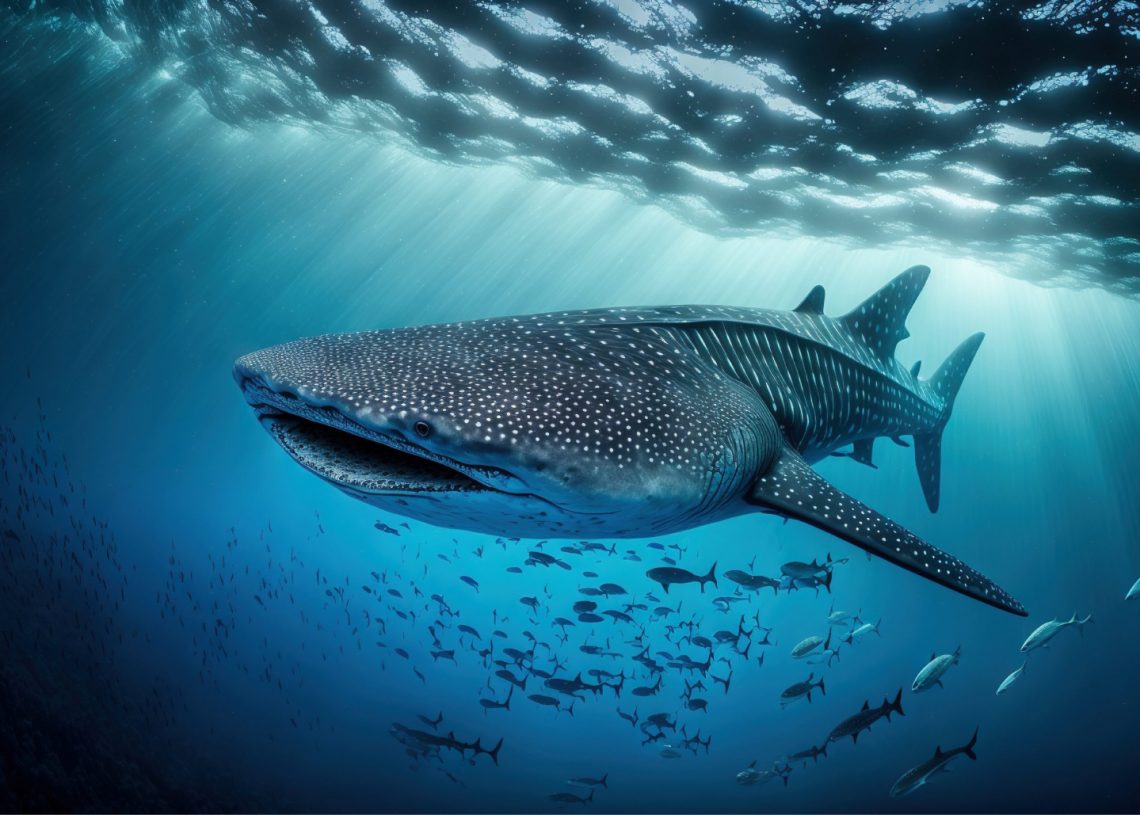
Otherwise, my shark encounters have all been on the other side of the equator, and what encounters they’ve been! Off the central, tropical coast of Western Australia I’ve swum with enormous, beautiful whale sharks, the biggest fish alive in the ocean today and utterly harmless unless you rub up against their rough skin the wrong way which would give you a nasty rash, but you really shouldn’t be getting that close anyway. The first time I saw a whale shark it was far bigger than I was expecting.
I hung motionless at the surface, too astonished to swim, and it just kept on coming, more and more of it, until eventually its tail swung into view — it was taller than me. I’ve had encounters with far smaller but no less gorgeous sharks, like the tasselled wobbegongs that lie on the seabed looking for all the world like a patch of weedy seabed. They show it’s another big lie that sharks must keep swimming to breathe. Some do, the so-called ram-jet ventilators like great whites and mako sharks which swim so fast they just open their mouths and let the water flow over their gills. But plenty of sharks can sit still and suck in all the water they need to breathe.
Whenever I’ve seen a shark it’s been an exciting experience. And whether it’s a pile of whitetip reef sharks snoozing together on the seabed, a nurse shark gliding by, even a group of huge bull sharks being fed tuna heads by strapping divemasters in Fiji, it has never occurred to me to be scared. I’ve only ever felt tremendously lucky to share the water for a while with these amazing animals.
There are still plenty of sharks I hope to see one day. I’d love to watch a walking shark do just that and strut across the seabed on its little fins, sashaying its metre-long, spotty body from side to side like a lizard. I’ve never seen any of the hammerhead shark species with their extraordinary tool heads, that would be fun, or a thresher shark with its insanely long whip of a tail.
Look but don’t touch
My point is there are heaps of different types of sharks out there, roughly 500 species, all of them elegant and mesmerising in their own ways. Sharks of the southern hemisphere are definitely not something to overly worry about and not something to keep you out of the water (although if you are in a region where any of the few, bigger and occasionally more aggressive sharks are known to hunt, like great whites, do the sensible thing and avoid going out at dawn and dusk when sharks are more likely to mistake you for food, and don’t whatever you do go swimming near a seal colony if big sharks are nearby).
As for other potentially dangerous ocean inhabitants in the southern hemisphere, mostly these are things you can actively avoid. Stick to the golden rule of ‘look but don’t touch’ and you’ll be fine. A blue-ringed octopus crawling over a coral head on the Great Barrier Reef could kill you if you make the foolish mistake of trying to poke it. I don’t honestly know how a woman on TikTok got away with her life when she filmed herself holding one.
You’d best steer clear of the reef-dwelling cone snails too. These have shells that look like miniature ice cream cones covered in spots or stripes. Out of hundreds of species there are just a couple that could serve up a lethal injection via a poison-laden, hypodermic tooth which it spits out into its prey or a human who picks one up. A bit like gathering wild mushrooms, you need to know which are the cone snails that are safe and which will kill you. They’re not always easy to tell apart, so best just leave them all alone.
There are also various venomous fish, more species in fact than there are venomous snakes. Most of them evolved their venoms as a means of defence. They don’t go around attacking things with poison fangs or spines, they are simply trying to avoid getting eaten themselves. As a consequence, their poisons have evolved to cause maximum pain. All they really want is for you to go away and learn to never tread on them/poke them/pick them up ever again. Some are very hard to spot, like stonefish which disguise themselves as rocks. If you do get a sting from a venomous fish, like a lionfish, then soaking the wound in hot water can help relieve the pain because the toxin is protein-based and breaks down with heat.

Hardest to avoid are the jellyfish because you might not always see them drifting up to you, and some trail incredibly long, transparent tentacles behind them. Believe me when I tell you the sting of the Portuguese man of war, also known as blue bottles, is horrible and lasts for ages. I was snorkelling off Rottnest Island in Western Australia when a fragment of detached tentacle wrapped around my ankle and found the only sliver of bare skin between the cuff of my wetsuit leg and bootie, leaving me in agony for hours. But the truth is I’ve spent many, many more hours in the water and I don’t really have any other horror stories to report.
In fact, my most painful ever encounter with a marine creature didn’t take place in the southern hemisphere but much closer to home. Last spring, I was surfing off the Atlantic coast of France when I put my foot down and stood on a weever fish. It hurt like hell at first, then the soul of my foot carried on feeling weird and achy for weeks afterwards. But I don’t blame the fish, after all I was the one trampling across its world.
Find Helen on Twitter @helenscales and Instagram @drhelenscales. This article is from the March 2023 issue of Outdoor Swimmer. Click here to subscribe to the magazine.