EXPLORE,  EXTRA,  Features,  March 2023,  Premium

The colour of cold: swimming in Cape Town, South Africa

Register to get free articles

No spam Unsubscribe anytime

Want unlimited access? View Plans

Already have an account? Sign in

With water temperatures averaging 13 degrees Celsius and air temperatures seldom above 32 degrees, Cape Town, South Africa, is a playground for open water swimmers. Capetonian and marathon swimmer Sam Whelpton shares her experience of swimming off the southern tip of Africa with her partner, extreme swimmer Ram Barkai. 

Cape Town is a vast peninsula reaching out into the Atlantic Ocean. The Atlantic is mostly chilly with the Benguela Current from Antarctica moving north, which cools the water temperatures in Llandudno, Clifton and Camps Bay to as low as 9 degrees. The deep water is always cold, but the surface water temperature is affected by the sun and the wind. 

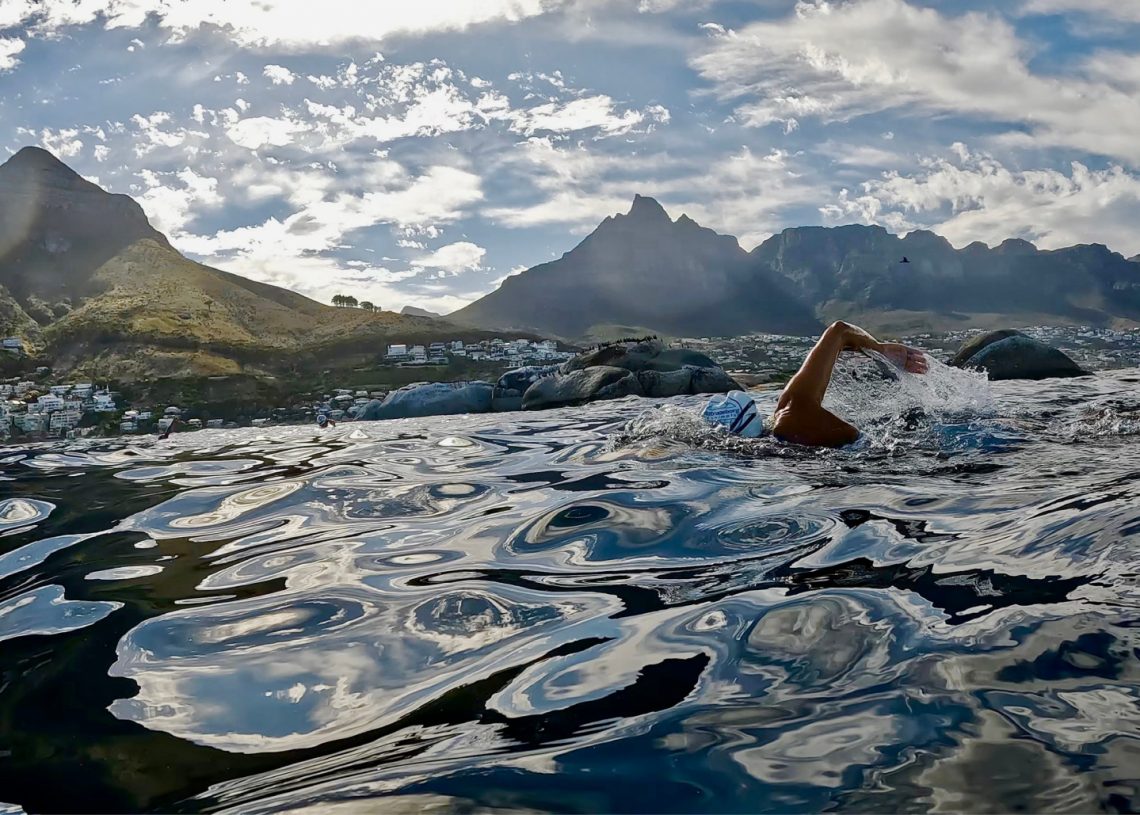
Cape Town’s summer wind, the infamous South Easter, also known as the ‘Cape Doctor’, pushes the surface water offshore and creates an upwell of icy waters. A strong South Easter in Camps Bay can take water temperature down from 15 to 10 degrees overnight. It also flattens the sea and clears the water, leaving it looking just like a tropical island with white sand and turquoise water. We call it ‘the colour of cold’.

Swimming in this clear, crisp water is like swimming in an aquarium. With great visibility, you can see 20 metres below you through kelp to the ocean floor which is covered with rocks, sand, corals, starfish and sea urchins.

At first, I was afraid to get close to the kelp, but as I familiarised myself with it, I learned to love it. Kelp has gotten me out of trouble a couple of times! Swimming near rocks can often be tricky especially when you get caught off-guard by a big swell, which is exactly what happened to us. 

Ram and I were swimming from Camps Bay to Clifton with friends, Kieron and Josh, when it happened. We were in a tight spot surrounded by boulders and submerged rocks when a big set rolled through. I panicked slightly and yelled to Ram for help. He shouted, “grab the kelp!” We dove down and hung onto the kelp for dear life until we had a gap to get out.

All ended well, which is how I learned to love the kelp. The kelp forests scattered on our shoreline are referred to as the ‘Great African Sea Forest’, an enormous, enchanted habitat home to thousands of creatures. Kelp forests fringe the Capetonian shores and stretch 1,000km north into Namibia.

The winter season in Cape Town

Our winter season starts in May, when air temperatures can drop to low single figures, but usually hover around 14 degrees, which is considered cold here. Our homes don’t really cater for cold weather, most houses have air conditioners with big windows and outdoor spaces. Central heating and insulation are not common in South Africa. 

In the winter months we get a north westerly wind that blows warm surface water from the north but also brings rain, fog, big swell and strong currents. The beaches are mostly open to the vast ocean, unlike the bays and coves you can find in the UK and Ireland. The water can get messy and murky with lots of foam, just like swimming in a washing machine.

I find these conditions exhilarating and exciting and it always takes the mind’s focus off the cold. Getting into the ocean during the winter months is so much easier, as the ambient temperature and water temperature don’t differ as much as in the summer months. The water is often slightly warmer and you don’t experience that brain-freeze feeling like you do in summer when the ambient temperature goes up to 28 and the water down to 10 degrees.

Orcas, jellies and African penguins

We have incredible marine life. Dusky, Heaviside’s, common and bottlenose dolphins, Cape fur seals, jellyfish – mostly harmless! Southern right and humpback whales, sunfish (also known as Mola mola), but Ram refers to them as ‘flat whites’. We have African penguins, orcas, many bird species and boats! The boats are probably the biggest concern as an open water swimmer. Wearing bright swim caps and tow floats is highly recommended!

Yes, Cape Town has sharks; it’s their home and they have been vastly misunderstood and vilified in blockbuster movies. False Bay’s famous flying great white sharks have made numerous appearances on the Discovery Channel and are the highlight of ‘shark week’.

False Bay has always been known for its great whites, yet most of them have disappeared from the bay in the last few years and are rarely spotted. Some say that the orcas have scared them away. Apparently, the orcas have developed a taste for the great white’s calorie-rich liver. Other marine experts blame over-fishing. Whatever the cause, this is a growing concern as sharks are an important and integral part of our ocean ecosystem.

Cape Town has developed a particularly good shark spotter system around the popular surfing beaches. This system cautions beach goers and surfers when sharks are spotted. We have many other shark species like bronze whalers (copper shark), hammerheads, broadnose, sevengill, pyjama sharks, blue sharks, shortfin mako and shy sharks. Some are more curious than dangerous. Sharks are endangered species, and we must respect them as we venture into their world and home. They require awareness, respect and a lot more protection. I feel much safer swimming out at sea with boat support than driving my car on our roads.

When we do a marathon distance swim, as an extra precaution, we use shark shields. These create an electrical field around the boat and swimmer which repels a shark if one should come in proximity. Whether it’s proven to work or not, it puts our minds at ease.

“The ocean is out outdoor pool”

In Cape Town, swimming outdoors means the ocean. The ocean is our outdoor pool. Whether you are a beginner or a seasoned open water swimmer, Cape Town has a lot to offer enthusiastic swimmers. Swim groups of various levels are easy to come by, from morning dips to distance. There are timed races to bucket list marathon swims all through the year. Our most iconic swim is, without a doubt, the Freedom Swim, founded by Ram in 2000. The Freedom Swim is a 7.5km swim from Robben Island, where Mandela was imprisoned for 27 years, to Blouberg on the mainland shore. Other bucket list Capetonian swims include Cape Point and Across False Bay, but the list goes on.

Daily dips in the Atlantic are just another luxury of living in Cape Town, which has exploded post-Covid. The health benefits of cold-water immersion and swimming has been a hot topic for a while. For some it’s a ritual with meditating and breathing techniques and for others it’s just another form of socialising, getting outdoors and a cold fix.

Camps Bay is iconic and central with easy access to the beach and many coffee shops and restaurants across the road. The Sunday Hot Chocolate Swimming Group swims every week at 9am and everyone is welcome. You can’t leave personal belongings on the beach unattended. You could ask someone to look after your stuff, but people move and your belongings may move too. Best to leave everything in your car or use a tow float bag. 

The bay is around 800m wide, so we usually swim from the middle to one side and across and back. This is around a mile. If conditions don’t allow us to swim across, we will do a few loops and spend between 30 minutes to an hour in the bay. Swimming at home in the open ocean has the benefit of swimming in a familiar territory knowing the currents, the tides and when and where to swim.

Closing the day ritual

Ram and I often enjoy a sunset swim, which is always more of a closing the day ritual than a serious training session. It’s a cleansing, soul food type of experience. Sunset, also known as the golden hour, illuminates the Twelve Apostles mountain range at the back of Table Mountain, which creates a spectacular golden backdrop. This is our favourite time to swim.

The best time to visit Cape Town is during the transition seasons like spring or autumn. In spring, the schools are open, the parents are at work and the wind is less frequent. The beaches are less crowded, and the weather is mostly dry and sunny.

We love to travel and swim abroad. Swimming allows us to connect with the global swimming community and make friends in all corners of the world. It also takes you to remarkably interesting and exotic places that one wouldn’t necessarily put on a travel list. This comes with a great benefit of meeting and connecting with diverse cultures in remote places. Bonding with people you would have never met as a tourist. We are very lucky to have such a great mix of local swimming and plenty of global adventures. We swim because we love swimming.

Cape Town Favourites

1. Clifton beaches – Atlantic Ocean

2. Camps Bay – Atlantic Ocean

3. Sea Point Pavilion Pool is a 50m outdoor and unheated pool open all year round.

4. Silvermine Reservoir – Up in the mountain central Cape Town

5. Simon’s Town Long Beach – False Bay

6. Blouberg – Atlantic Ocean

7. Gordon’s Bay – Atlantic Ocean

8. Langebaan Lagoon – On the west coast

This article is from the March 2023 issue of Outdoor Swimmer. Click here to subscribe to the magazine.

To see all the online content from the March 2023 issue of Outdoor Swimmer, visit the 'Hemispheres' issue page.
Stay up to date with The Dip, our free weekly outdoor swimming newsletter.

Outdoor Swimmer is the magazine for outdoor swimmers by outdoor swimmers. We write about fabulous wild swimming locations, amazing swim challenges, swim training advice and swimming gear reviews.