

Lifestyle swimmers
Why is outdoor swimming so much more than a hobby? Rowan Clarke finds out
Watch out for outdoor swimming. It often starts like any other activity or hobby, but it finds a way to become part of your identity. Before you know it, you’ve got badges sewn onto your changing robe, your birthday gifts are all swimming-related, you’ve had to find dedicated cupboard space for your kit, and all your holidays are oriented around the blue bits on the map.
How does that happen? And, if you think about the start of your outdoor swimming journey, did you expect it to become such an important part of your life?
Like any new activity, it begins with an intention. Intention setting is an oftenused tool to consciously and deliberately direct our thoughts and actions towards a desire – an outcome, a state of being, or an experience.
Intentions draw on our past and current experiences, influences and values. For example, if you loved seaside holidays as a child, value the natural world and watched a documentary on how cold water immersion supports mental health, you may set yourself the intention to start dipping in the ocean to help ease your anxiety. Or, if you experienced a knee injury but value being active and have a friend who raves about doing swim events, you might set yourself the intention to train for a swim challenge and sign up for the Bantham Swoosh.

“When I turned 50, and it’s going to sound a bit weird, but as a treat to myself, I did my first ever triathlon,” says jeweller and outdoor swimmer, Claudia Bradby. An old friend reconnected with Claudia after her husband had been unwell and invited her to train with her for a triathlon. “I’d always wanted to do a triathlon, and I quite like training for things. Then, about a month before, my friend invited me to swim at a lake. I went to this not very nice goose poo suspended lake near Eastley airport, and she said, ‘you’ll probably hold your breath and come up spluttering after about 100 metres,’ which I duly did.”
Beyond intentions
The experiences, influences and values behind our intention to start swimming outdoors are varied, but the pattern is the same. Claudia’s intention to do a triathlon that took her to that goose-poo ridden lake was backed by happy experiences of swimming when she was younger, her value of training for things, and the influence of her friends. But it’s what happened next that’s fascinating.
“The thing that I really loved about doing the triathlon was swimming outside and the whole immersion in nature,” says Claudia. “My two friends went on to really go for it competitively with the triathlons, but I was a bit challenged. I was like, well, why am I not doing this? I worked out that actually it wasn’t the competition element of the swimming that I loved, it was the community and nature, and the connection with water that really got under my skin and has brought so much to my life.”
This is so often the story with swimming outdoors. You begin with a simple intention, but what ensues is so much bigger than you expected. Life-changing, even.

“I’m in my 50s and have discovered the cold water community. The last few years have been the best of my life,” says year-round swimmer Lisa Cornwall. “I started swimming during lockdown in the River Tone with my friend Jackie. I was hooked and started swimming at Clevedon with the Bluetits and various others – I couldn’t get enough.”
For swimmers like Lisa, the benefits of swimming outdoors far exceed expectations. Lisa’s childhood experience of sport was traumatic, compounded by suffering a lifechanging spinal injury in her 40s. For her, cold water swimming has been nothing short of transformative.
“I felt accepted, good enough, no one laughed when I walked anywhere in a swimsuit,” she says. “More than all that, cold water therapy has helped me come to terms with my accident. It helps me manage my pain… But most of all, I laid those demons to rest. Cold water swimming and the community have given me confidence and acceptance.”
Lifestyle benefits
Dr Mark Harper, Co-Director of Mental Health Swims and Co-creator of Chill Swims, found similar stories when researching his book, Chill: The Cold Water Swim Cure.
“The great thing about [cold water swimming] is that it comes to people who don’t do it with that expectation, and it becomes a lifestyle that’s important for their health,” he says. “One guy I mention in my book, Rob, took it up because he wanted to swim the Channel. But then he realised what effect it had on his inflammatory bowel disease, and it became a lifestyle.”

Outdoor swimming can be classified as a lifestyle sport. Defined by researchers at the University of Brighton, lifestyle sport is participatory, informal, adventurous, rebellious, creative and integrated with the environment. Unlike traditional competitive sports, there’s no set way to do lifestyle sports.
“We use the term lifestyle sports as an umbrella term to refer to a range of participatory, informal and ‘stoke’-seeking urban and rural sporting activities,” write researchers Paul Gilchrist and Belinda Wheaton in their paper, Lifestyle and Adventure Sports Among Youth. “[Many have] characteristics that are different to traditional rule-bound, competitive and institutionalised sport. They have been characterised by their challenge to the dominant Western ‘achievement sport’ culture and values.”
For people like Lisa, who not only had negative experiences of achievement sports, but also has a physical disability, the participatory, informal, adventurous, creative and rebellious nature of swimming in cold water is truly transformative and incredibly healing.

Even for swimmers with a positive association with competitive sports, the creativity, immersing in the natural environment and breaking free of rules is revelatory. What’s fascinating is how swimmers who we might view as ‘serious swimmers’ feel that freedom as much as dippers.
“I like pushing myself. I like setting myself big, scary, audacious goals. I like to see what I can do and how far I can go,” says ultramarathon swimmer Amy Ennion. “And, as a plus-sized woman, that is very difficult to do in a sport on land where gravity is involved. I quite simply do not have the knees for gravity! But none of that matters in the water, so the potential for anyone coming to open water swimming is limitless.”
A quiet rebellion
Amy’s last sentence is powerful. The words ‘anyone’ and ‘limitless’ are meaningful because they describe the potential of outdoor swimming to break physical, mental and social barriers.
A physical barrier might be an illness, injury, disability or the wear and tear that comes with ageing. A mental barrier might be a lack of confidence, low self-esteem or a mental health issue like depression and anxiety. And social barriers exist around how we feel people, or society, expect us to look or behave.
“The sense of loss was profound, and I felt really adrift. It sounds dramatic, but that’s how it was,” says Hannah McNally about her forced retirement from boxing because of a worsening back condition. “After my back condition was fully diagnosed, swimming became my sole option. I live next to a beach, so I dove in. Then I started to realise how challenging and fulfilling swimming could be.”
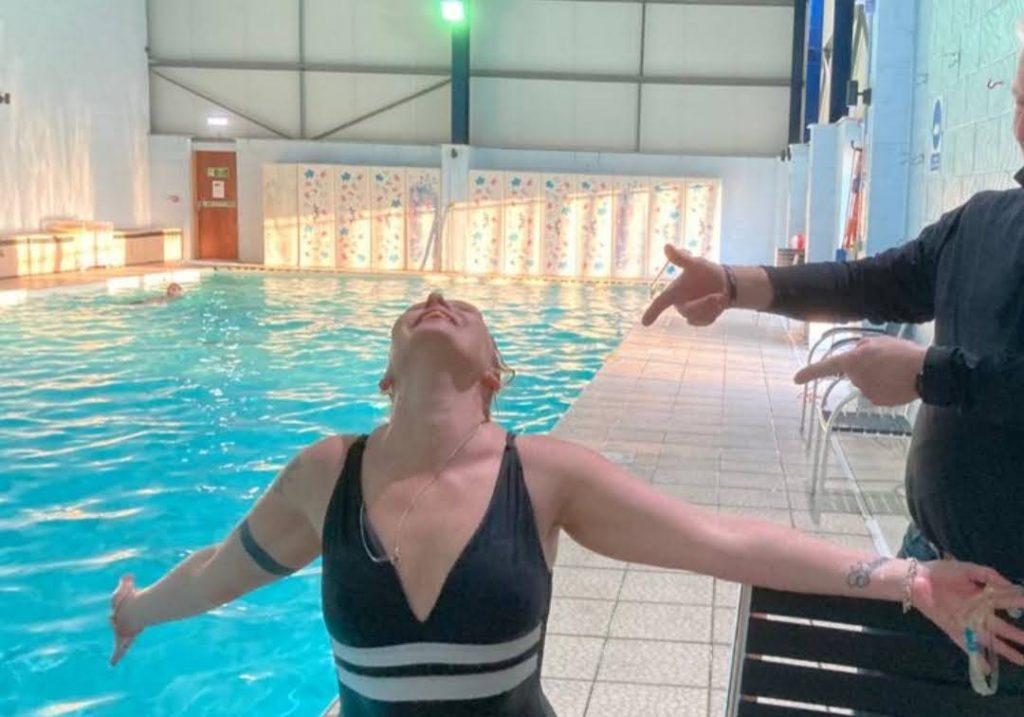
As with Amy, Lisa and Claudia’s stories, Hannah’s shows how interconnected the physical, mental and social benefits of outdoor swimming are. They also show the power of rebelling against whatever limitations you may face.
“Swimming has become essential for me,” says Hannah. “It’s a challenge and a source of joy. I’ve mastered front crawl – I could only do breaststroke before. And now I’m eyeing up backstroke! It’s helped me physically and mentally and been therapeutic for my back condition.”
Lifestyle medicine
So, it’s not only the holistic benefits of outdoor swimming, but also sticking it to your illness, injury, age and whatever you find challenging about yourself or your life. It’s a total freedom from the rules – real or perceived – around sport and around how you should look or behave. It’s also freedom to express yourself, to be adventurous and brave, and connect with nature. And all this rebellion is magnified by experiencing with other people and from the cold water itself.
“We’re essentially getting addictive chemicals sent through the body – dopamine and adrenaline, which is exactly what you’d get if you took cocaine,” says Dr. Mark Harper, who first experienced cold water swimming in the sea in Brighton in 2003. “But the thing is that you don’t get the real low after. Some people, especially if you have medical issues, infection, or illness, can get tired but don’t get those lows, because the body is working within its own limits.”
In terms of sustainable, health-improving habits, swimming outdoors exceeds objectives. It could be considered not only a lifestyle choice, but also a lifestyle medicine with tremendous power to prevent illness as well as alleviate chronic conditions.
“Lifestyle medicine is essentially free for the NHS. There’s a difference between a National Health Service, which we don’t have, and the national disease service that we have. Lifestyle medicine is part of a National Health Service,” says Mark. “It’s really important because it’s free, it stops people presenting to their doctors – it’s the whole package and that’s what I love about it.”

Mark cites the British Society of Lifestyle Medicine’s six pillars of lifestyle medicine – mental wellbeing, minimising harmful substances, healthy relationships, sleep, physical activity and healthy eating. Outdoor swimming supports all except perhaps healthy eating, although Mark does point out that the Swedish habit of ‘fika’ is all about sharing coffee and cake with friends for better wellbeing.
So, outdoor swimming fits the definition of lifestyle medicine, and it fits the definition of a lifestyle sport. While these two definitions help explain why it’s a lifestyle, outdoor swimming goes beyond classification. In Claudia Bradby’s words, “it is more than the sum of its parts.”
It reaches into our careers – me, writing this feature, Jo and Ella who’ll edit it, Claudia’s beautiful Meditative Pearls jewellery collection that’s inspired by how swimming outdoors makes her feel, Mark’s research and writing. It reaches our friendships, the deep bonds we make with our swimming friends. It reaches our home décor; Amy has just installed a floor-toceiling wardrobe for all her kit.
When we set that first intention to swim outdoors, how could we know where it would take us? We don’t just swim outdoors; we are outdoor swimmers, and our lives are better for it.