

Mermaid of the seven seas
Open water swimmers need to be ambassadors for our precious blue spaces, Oceans Seven swimmer Bárbara Hernández tells Abigail Whyte
From the icy depths at the foot of glaciers to the tropical waters of the Molokai Channel, Bárbara Hernández has seen the world from the water. In June 2024 Bárbara became the 28th person, 8th woman and first South American to complete the Oceans Seven, a marathon swimming challenge that comprises seven of the toughest channel swims in the world.
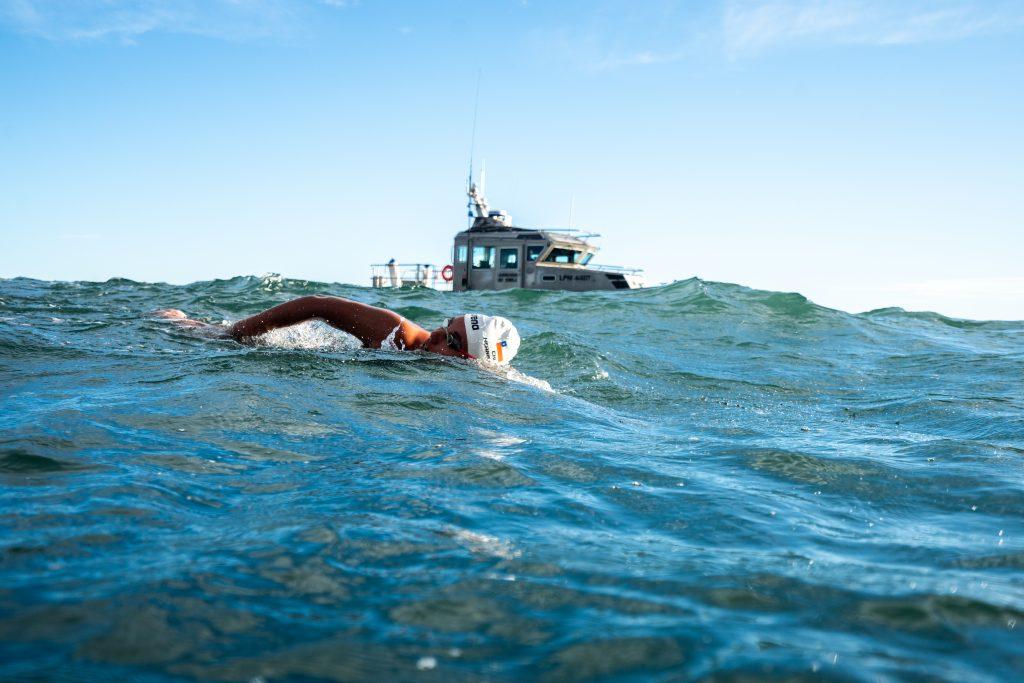
A distance of 230km, these crossings present unique challenges for the swimmer including strong tides, rough swells, extreme cold and jellyfish. To finish the challenge to Marathon Swimming Federation standards, challengers must complete the swims without any equipment that benefits speed, buoyancy or heat retention.
Luckily, Bárbara is no stranger to the cold. Interspersed with her Oceans Seven, Bárbara took on other astounding feats, including her fastest female swim (without skins) in the Strait of Magellan, and her world’s longest swim in Antarctica – swims that have earned her the nickname ‘The Ice Mermaid’.
Ten months on from completing the final leg of her Oceans Seven, we caught up with Bárbara about her reflections on the marathon challenge, her wedding in her favourite wild swimming spot and her preparations for the English Channel Double Crossing in July.
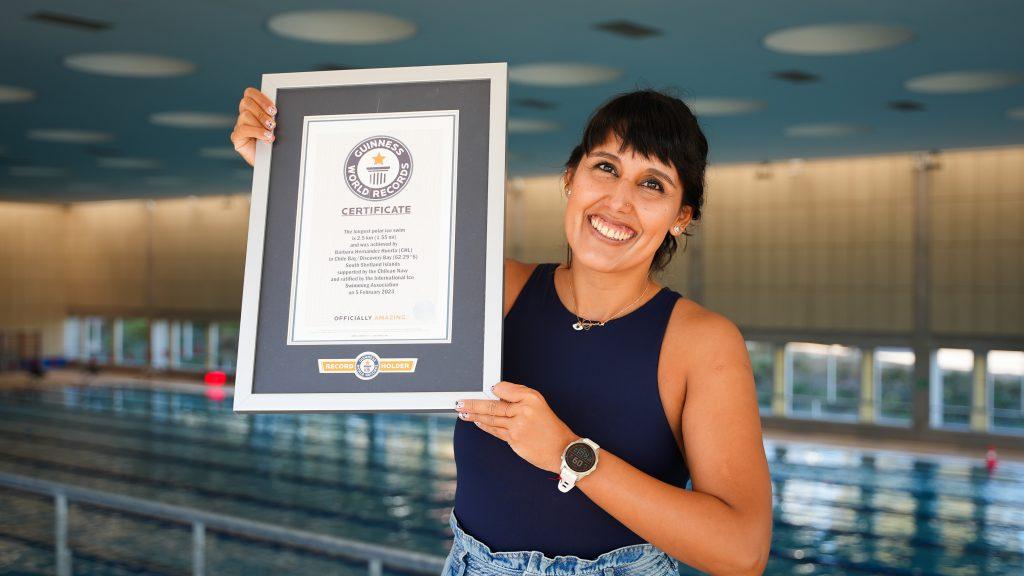
Bárbara, firstly, congratulations on completing the Oceans Seven. How does it feel to be the first South American to finish the challenge?
It feels amazing to have completed this crazy challenge that was 10 years of my life. A dream. Most of the swims I did were a first for my country – the last Chilean to swim the English Channel was back in the 1970s.
To take on something like this – the travel and the training – it’s all so expensive. I come from a working class family in Santiago, the capital of Chile, which is nowhere near the sea. So for me to achieve all this with the support of my team is amazing.
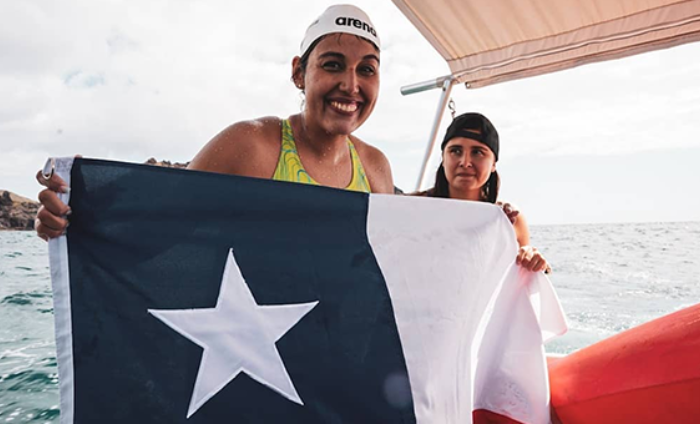
I think sometimes athletes or swimmers like myself are considered too old to do things like this. So I hope my example is encouraging more female swimmers of any age to achieve their ambitions. I’ve had women in their 60s and 70s write to me to tell my they’ve started learning to swim in the ocean and in cold water. That is my goal. And it’s what makes me happy – the people I encounter along this journey, and being able to open up opportunities for others.
After you completed the North Channel, which was the fifth swim of your challenge, you said it was the hardest swim you’d done so far. Has that changed now you’ve completed all seven swims?
Looking back, I’d say the Tsugaru Strait (the final swim) was the hardest. The water was so cold. When we were there the previous year (for an attempt that had to be cancelled) the water was a lot warmer, around 26 degrees. But when I returned in June, it was so strange – the water was over 10 degrees colder.
But the obstacle was my mind. I wasn’t afraid of the temperature or the jellyfish. I was so afraid of failure. Failing my family and my sponsors. I was so afraid of letting down my country if I didn’t finish the swim because it was such a big deal in Chile – it was on TV and in the newspapers. I felt a lot of responsibility.
But I learned how to deal with it. I gave the fear and pain a very small space in my mind and just stayed focused on the swim. I was so happy when I finished – my friends were among the support crew, including my role model, Nora Toledano Cadena. She was the first Latin American swimmer to finish the Oceans Seven. And my boyfriend (now my husband!) was there too. We were engaged for a while but I told him that the wedding could wait until I finished the Oceans Seven. We were married in September.
Do you have a mantra you say to motivate yourself through your swims?
Before I jump into the water, I hug my team and my partner, and he always says to me “You can do this. This is possible.” I just keep that in my mind because these are such long swims, some of them at night.
I actually love swimming at night. I know for some swimmers it can be very scary because you can’t tell the difference between the sea and the sky – it’s just all black. But for me, I love that sensation, when I can just feel my heart, my breath and my memories.
Were there any low moments throughout the Oceans Seven – moments when you thought ‘I don’t think I can do this’? And how do you overcome those moments?
I felt that for every swim! I think for many swimmers who do these challenges, people tend to assume that we’re perfect swimmers. But we feel fear and pain. We might be going through difficult things in our personal lives that affect our performance. We’re real people living real lives. But I’ve learned to train my mind to focus on what I need to do.
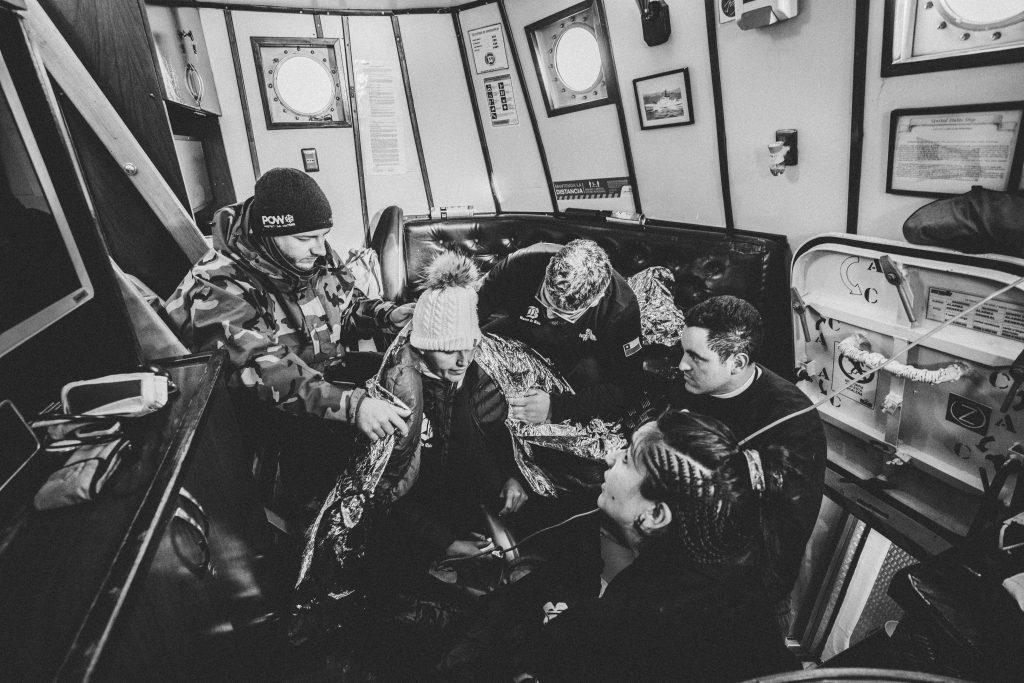
I have a big swim coming up soon. it will be my first night swim in Chile and it will take about eight hours. The water will be cold, around 13 degrees. Swims like this are daunting in my mind because sometimes I think to myself ‘I’m so slow, my arm is painful, etc.’ But that is just one tiny thought among a million other thoughts. I must choose to think about my purpose, my country and my people.
I also have this bracelet, which my late grandmother gave me – she was an amazing woman. I wear this for all my swims, and when I see it on my wrist while I’m in the water, it reminds me of her and I remember why I’m doing this. I know I can try more. I’m the owner of my mind and my thoughts. I’m in control.
What were your favourite moments from the challenge?
The wildlife! In the Catalina Channel I saw bioluminescent phytoplankton. I thought I was hallucinating; I had to ask my team if they could see it too! Also, swimming alongside dolphins – that was amazing.
During my Antarctic challenge I swam with penguins. I also saw a leopard seal resting on the ice – I hoped it would get in the water with me but obviously not too close.
Was there a favourite place you visited?
That’s very difficult to choose. I loved being in Hawaii because of the warm water. I’m so used to the water being cold here in Chile. And of course, Japan. I loved the culture and the people. When I finished the challenge I had a tattoo done on my wrist – it says ‘Release’ in Japanese. I also have the number 7 in Japanese on my leg.
What have all these years of swimming all over the world taught you?
To be humble! We swimmers are out there in nature, and nature is the most important thing. You could be the fastest, most amazing swimmer, but Mother Nature is in charge. She does what she wants to do.
It is wonderful to go all these places, experience different cultures and meet other swimmers from all over the world. But it’s so important we use this as an opportunity to talk about the preservation of our oceans, and about climate change. For us open water swimmers, that needs to be the purpose, not the medals or the breaking records.
Have you had any swimming related injuries?
I think I have a high pain threshold (actually I think all women have that!) but I felt a lot of pain in my hip during the North Channel swim. Usually I’m a very happy swimmer, making jokes and smiling a lot, but at the end of that swim the pain was so bad, I could barely breathe. I touched a lot of lion’s mane jellyfish during the swim so I wondered if it was something to do with that.
I felt the pain for a long time afterwards, and I’ve since learned that it was a muscle tear. My coach helped me rehabilitate from this injury because my mental and physical health is the most important thing.
Is there a particular technique in your front crawl training that has helped you for your swims?
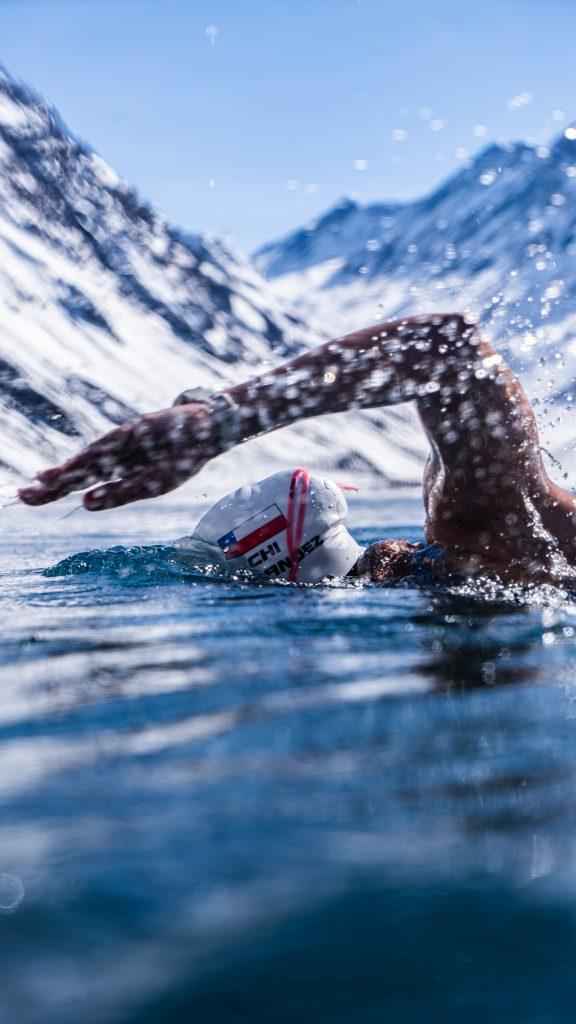
A few years ago I did a 7km in Chungará, the highest non-navigable lake in the world at 4,560 meters above sea level. For this high altitude I trained to breathe up to every seven strokes. Learning to master your breathing is particularly good for sea swimming, where a swimmer must be prepared to adapt to what the sea gives us.
Where is your favourite place to swim at home?
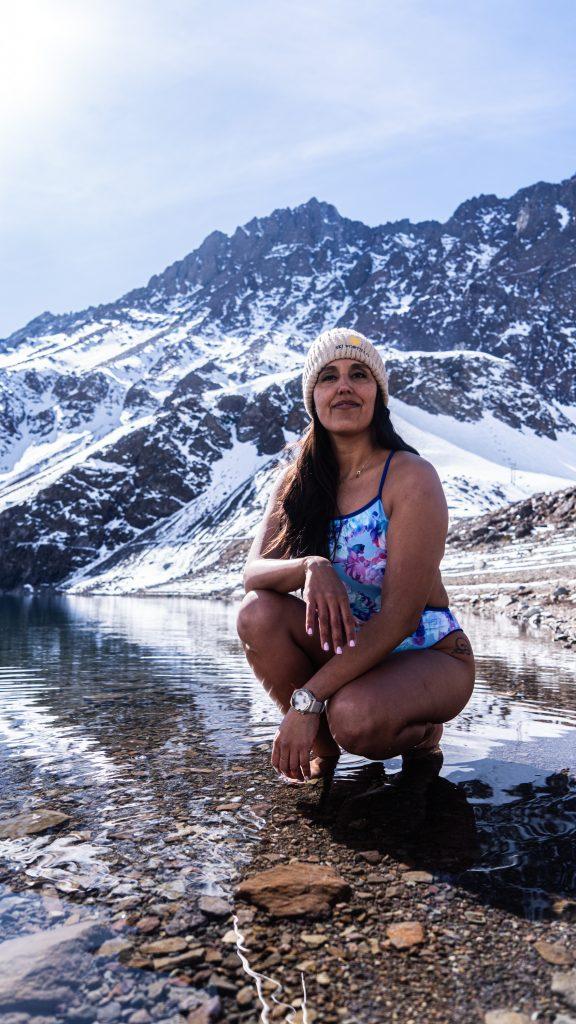
Portillo, in the middle of the Andes mountains. There’s a small lagoon with clear, blue waters surrounded by snowy mountains. It’s actually where I got married!
Also, I love glacial swimming in Patagonia. For the past 10 years I’ve swum near the glaciers, and each time is a new experience. It’s incredible feeling to be so close to a wall of ice.
So, you’ve already conquered the English Channel as part of the Oceans Seven. We hear you’re doing it again, BOTH ways?!
Yes I’m doing it in July and I don’t know why! Doing it one-way is hard enough. My friend Nora Toledano Cadena did the challenge and she’s my idol, so I’m inspired by her. I’m doing my qualification swim here in Chile, I’m just waiting for permission from the Chilean navy. They’re always afraid of what crazy thing I’m going to ask them next! I went with them to do my Antarctic swim.
The English Channel Double will be a difficult one. Last year I didn’t manage to do the Catalina Double Crossing. It’s the first time in my life I didn’t finish a swim. I’d swum 16 hours; night was coming; there were another 10 hours to go and I wasn’t feeling great, so I just decided ‘No’. So to go for this English Channel Double is a challenge, for my mind especially. I will do my best.
Is there anywhere else in the world you’d love to swim?
I’d like to head up north to swim in the Arctic. I’d love to see a narwhal – I don’t know if it’s possible to swim near them but I definitely want to see one.
And there’s so much to explore around here in Chile. There are lots of islands and undiscovered places. Chile has over 26,000 glaciers. While having the opportunity to access these places, it’s important for me to talk about how to protect them. All of my challenges are opportunities to talk about the oceans, and to inspire more women to challenge old ideas and to love the water. That is my beautiful purpose.
How does swimming enrich your life?
For me, swimming in open water is a privilege. Of course it can be difficult as I don’t swim in normal conditions. I love extremes. But when my body first gets in the water, it knows it instantly. It’s home. I belong in that place.

Abigail Whyte
Abi writes swimming news stories and features for the Outdoor Swimmer website and manages the social media channels. She loves to swim, run, hike and SUP close to her home in Herefordshire. While she’s a keen wild swimmer, Abi is new to the world of open water events and recently completed her first open water mile. She has previously written for The Guardian, BBC Countryfile Magazine, BBC History Magazine and Ernest Journal.