

Mud, mud, glorious mud
The quirkiest of aquatic disciplines turned 50 in 2026. Elaine K Howley takes us through the history of bog snorkelling
Behold, the wild swimming–adjacent sport of bog snorkelling. Never heard of bog snorkelling? You’re in good company. The very British and exceedingly niche – some might even say extreme – activity marries the wonders of cold-water wild swimming with the slimy mess of mud wrestling to produce one of the quirkiest aquatic disciplines around.
Described at turns as brilliant, claustrophobic, wild, weird, whacky, and wet, the sport was born in a cosy Welsh pub 50 years ago. Back in 1976, local landlord Gordon Green and other business owners were trying to find creative ways to raise money for charity. After a few pints, they eventually stumbled right into a new, if mucky, sport.
That first annual outing featured just a few brave competitors who submerged into the mire to see how fast they could move through it. But over time, the number of participants – and spectators – steadily grew. Soon, folks from around the world came to test their mettle in muddy water.
The first official World Bog Snorkelling Championship was held in 1985, and the event has run every year since (except 2020 and 2021 because of COVID-19), reaching an ever-growing worldwide audience. In 2026, some 200 mud-loving snorkellers took the plunge.
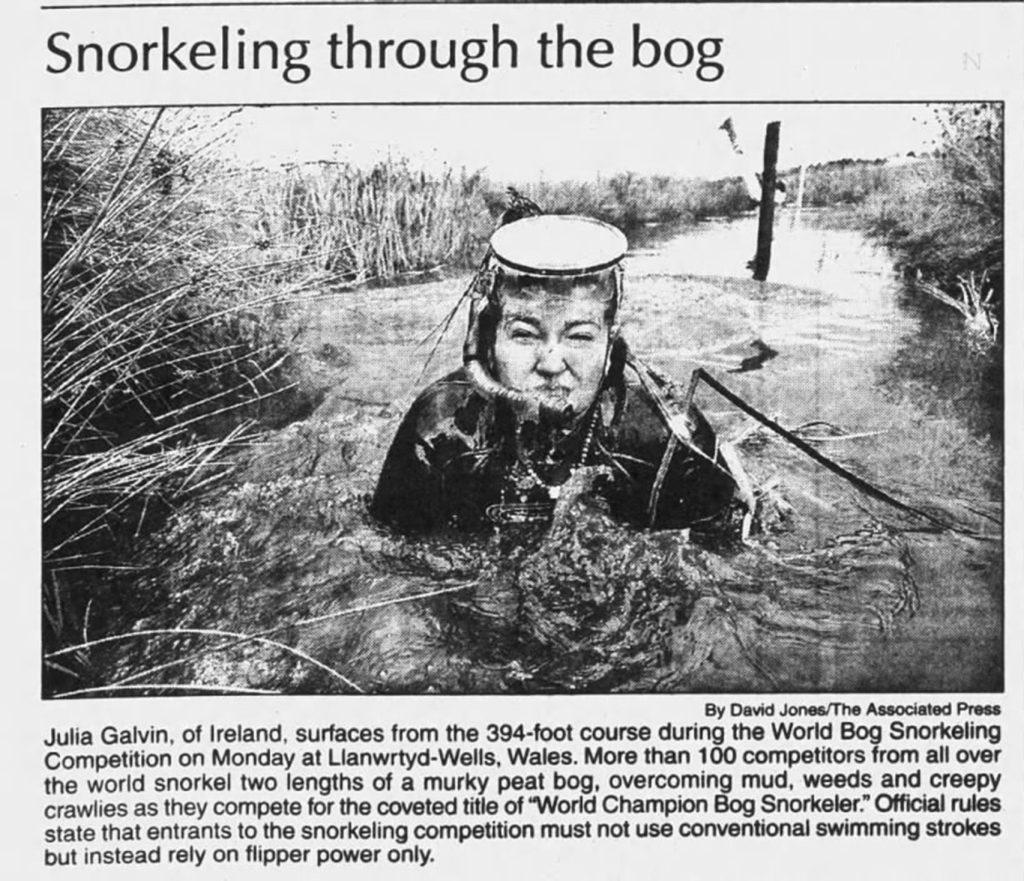
The rules are simple: one-at-a-time and without using conventional swim strokes, competitors must traverse two consecutive lengths of a 60-yard long, 4-foot-deep by 3-foot-wide trench dug on a “Site of Special Scientific Interest” at the Waen Rhydd peat bog in Llanwrtyd Wells in Powys, Wales. Though similar bog-snorkelling events have cropped up in other wetlands around the world, the Waen Rhydd event remains the sport’s standard-bearer.
But is bog snorkelling truly a sport? For Neil Rutter, a 42-year-old schoolteacher from Marshfield, near Bath the answer is a resounding “yes.” In 2017, he won his first World Bog Snorkelling Championship and retained that title across the next six championships.
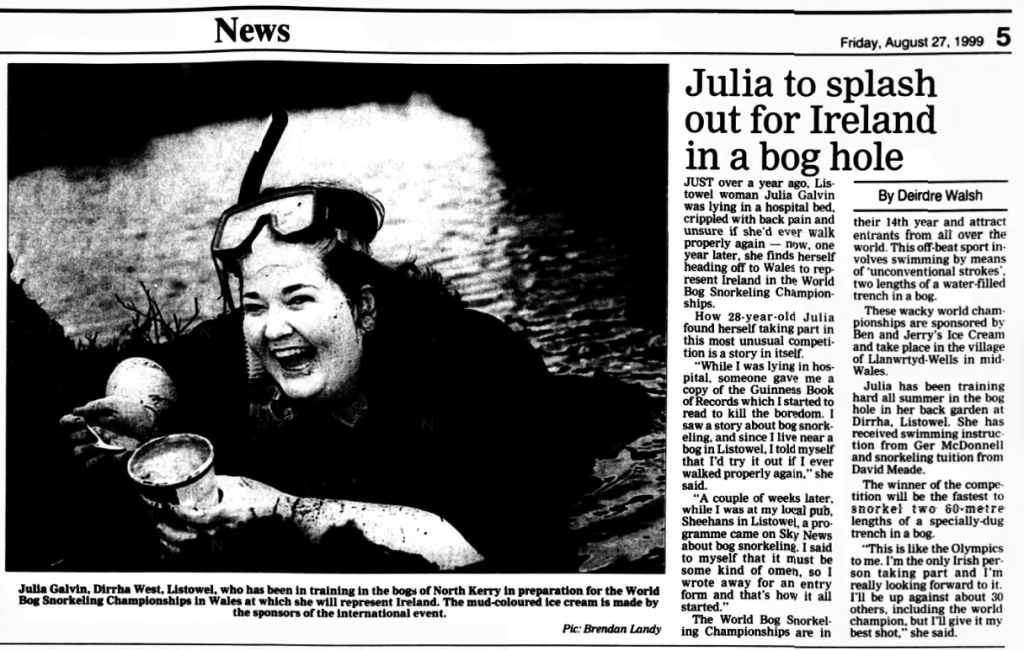
Rutter, who swam as a kid, currently holds the world record of 1 minute 12.34 seconds, set on 27 August 2023. Kirsty Johnson of Lightwater, Surrey – also a lifelong swimmer – still holds the women’s record of 1 minute 22.56 seconds set on 24 August 2014. Her record was the fastest time on the course fullstop until Rutter lowered the men’s standard in 2018. (Women have frequently beaten all the men in this gender-inclusive sport, with Irishwoman Julia Galvin being one of its most decorated and recognisable stars in this cloudy universe.)
In a lengthy interview with COVER Images published in 2023, Rutter explained that bog snorkelling is every inch a sport that demands focused attention from practitioners. “It’s a bit like running a 400m race or cycling a kilometre as fast as you can. It burns the lungs, it burns the legs.”
Rutter’s journey to become King of the Bog started in 2017 when he and about a dozen friends signed up as a fun way to celebrate a birthday. “At the end of the day, somehow, I had the fastest time and was declared world champion. And so, it turned out that I’d found my calling in life.”
The bog water is icy cold, dark, dank, and smelly, Rutter notes, and getting through it requires a particular mindset. A good wetsuit, big swim fins, and a top-of-the-line, frontmounted snorkel haven’t hurt his chances either. He also wears a sleek snorkelling mask, a snug swim hat, and ear plugs to keep the grime out.
Rutter’s speedy technique focuses on holding an arrow-straight line and a trim streamline with hands clasped tightly overhead. He keeps his chin tucked and uses a powerful dolphin kick to zip down the narrow mud-way where he executes a swift open turn to reverse direction. “It’s a leg sport,” he says advising would-be competitors to select the biggest pair of flippers you can manage.
The event is run in a time-trial format because the bog is too narrow for two. Whoever has the fastest time at the end of the day is declared the world champion.
But it hasn’t been an easy thing to stay top of the heap. Extremely hot weather meant there “wasn’t much bog left” when it came time to race in 2022, Rutter said. The lower water level meant the mud was “far more viscus than normal.”
What’s more, the snorkel makes it difficult to get enough oxygen in for athletes who are truly sprinting for a win. And Rutter inhaled bog water during that race. He says it tastes terrible.
Nevertheless, for Rutter, there’s no better athletic outlet than bog snorkelling because of the natural extremity of the milieu.
“When you’re in the bog, yeah, it’s murky and it’s a bit dank and there’s a peaty smell to it. But quite literally, you’re immersed in that environment – an area of special scientific interest. They only open it up once a year for that one championship, and it’s so special to be able to get involved and quite literally become one with the bog.”
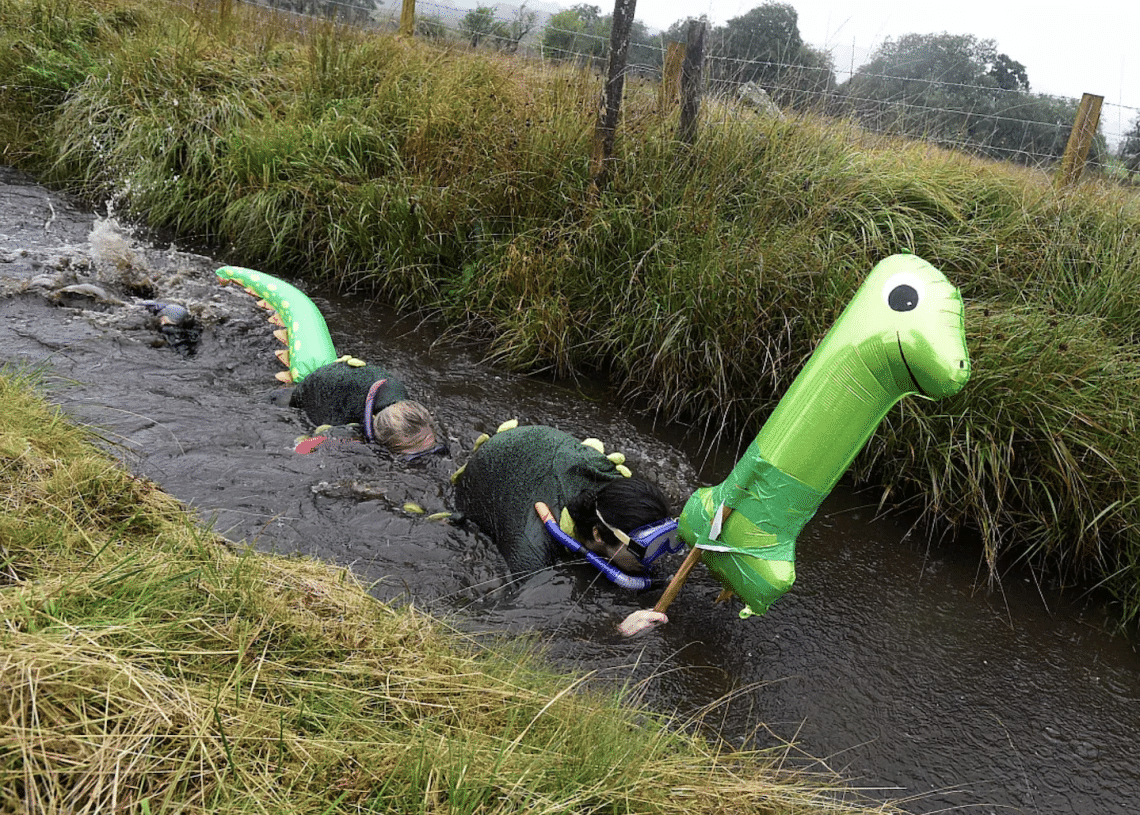
Rutter makes a compelling argument for going full-throttle down the bog and back, but not all bog snorkellers are going for gold. Many enjoy the festive atmosphere surrounding the championship, donning silly costumes and taking their time slushing through the chocolate-colored water.
The New York Times reported on 2 September 2026 that Rutter is now retired from bog snorkelling, but his record “looks likely to last some time.” The secret to his success? “Most people do a doggy-paddletype style, or they’ll have their arms by their side and they’ll do a front crawl kick or something like that. But if you’ve got a decent butterfly kick, it’s really quick,” he said.

Outdoor Swimmer
Outdoor Swimmer is the magazine for outdoor swimmers by outdoor swimmers. We write about fabulous wild swimming locations, amazing swim challenges, swim training advice and swimming gear reviews.