My summer of lidos
A regular at Parliament Hill Lido, Sally Goble loves a pool. This summer, she embarked on a personal challenge – to swim in every single publicly accessible lido in the UK – with some sea pools thrown in for good measure
In the Hollywood film The Swimmer, based on the John Cheever short story, Burt Lancaster plays Ned, a man who decides one day to swim home through suburban Connecticut via an assortment of swimming pools, unravelling mentally as he goes. It’s a fantastic film. Somewhere, it has lingered in the recesses of my mind. Until now.
As someone who just loves being in the water, I don’t discriminante between pool, lido, sea, river, lake. You name it, I love it. I’ve heard open water swimmers refer to the pool as ‘a concrete cage’ and while open water gives you freedom and a connection to nature, pools offer a whole different set of things to love, especially outdoor pools.
So how did I get to where I am now?
In 2006 I swam the English Channel solo.
In 2016, to celebrate my 50th birthday, I decided to swim for 50 consecutive days in 50 different pools around London.
In 2026 I was due a four-week sabbatical from work. Surely it was now or never to take on a big but fun swimming project?
Armed with Emma Pusill and Janet Wilkinson’s fantastically useful The Lido Guide, I could have travelled around the odd day here and there ticking off lidos around the country. But where’s the fun in that? I do like a challenge. I decided it would be much more fun to do One Big Road Trip, and try to swim in every single publicly accessible lido – with some sea pools thrown in for good measure.

Planning
First, I had to define my criteria. My rules of engagement were:
• I’d swim in only publicly available pools – no private hotel pools or fancy members-only places
• Only the UK mainland – England Scotland and Wales. I didn’t have time to go to the Channel Islands, Ireland or the Isle of Wight.
• If I did some sea pools, it would only be ones I fancied doing
• I want to swim not pootle. I wasn’t interested in fun pools or splash pools or theme parks. I struck those off the list.
• I’d swim 1km in each one, not the ‘one length’ that some presumed I’d do (in reality 1km was sometimes harder than I anticipated)

Using The Lido Guide and the internet, I made a list of all eligible pools, and counted them up – there were roughly 110 or so. I calculated that at three per day average, I would take 40 or so days. Plenty of time!
In January, I booked my four-week sabbatical, starting mid-June – lido season! I added a one-week holiday onto the end – that gave me 35 days. My boss approved, and I promptly forgot about it for two months.
The details
At the beginning of March I started detailed planning. I plotted every pool on a Google map. I was always going to drive – there was no way this could be done by public transport. I decided on a route going anti-clockwise round the country, starting just North of London and journeying around the UK mainland in my tiny Fiat 500, a drive that ultimately took me 4,000 miles.

Each evening, I sat staring at the map, figuring out how close each pool was, how many I could feasibly do in a day, and planning where to stay each night. I recorded my itinerary on a giant spreadsheet.
I had planned more or less that if I could do one pool early morning, one around lunchtime and one late afternoon that would be fine. Sometimes it was and sometimes it wasn’t.
After planning the first two weeks, I went back to ask for another week off – five weeks didn’t seem enough. My boss just shrugged and grinned. Phew.
After weeks, I had my itinerary, with swims allocated to each day and hotels booked, with a couple of rest days factored in. I then started booking the swims themselves. Almost every single pool had its own booking system, and own rules about how long in advance to book, and some had really odd opening hours. This part was a nightmare.

I ordered extras goggles, hats, towels for my swim bag and six costumes – my swim bag was heavier than my suitcase. I packed my regular suitcase with as little as I could and hoped for the best!
The trip
I set off early on a Sunday morning in the middle of June. By day three I felt like I’d been away two weeks. The constant change was exciting – the countryside was opening up before me: from the long straight roads of the Lincolnshire fens, to the beautiful lush deep green glens of Scotland, through the rolling hills of the Eden Vale and the mad high-hedged impossibly tiny roads in Cornwall and Devon, the driving became as much part of the trip as the swimming.
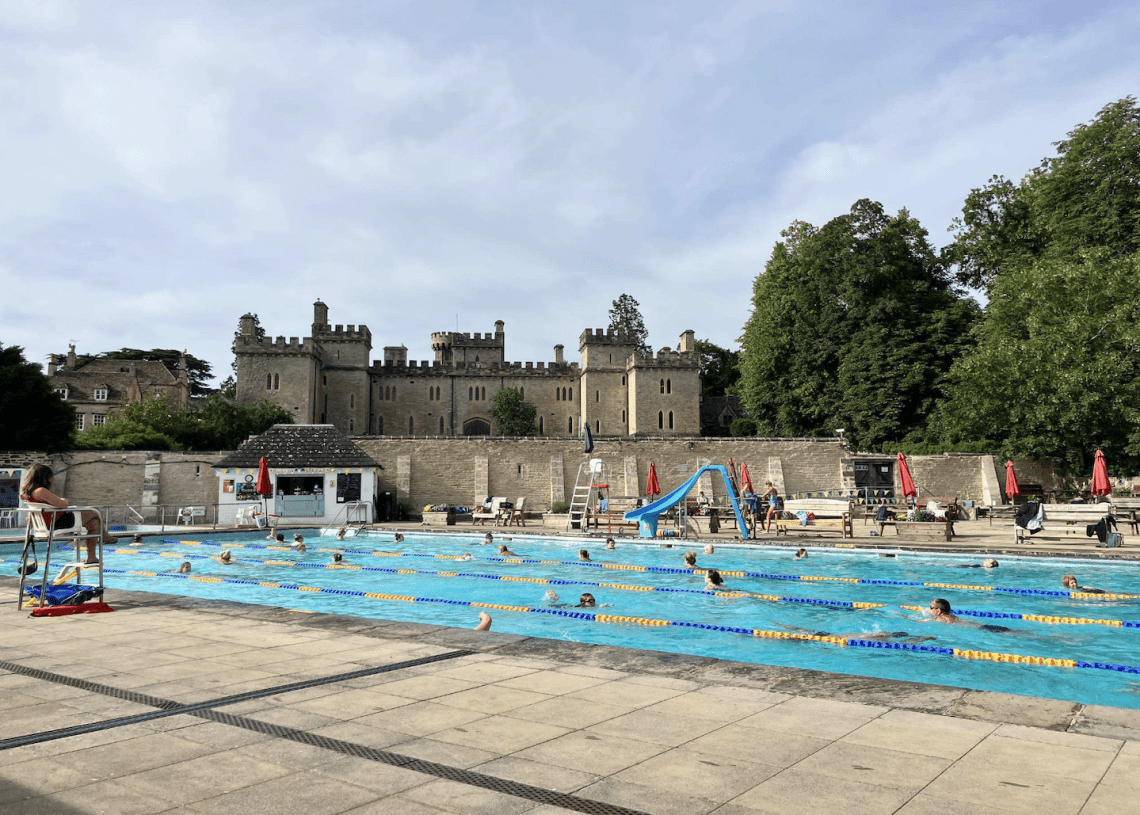
The pools were all a delight as I knew that they would be. In any given day, I could be swimming in a 50-metre, 1930s Art Deco pistachio-coloured municipal lido, followed by a tiny community pool (the smallest was 10 metres long), and then a 25-metre brine pool in a random town. I went to beautiful places I’ve never heard of – and certainly some places I never want to go to again.

Lidos are all about people and communities, and one of the joys of doing this trip solo was that it forced me to chat to other people. In Lincolnshire, at Metheringham open air pool, I was the only person who had booked a lunchtime slot. They quickly rustled up two extra swimmers to come and join me (they are not lifeguarded so need three swimmers to be safe). A swimmer’s dad had created the foundations of the pool in the 1970s. In Stonehaven, a member of the Friends of Stoney committee gave me a lift back to the station and a tour round the harbour to show me the sights. In Dartmouth, I met a pair of retirees who told me the best cafe to eat in in Totnes, and in Topsham a young girl and I were the only swimmers with hats and goggles, desperately swimming lengths in a sea of ‘fun’ swimmers, sharing camaraderie and a desperation at our hopeless project. A woman I met in a cafe in Droitwich Spa suggested I park in
her mum’s driveway close to the pool because I’d mentioned that the pool carpark was full.
I had no idea either that the history would be so tangible. I learned that in Lincolnshire in the 1970s, the government offered grants to local authorities to build pools because of the high incidence of drownings in the Fens. I learnt that Droitwich and Nantwich are salt mining towns, where rock salt is excavated, and that’s why they have brine pools (or baths).
I learned that Street, Somerset, is the home to the Clark’s shoe empire, which was founded by the Clarks brothers; and that Alice Clark of that family bequeathed Greenbank Pool to the women and children of the town.
Not all all plain sailing
Along the way, I lost time to my car breaking down not once but twice; I had food poisoning that incapacitated me for a day, and I managed to avoid a massive ball of fire in Devon while driving. I had to miss some pools because they were closed. Water too hot! Water too cold! Or they just weren’t open on a day I was passing through.
As I was on a tight schedule and had booked non-flexible hotel rooms throughout to save money; I just had to not worry and move on. The heatwave made it both more pleasurable (who doesn’t want to swim in the sun with a blue sky) and also harder (some of the pools were madly busy!)
What did I learn?
In the end, I took 42 days to swim in 96 pools and lidos. I drove 4,000 miles, and swam 94km. I felt like I’d had three months off.
Everyone asks me ‘what was your favourite lido’ thinking that it would be an easy question to answer. In fact, it’s impossible. What I did discover is that whenever there is heatwave in the UK, the press sends journalists down to Brockwell Lido in London or Tinside Lido in Plymouth – both big busy pools that are iconic in terms of size and architecture. They are heroic. But there were other heroes.
There were the tiny community pools run by locals and who obviously care deeply about them. All of these pools and lidos are the heart of the communities where kids learn to swim and retirees do aqua jog or sit around drinking tea in proper mugs after a swim in the morning. They have flowers pots and murals, and they teach the local kids to swim, and the lifeguards also man the reception and administer band aids and sell ice creams.
Other heroes are the historic pools like Pells Pool, Bourne Outdoor Swimming Pool and Shaftsbury Lido, which have stood the test of time and endured through the ages despite concerted efforts to close them down.
Then there are the sea pools, the fun pools, the really odd-shaped pools, the lazy rivers and flumes and spring boards, which quite frankly I’d rather avoid if there is serious swimming to be done – but these are also the places where a love of water and freedom and joy is formed, where kids learn to swim and play.
And in every one of these places there are people like me who get in intent on ‘a proper swim’ – but that proper swim is different from an indoor swim or a swim in the sea because there are mermaid murals, and the smell of cow dung, and the sun on your back, and the bubbles formed by small children hurling themselves into the water to watch as you swim, and an ice cream that awaits you when you’re done. And how else would you want to spend your sabbatical,
I ask you?
Finally, doing this in a heatwave has been timely – it reveals how we need more pools and lidos not fewer. We need places to cool down, we need places to teach our children and adults to swim and to be confident in the water, and we need communities to nurture us. My trip might have been inspired by a story about swimming home, but in the end every lido I went to felt like coming home to me.
Sally Goble can be found at Parliament Hill Lido or in the London Royal Docks. Her winters are spent at various indoor pools in London. She also volunteers for WeSwim (weswim.club), a London-based charity that helps adults with disabilities enjoy the water. You can find her lido recommendations at @theswimtourist on Instagram. Scan the QR code to buy a copy of The Lido Guide.