
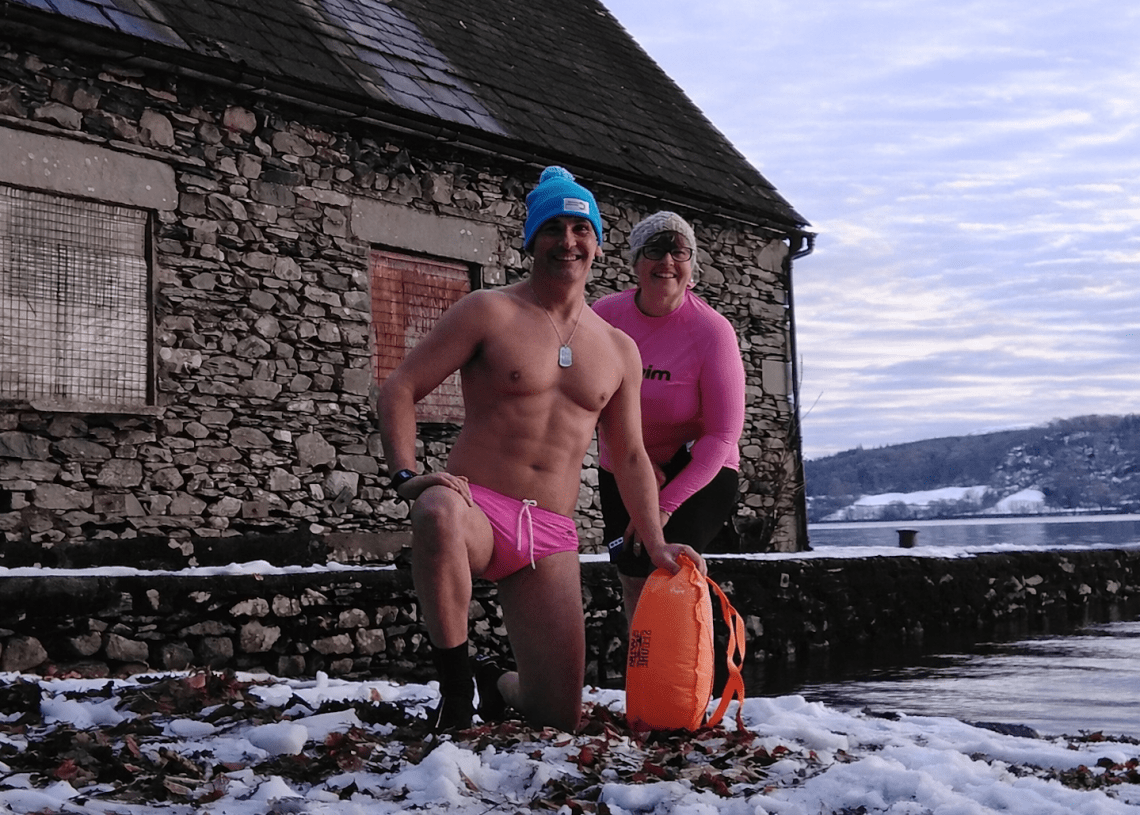
One man and his tow float
Dr Mark Christie is a Senior Lecturer of Sport and Physical Activity Development at University of Cumbria; his professional career is vast. This summer he published his new book, One Man and His Tow Float: Stories, Science and the Joy of Open Water Swimming, which pulls together his work and experiences from the swimming community
The first time I stepped into cold open water, I was feeling somewhat bereft: years of fell running had finally caught up with me. Osteoarthritis had brought an untimely end to a sport I’d loved for decades, leaving a gap that cycling somehow failed to fill. Then came five introductory lessons in a flooded quarry one spring. Rain lashed the windscreen; the car thermometer read 8°C. Even in a wetsuit, the water felt freezing.
“Why on earth have I spent £100 on this?” I remember thinking. “I must be mad”.
I had no idea those tentative first strokes would lead me in an entirely new direction. Five years later, I have swum in lakes, tarns and seas across Britain in every season, often wearing little more than a pair of trunks and accompanied by the now familiar tow float that eventually inspired the title of my book.
Like many swimmers, I initially assumed the attraction was simply the exhilaration. I soon realised it ran much deeper than that. As a retired academic, curiosity has always accompanied experience. I began researching why people are drawn to natural waters and what they gain from it. That journey eventually became One Man and His Tow Float, bringing together my own experiences with the voices of hundreds of swimmers from across the open water community. Across eight published peer-reviewed studies, I interviewed and surveyed everyone from nervous beginners taking their first dip to seasoned marathon swimmers.
This book offers something distinctive: the subjective accounts in personal memoir and testimonies, combined with the objective lens of scientific research. In doing so, it sheds light upon the physiological responses, the psychological impacts, the social bonds that are forged and the influence of nature on our lives. But it doesn’t refrain from analysing the risks involved, whilst examining the essential practices that need to be adopted to ensure open water swimming is a safe and enjoyable experience.

Recreational swimmers rarely spoke about distance, speed or personal bests. They talked about leaving anxiety on the shoreline, clearer thinking, renewed confidence, stronger friendships and an overwhelming sense of perspective. Many struggled to explain exactly why this happened. They simply knew that life somehow felt more manageable after a swim.
One of the strongest themes to emerge was the importance of community. Many swimmers become part of supportive groups. Whether a dawn meet-up or winter dips, the water seems to dissolve many of the barriers that exist on land. I’ve watched nervous first-timers encouraged by people who were beginners only months before. I’ve seen strangers become lifelong friends. There is very little status in cold water. Everyone shivers. Everyone laughs. Everyone shares advice and swaps stories. Nowhere else have I seen hugs exchanged so freely between people who only days before had been complete strangers.
Then there is being immersed in nature. Swimming at water level changes your perspective. Mountains seem taller. The sky appears larger. The world somehow becomes both quieter and sharper. I’ve lost count of the number of times I’ve swum alongside flotillas of geese, or paused to observe a heron patrolling the shoreline. In those moments, it becomes difficult to dwell on the worries that so often occupy everyday life.


However, the book isn’t just about story-telling; the science is beginning to catch up with experiences. Cold water immersion triggers a remarkable cascade of physiological responses that researchers are still seeking to understand. Regular immersion may help the body adapt more effectively to stress, while natural blue spaces have long been associated with reduced mental fatigue and improved psychological wellbeing.
Open water swimming is not without risk, of course. Cold water deserves respect. I became interested in understanding how swimmers assess and manage risk. Subjects ranging from acclimatisation and after-drop to the rare phenomenon of transient global amnesia are examined, always with the aim of helping swimmers enjoy the water safely and confidently.

The diversity of experience is conveyed through many different voices. Alongside recreational swimmers are contributions from Olympic open water swimmer Hector Pardoe, marathon and ice swimmer Colin Hill, and leading coaches, each offering their own perspective on performance, training, resilience, and what keeps drawing us back into cold water, year after year.
One of the unexpected pleasures of writing the book was realising that it had become about far more than swimming. It became about resilience, adapting when life changes direction, and discovering that wellbeing is often found not through dramatic transformations but through simple, repeated acts: walking to the water’s edge, taking a deep breath on wading in, and experiencing the cold water’s embrace. It is about reconnecting – with nature, with other people and, perhaps most importantly, with ourselves.
The tow float that began as nothing more than a piece of safety equipment gradually became a symbol of that journey. It represents every early morning start, every lakeshore conversation, every reminder that some of life’s greatest adventures begin simply by stepping into the water.