The Thames: London’s wildlife artery
Register to get free articles
Want unlimited access? View Plans
Already have an account? Sign in
Far from being “biologically dead”, the Thames is a great place for wildlife, says Simon Griffiths
“It’s behind you!”
And no, this wasn’t pantomime. This was in the Thames (oh yes it was). The “it” was a large grey seal that had popped its head above the water just behind my friend Andrew.
It was only there for a moment. By the time Andrew turned, it had submerged – the classic “oh no it isn’t” moment.
Grey seals are big. An adult male can weigh up to 300kg. They swim up the Thames on foraging missions, feeding on eels, flounder, dace and roach. I once saw one bite clean through a zander the size of my arm. Luckily, our encounters to date have been visual only – a head breaking the surface, eyes meeting yours before it casually dismisses you as neither prey nor predator. Sometimes you imagine something solid and warm brushing past you underwater. It doesn’t stop us swimming, but it keeps us alert.
All creatures great and small
Another rare and thrilling sighting is the kingfisher. I had never seen one until I swam in the Thames – and I’ve still only seen a handful. A sudden flash of turquoise is what alerts you. If you’re lucky, you get a few seconds of its dazzling, undulating flight before it vanishes again. I always look out for them, but sightings seem to happen only when I least expect them. Still, it brings me joy, knowing they are there.
And common ones, too
Seals impress us with their size and grace; kingfishers with speed and beauty. Both are rare enough sightings that we talk about them for days. But I also enjoy swimming with the Thames’s regular residents. We see mallards, geese, coots and mute swans almost every day, and, increasingly, herons too.
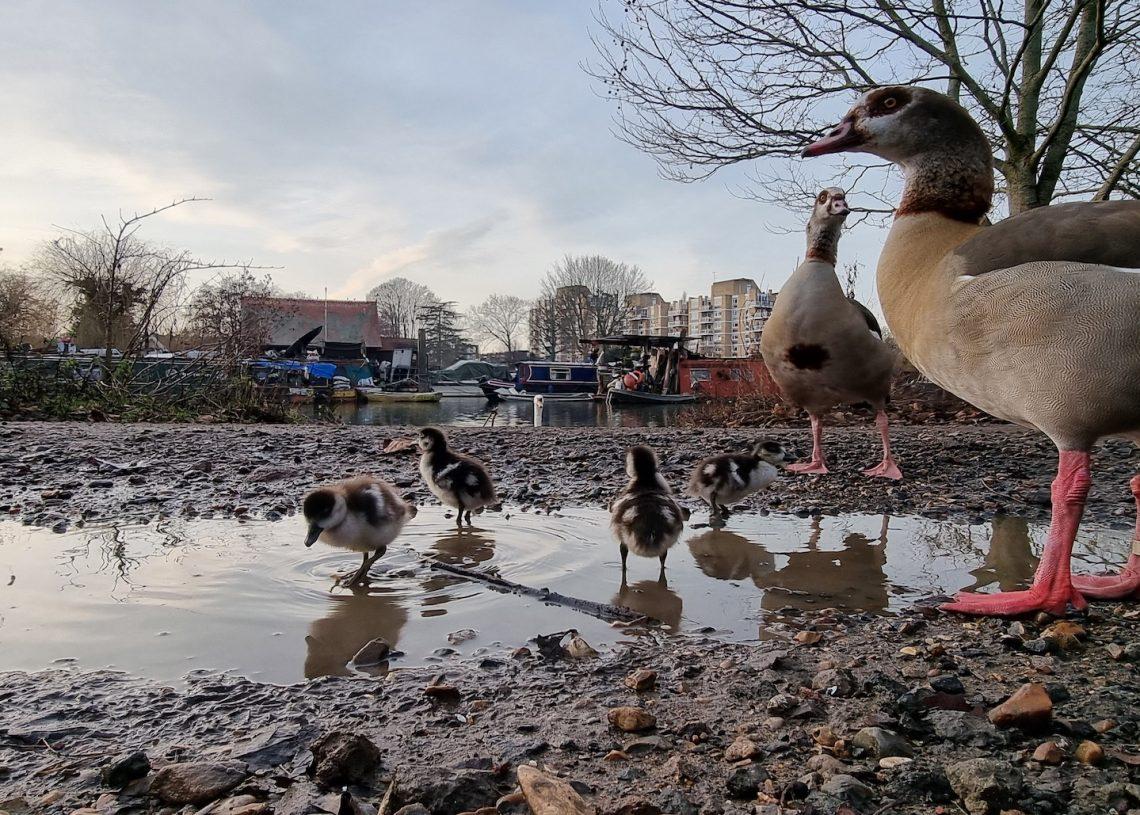
Many of these birds nest and raise families where we swim. One of the pleasures of spring is the first encounters with goslings, ducklings and cygnets, then watching them grow. We count the little ones and hope they make it. Sometimes you even recognise individuals: for a couple of seasons we were accompanied by a distinctive albino mallard.
Despite fish being abundant enough to attract both seals and anglers, we rarely see them in the murk. Occasionally, one jumps. Or, more often, we hear it land. In late spring, shoals of fry appear in the warm shallows near the banks. Dangle your toes and they’ll nudge, even nibble – proof the river is busy with life even when it looks empty.
In summer, we’re joined by damselflies, sparkling like miniature kingfishers. Swim at dusk and you’ll see bats swooping low over the water.
Alive!
The Thames was declared biologically dead in 1957. Today, despite pollution and the ongoing sewage scandal, it has recovered enough to support a wide range of life. That’s something to celebrate – but not to take for granted.

Abundant wildlife is a sign of a healthier river, yet its cleanliness remains finely balanced. Encounters with other creatures can be joyful or unsettling, sometimes both, but they’re an essential part of outdoor swimming. If other creatures can thrive here, then so can we. But if they can’t, we should be alarmed.
Care and respect
A living river is different to a sterile pool, and how we swim in them matters – both for our safety and to protect the environment.
Look first. Take a moment before getting in. Make sure your entry to the water doesn’t cause harm or disturbance.
Swim lightly. Look but don’t approach. Avoid nests and keep clear of wildlife families. Even temporarily separating a duckling from its parents can cause distress.
Don’t stop fighting for cleaner water. Wildlife is a good sign but it doesn’t mean our rivers are perfect.
Wildlife encounters are a big part of outdoor swimming. Take the trouble to notice what’s around you and celebrate what it’s showing you.