Wired for water
Register to get 3 free articles
Want unlimited access? View Plans
Already have an account? Sign in
We swim outdoors to escape the digital world, yet technology has quietly transformed almost every aspect of the experience. From safer swims and smarter training to stronger communities and cleaner water, Rowan Clarke discovers why we’re all digital swimmers – whether we realise it or not.
As much as we swim to escape the digital world, it’s almost impossible. Fundamentally changing outdoor swimming, digitalisation has shaped our experience of wild water – even when we consciously choose to swim tech free. That’s not to say that, at its most elemental, outdoor swimming doesn’t remain a beautifully primitive, human experience. But, the digital undercurrent is always there, stronger than ever. So, how can that be? And is it such a bad thing?
The truth is, we’re all digital swimmers. But there is a continuum. At one end, those who purposefully shun gadgets, at the other, those who track every swim and pore over the data. These choices orientate around tech – increasingly functional wearables, like smart watches and innovative smart goggles.
But tech is just the surface. What’s fundamentally altered how we swim isn’t our smart watches or goggles – it’s the digital infrastructure behind outdoor swimming. From water testing and navigation to connecting with communities, even tech shy outdoor swimmers are now touched by the digital world.
The tech is just the tip
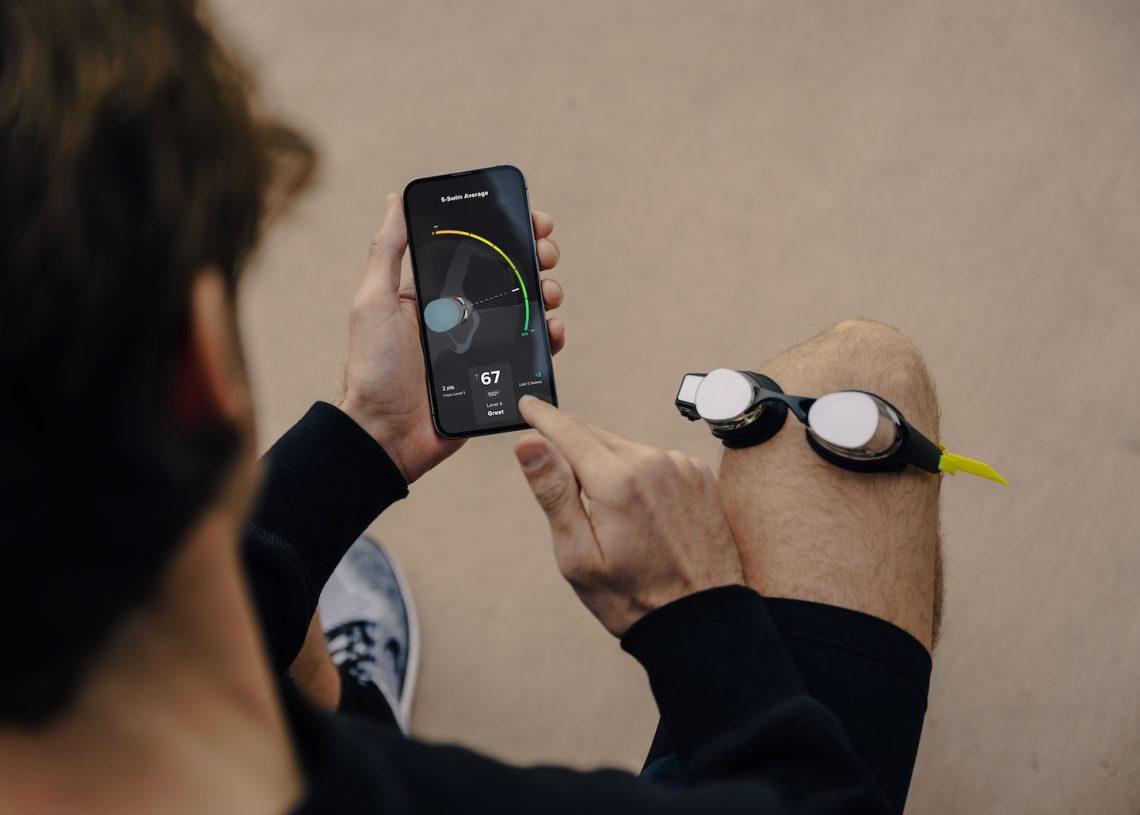
Back in 2024, we interviewed Dan Eisenhardt, innovator and founder of FORM. Swimmers had never known tech quite like FORM’s Smart Goggles before, designed specifically for swimming to not only help you with technique, pace and form, but also navigate in open water.
“The digital compass inside the goggles helps you swim in a straight line,” explained Dan. “We’ve heard from our communities that having something familiar to look at takes your focus away from things you could be scared of in the water, like looking into the darkness. And then, because you’re not wasting energy zig-zagging and becoming frustrated by that, you feel you’re in control, which also lowers your anxiety.”
This is an excellent example of how tech goes beyond its functionality – a digital device designed for navigation that also lowers anxiety, mitigates risk and supports us to swim more confidently. When Trudy Ederle swam the English Channel 100 years ago, she was guided by a ship whose captain relied on a combination of dead reckoning (calculating speed and direction over time), celestial coordinates, compasses and nautical charts. For the final mile of her historic crossing, Ederle’s guide boat, Alsace, had to drop back because it risked running aground in the shallow water. Swimming alone and unguided through pitch-black water, Ederle found the shore by swimming towards the glow of beach bonfires and flares lit by spectators.
Now, digital advancements have transformed distance swimming. Channel pilots use integrated chart plotters to process real-time meteorological and hydrographic data, while we follow a swimmer’s progress using their live GPS feed, and their coaches track their critical swim speed and heartrate using wearables, logging the exact timing, calorie counts and temperature of their nutrition, eliminating human error and guesswork.
Safer swimming
These technological innovations have made distance swimming infinitely safer, thus enabling more swimmers to push their boundaries and explore new waters. They’ve also made outdoor swimming safer in general, contributing to the activity’s exponential growth. Go back just a decade, and open water swimming was still pretty niche, relying on word of mouth and received wisdom.


Now, we can digitally research venues, book swims, record activity, receive safety advice and connect with a wider swimming community.
“Our mission has always been simple: More water, more people, more safety – everything we build starts from that principle,” says Paul Blue, Managing Director of NOWCA, the UK’s largest network of open water swimming venues.
For almost ten years, NOWCA has been pioneering digital solutions for the unique challenges of open water swimming, transforming how UK open water venues operate. Venues that use NOWCA systems can see real-time swimmer activity, so they know who’s in the water, when they got in, and when they got out.
“Knowing who is in the water at any given moment changes everything,” says Paul. “It gives venues confidence, and it gives swimmers reassurance.”
You might be familiar with tapping in and out of a venue with your NOWCA wristband, and enjoying the reassurance that swimming at a managed venue brings. But beyond open water venues, even our wildest swims are digitally enhanced.
Think about your last river or sea swim. Did you check the water quality with The Rivers Trust, Surfer’s Against Sewage or Environment Agency? What about the tides, weather or wind forecast? Did you swim with friends you’d arranged to meet via WhatsApp, or a group you met on Facebook? Perhaps you used NOWCA Wild to log your swim location before taking the plunge, so your nominated contacts knew where you were.
Digital growth
We have so much data at our disposal that makes swimming outdoors easier, more comfortable and safer, so it’s little wonder the activity has boomed in the past six years, and continues to grow.
Data helps us understand that growth. For example, the NOWCA network logged 15% more swims between 2024 and 2025 across comparable venues. Data collected through its swimmer platform, ACTiO, shows that the average active swimmer logs 7.7 swims per year, up from 7.0 the previous year, while participation among higher-frequency swimmers also continues to grow.
“What we are seeing is not a short-term spike, but a fundamental change in how people engage with open water,” says Paul. “Data doesn’t just help us run venues more safely – it helps us understand swimmers as a community.”
The community angle is particularly interesting. Networks like NOWCA and community organisations that connect through social media have offered supported access to outdoor swimming beyond traditional sports clubs. This hasn’t only helped outdoor swimming grow in volume, but also in breadth.
Social media has been the biggest proponent of this growth. By decentralising community organisation, it’s eliminated structured club fees and rules to allow anyone with a smartphone to find a local swim meetup, thus removing socioeconomic and geographical barriers to participation. It’s also shifted open water swimming’s image from an elite, high-endurance extreme sport to a visually appealing lifestyle focused on mental wellbeing and inclusivity. In other words, digital platforms have democratised the water.
The Bluetits Chill Swimmers, for example, which started in 2014, has exploded into a global phenomenon with more than 120,000 members across more than 150 groups worldwide. Far removed from traditional clubs, its inclusive ‘flocks’ focus on fun, dips, experience, mental health and community. In a recent survey, 94% of its members said that “being a Bluetit has a positive effect on their mental health,” and “72% experience a stronger sense of community and inclusivity.”
Better for everyone
Social media has also given rise to the ‘swimfluencer’, helping change our perceptions of what an athlete looks like, and consequentially, our ambitions and selfexpectations.
“I get messages that say, ‘I didn’t think I had the body for swimming, and then I saw your posts and I realised I could,’ and then they go and sign up for swimming lessons, go open water swimming for the first time, or sign up to their first race,” says endurance swimmer, Amy Ennion. “I love those messages because it makes me feel like I’m doing something valuable with my platform… I think that’s a really good use of social media, and I’m very proud to be part of it.”
As well as influencing people of different shapes, sizes and abilities, we also have access to a world of information, digital support and training. Visually impaired swimmers, for example, can use bone conduction headsets to be guided by their coaches, cold water swimmers can do NOWCA’s online safety course, and virtual coaching can help anyone.

Rebecca Wetten is the co-founder of digital coaching app, Catch, which allows her to not only share her wealth of coaching knowledge, but also tailor it to provided highly personalised, interactive coaching.
“If you can find in-person coaching that’s affordable, local and fits around your week, go for that,” says Rebecca. “But for most swimmers, that’s hard to find. That’s where digital coaching comes in and why we built Catch.”
Having coached in-person and published YouTube videos, the breakthrough was when Rebecca’s mathematician co-founder, Will Peek, came up with a personalisation algorithm to integrate Rebecca’s extensive coaching expertise into an app that syncs with your smart watch. But, she explains, far from marrying you to your screen, Catch enables you to escape.
“Catch’s watch integration means you can actually switch off mid-swim– the screen isn’t designed to hook you, it’s designed to guide you step-by-step through the session: counting your laps, your rest, and telling you what’s next,” she says. “Combine that with a plan personalised to you and your goals, and it’s a magical, stress-free way to improve rapidly.”
As if making us better swimmers, helping us access communities and improving our wellbeing wasn’t enough, digital technology is also helping environmentally. Citizen science platforms allow swimmers to test and log water quality. Data collected through charities like The Rivers Trust and apps like NOWCA Wild, can then help support water quality campaigns and Designated Bathing Water Status applications.
“We’ve seen how communities collecting, analysing and publishing their own water quality monitoring data gives them confidence to challenge polluters and regulators on an equal footing,” says Michelle Walker from the Rivers Trust. “Citizen science empowers people.”
And the future?
Whether we embrace or try to escape the overtly digital aspects of swimming outdoors – the wearables, smart devices, and virtual coaching – data and digital platforms hum along in the background of every swim or dip.
And that’s only being accelerated by AI. Whether it’s choosing new swimwear, building a training plan, or predicting conditions, AI is a fast-growing resource. It’s far from perfect, though, and most of the time, you’ll still need the support of an actual human. Afterall, AI can’t swim.
“It’s never been about outsourcing everything to technology – ask ChatGPT for a swim plan, then try Catch for the same goal, and you’ll feel the difference,” says Rebecca. “Human coaching crafted the foundation of Catch; the algorithm scales it to meet thousands of swimmers’ needs at once.”
It’s an important point. As digital technology and artificial intelligence continue to develop over the coming years, it’s worth remembering that we’re never going to outsource the primal and very corporeal experience of swimming outdoors and connecting with real people and nature.
We can, and should, continue to swim to disconnect, unplug and escape the matrix. As Paul from NOWCA points out, the best technology is invisible – it simply keeps us safe, connected and allows us to expand our swimming horizons. “We are still at the beginning of what is possible,” he says. “The more connected the sport becomes, the safer and more accessible it can be.”
And that’s the paradox of being a digital swimmer; the more digital we are, the more we can enjoy truly escaping into the blue.