

Want to learn more about river swimming? Try kayaking
Whether learning how to find the fastest flow of water or avoiding hazards unique to rivers, Simon Griffiths suggests trying kayaking to learn more about river swimming.
A lot of what I know about swimming in rivers comes from kayaking. I was lucky that kayaking was offered as a games option at school instead of rugby, which I never enjoyed. Every Wednesday afternoon, we loaded kayaks onto a trailer, piled onto the side-facing, travel-sick inducing benches of the school minibus and set off for the rapids at Symonds Yat on the River Wye with a gruff history teacher and eccentric economics teacher.
The first time we approached the rapids, our teachers pointed out the line of white water and told us to listen for the roar that warns kayakers of danger – and fun – ahead. But what I also remember is the smell. I can only assume that the rapids created an aerosol, and what I could smell was organic compounds dissolved in the water and carried into the air. Sometimes today, when I’m in or near water, I smell it again, and it triggers a surge of adrenaline and excitement.
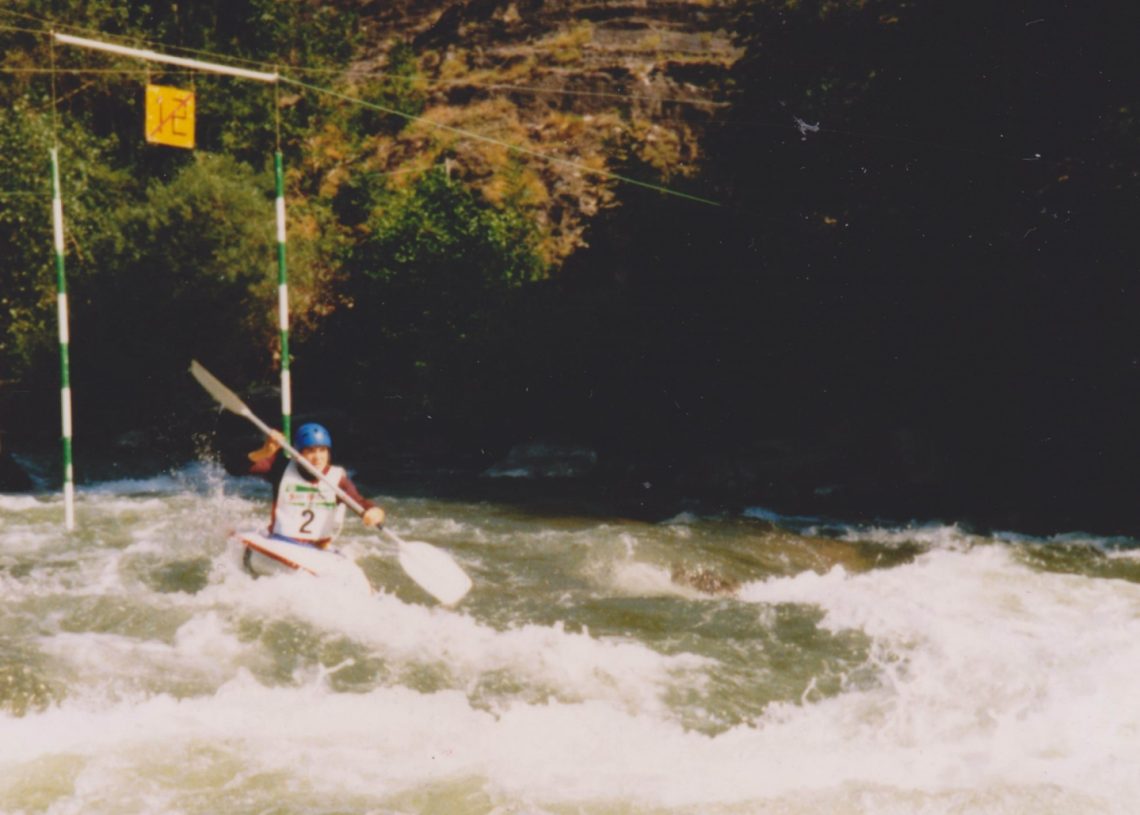
Initially the rapids terrified me. I’d avoid risks and stay away from the biggest waves, fearful that I’d capsize and have to bail out. In frustration at my dithering, one of my teachers pushed me into a large “stopper” – a standing wave resulting from water cascading over a barrier. That would probably be a sackable offence today, but I stayed upright, surfed across the wave and popped out the other side with new found confidence. I went on to race in slalom and white water races around the UK.
Through kayaking I learned that the shortest line down a river is not necessarily the fastest. Water tends to flow faster around the outside of a bend than the inside – knowledge that has come in handy on several river swims. I also put into practice the vectors I was learning in maths. In a fast flowing river, you can’t cross directly, but need to angle your kayak upstream. And you need to do the same if you want to swim across (see my training article this month for more on this). Finally, I learned to spot and avoid the unique hazards in rivers, from being pinned against boulders or bridge piers, to getting trapped in riverside branches or at the bottom of weirs.
The love of rivers I developed through kayaking has stayed with me now I do more swimming than paddling. Rivers are special places to swim but present different challenges and risks than lakes or the ocean. All open water is dynamic and changeable, but this is especially true in rivers. To the uninitiated, they can be intimidating. Mature rivers, deep and wide enough for longer swims, are often silt-laden, meaning the water clarity is less than in lakes and seas. Some, such as the Thames or the Elbe have been terribly polluted by industry and agriculture in the past and still carry a stigma, despite now often being clean enough for swimming.
I’d urge you to find your nearest swimable river, learn its ways and moods, and swim when it’s safe to do so. If you can, try paddling or rowing on rivers too. You will learn a lot. Or at least speak with other river users and learn from their experience. The more we use and understand our rivers, the more capable we are of both enjoying them and defending them.

Simon Griffiths
I started Outdoor Swimmer in 2011 (initially as H2Open Magazine) as an outlet for my passion for swimming outdoors. I've been a swimmer and outdoor swimmer for as long as I remember. Swimming has made a huge difference to my life and I want to share its joys and benefits with as many people as possible. I am also the author of Swim Wild & Free: A Practical Guide to Swimming Outdoors 365 a Year, I provide one-to-one support to swimmers through Swim Mentoring and I'm the creator of the Renaissance Swimmer project.