Swimming the shires west of London
Register to get free articles
Want unlimited access? View Plans
Already have an account? Sign in
Philip Nice, author of the new book Wild Swimming Walks Thames and West, shares his five favourite walks with wild swims along the way
The shires to the west of London are comfortable lands: cosy and bucolic, with gentle hills and a patchwork of lush fields that, for many, represent the quintessence of the English landscape. Their villages and towns preserve historic buildings and traditions, while remaining close to the capital’s influence. The rivers are ideal for swimming: being low-lying, they often run slowly and deeply. The coastal inlets offer fine options too, and the dense path network takes one deep into the countryside while rarely being far from a pleasant hostelry.
Olney circular
A six-mile amble through the historic town of Olney and a family-friendly country park, then across the Ouse valley fields to a famous traditional bathing place, with the chance of discovering rare tomb sculptures and a community-run pub. From the marketplace, with its inviting cafes, you pass the museum dedicated to the local poet Cowper and abolitionist Newton (himself a slave until his crewmates sold him). A pool in the river offers the first dip, with a view of the church where the renowned Pancake Race finishes. The prize is now cash, rather than a prayer book and a kiss (the race is women-only). After Emberton Country Park, with its playground and ices, comes an interlude of proper countryside, climbing to a vista over the town and an optional detour to Clifton Reynes, with its wooden tomb figures and welcoming Robin Hood pub. Then descend to the delightful terraced bathing place before heading back into town.
Windsor & Eton circular

This 8½-mile walk through royal and aristocratic history takes you through the heart of Windsor, along the artfully landscaped Jubilee River, and back via a stretch of the Thames where generations of Eton schoolboys learned to swim. From the station, wend your way past reminders of royal affections – the late Queen’s corgis in statue form, the home of Charles II’s mistress Nell Gwynn – to Windsor Castle, the epicentre of royal power since the 12th century. Next, enjoy the iconic view of the castle from the north bank of the Thames, followed by Eton College, the infamous ‘prime minister factory’. Fields lead to the Jubilee River, a disguised overflow channel, where in its more arcadian parts, families cheerfully ignore the occasional ‘No Swimming’ sign. Then, return to the Thames at the atmospheric St Mary’s Church, where gaps in the riverside vegetation beckon. The route finishes past what once was a hierarchy of Eton bathing places.
Bursledon to Hamble

A 2½ mile loop to the sylvan River Hamble Country Park, best at high tide, and a 6½ mile walk bursting with maritime heritage beside the River Hamble and Southampton Water, can be combined for an ozone-filled day out. From Bursledon station, head first to the upper reaches of the Hamble. Here, secluded little beaches are ideal for a high tide swim. Furthermore, a floating jetty provides access to deep water even when the muddy banks are exposed, and is great fun to play on. (There is merely a caution against swimming from it rather than an outright prohibition.) To continue the walk, follow the sinuous causeway along the Hamble opposite plutocrats’ yachts, and cross on the luminously pink ferry. The England Coast Path leads past beaches where you can gaze at tankers and liners, to what was once the ground-breaking Royal Victoria hospital. Behind the Cedar Tearooms, a disused railway takes you to Hamble station.
The Cherwell, Oxford to Sunnymead

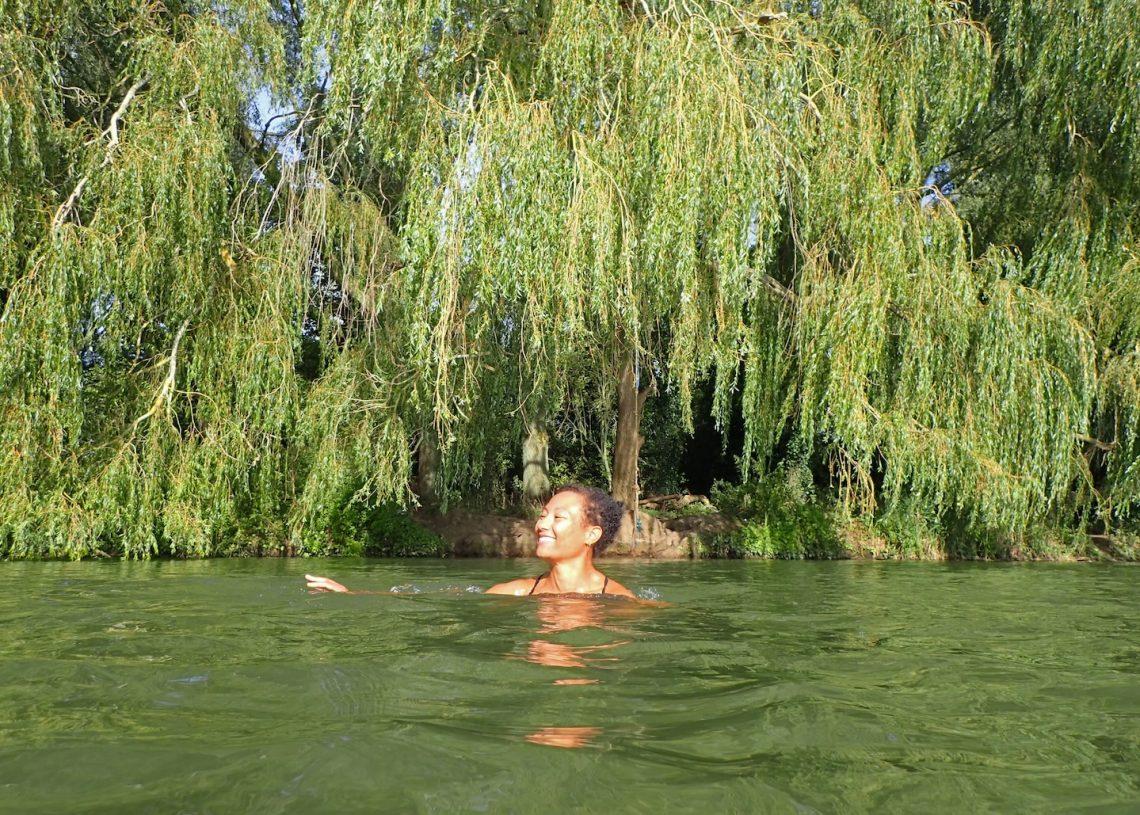
An easy walk of historical interest, following one of Oxford’s famous rivers through parks and meadows, with many memorable swimming spots to choose from. Leaving Oxford station, the route passes some of the city’s best-known landmarks before arriving at the River Cherwell in the beautiful University Parks. Here, a riverside bench commemorates The Lord of the Rings author, Tolkien. The Cherwell, a smaller, gentler river than the Thames, has long been popular for punting, picnicking and swimming. The route first meets the Cherwell at the site of two former formal bathing places, now demolished: the legendary Parsons Pleasure, famous for nude bathing by men, and nearby, Dames Delight for women. After an optional detour to secluded pools downstream, the route heads upstream, under ancient willow trees, passing a delightful riverside pub before reaching the final swimming spot in Cutteslowe and Sunnymead Park. This is the site of another historical bathing place, where a few remnants survive, including steps down to the water.
Buckland circular

A peaceful 7-mile walk from an exceptionally pretty village, including one of the remotest parts of the Thames Path, with many places for a quiet swim. Buckland looks like an archetypal old English village and yet feels like a living community. It has a welcoming pub, the Lamb Tavern, and an impressive 12th-century church. The route leads downhill to a delightful first swim at Tenfoot Bridge, a wooden, arched footbridge. It then follows the Thames Path upstream, where the river meanders between reedy banks, passing Chimney Meadows, former water meadows now a nature reserve, full of wildflowers. After some willow groves, marshy areas, and more possible swimming places, it arrives at the popular Trout Inn and 18th-century Tadpole Bridge. Further on, at Rushey Lock, there is an option of continuing to a particularly attractive swimming place where the river runs deep and offers good diving from the bank. Finally, the route returns through fields to Buckland.
Philip Nice is author of ‘Wild Swimming Walks Thames & West of London’, published by Wild Things
Publishing (£14.99). Readers can receive 25% off and free P&P with code OSM26