Environment,  EXTRA,  July 2023,  Premium

Common Minke Whale

Register to get free articles

No spam Unsubscribe anytime

Want unlimited access? View Plans

Already have an account? Sign in

Susanne Masters introduces us to the Common Minke Whale (Balaenoptera acutorostrata), a ‘small’ whale that reaches 8-9m long. 

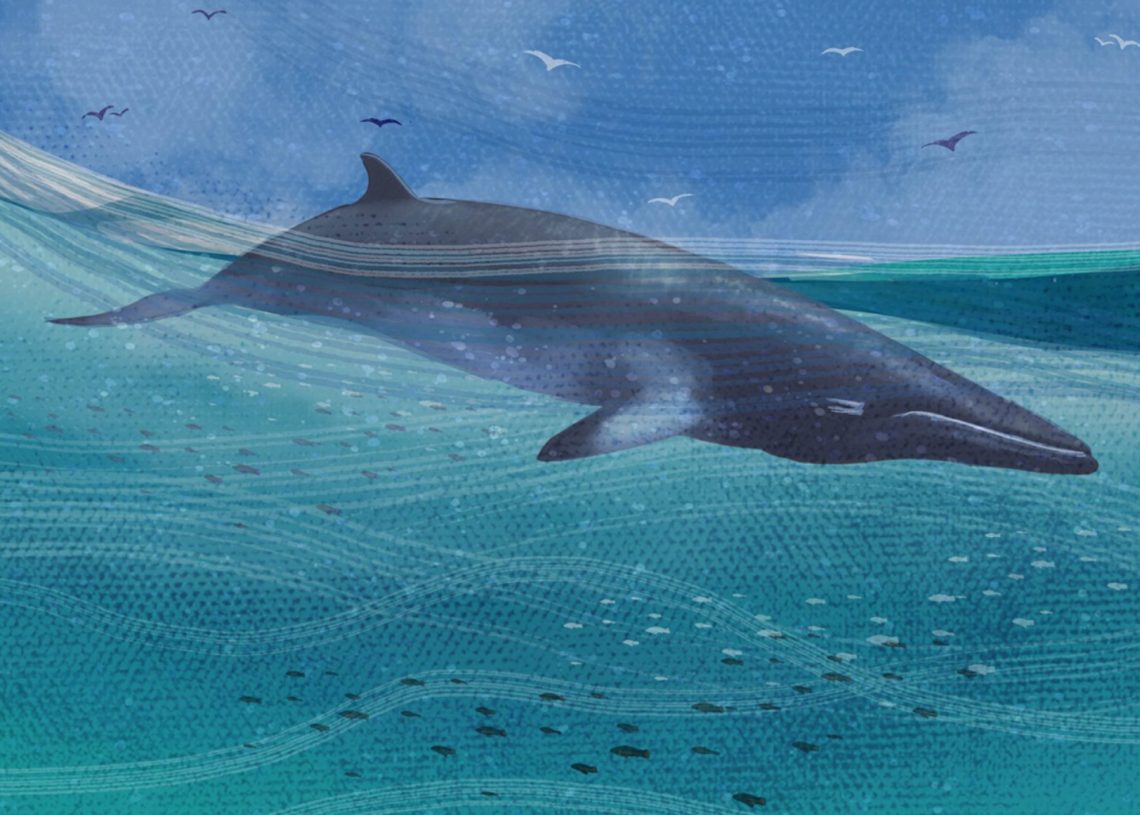
I first saw minke whales when travelling on a boat between islands in the Outer Hebrides with a pod of swimmers. Weighing in at 5-10 tonnes, Minke are considered to be small whales. They do occasionally leap out of the water, but from a distance you’re more likely to see them in segments. Their surfacing roll is fast. After a glimpse of their snout and a small cloud of blow as they exhale, their back slides up out of the water, and towards the end you can see their hooked dorsal fin. Then the base of their tail slips out of the water and the minke whale is completely submerged again. They don’t display their tail flukes when they dive down. Close-up a distinctive characteristic of common minke whales, distinguishing them from other regional variants of minke whale, is white marks on their flippers that look like white arm bands. 

Because minke whales were considered small they weren’t hunted as much as other whale species during the peak of the global whaling industry. However, they are hunted today for their meat. Iceland’s whale hunting licence holders have hardly used their quotas in recent years. 

Since Japan’s return to commercial whaling in 2019, the import demand from Japan has decreased. Iceland is planning on ending their whale hunting in 2024. Norway’s whale hunting continues, with export to Japan and some local consumption. Demand for whale meat is waning in Norway. Falling demand for eating their meat and increasing numbers of people going on whale watching trips are economic drivers that may continue to diminish minke whale hunting.

Where to see minke whales

You are most likely to see minke whales when you are on a boat, on the way to or from an island or peninsula. You can also see them from land as they frequent water that is 200m or less in depth. There are reported sightings throughout the year, but much more of them from May to September.

  • Blasket Islands, Dingle Bay, Co Clare 
  • Whitby, Yorkshire
  • Tobermory, Isle of Mull, Inner Hebrides 
  • South Stack, Anglesey

Illustration: Alice Goodridge

Stay up to date with The Dip, our free weekly outdoor swimming newsletter.

Outdoor Swimmer is the magazine for outdoor swimmers by outdoor swimmers. We write about fabulous wild swimming locations, amazing swim challenges, swim training advice and swimming gear reviews.