

Let’s play
Outdoor swimming is inherently spirited, joyful and fun, helping us connect with our childhood selves, with nature and with our communities. Rowan Clarke finds out why childishly playing in the water is the tonic we all need.
Among our most amazing open water achievements – channel crossings, ice-miles, world records – play is never far from the surface. From serious endurance swims to frolicking in the waves, outdoor swimming is inherently spirited, joyful and fun. This playfulness connects us with our childhood selves, with our communities, with nature and the environment and brings so many benefits at every level.
But this playfulness isn’t just downtime or a frivolous by-product of swimming outdoors, secondary to ‘proper swimming’ and athleticism. Playing is incredibly important for our self-confidence – even as adults. Tapping into our inner child, harking back to our childhood, feeling small, finding joy and wonder and having fun not only makes us feel good, but it’s also laden with value. So, why is it so important that we make time to play in the water?
Going out to play
Defining play is a good place to begin: ‘Play is not just about having fun but about taking risks, experimenting, and testing boundaries,’ according to the American Academy of Pediatrics. This definition is about children, but the same is true for adults. Think about swimming outdoors; taking risks, experimenting and testing boundaries is exactly what you’re doing each time you swim.
“The expectation is that you become an adult and you stop playing, you stop having this freedom to do unstructured stuff. You’re told that there are lots of rules and regulations in your life that you have to adhere to,” says Dr Michaela James, Research Officer in Play and Physical Activity in Swansea. “So, the idea of play gets completely removed, but it’s so important. Through playing there are so many things that you encounter – the idea of failing, resilience, and having that freedom to do whatever you want without being refereed by anyone.”
Presented with a body of water, you have freedom to explore, adventure and move in whatever way you choose. That’s quite unusual in adult life where we’re used to conforming to both explicit and unwritten rules. It pushes you to test boundaries. Not just physical boundaries like coping with the cold or waves or swimming a long distance, but also social boundaries, those societal expectations that structure our lives.
“I see it as a tiny act of rebellion that I can do every single day that really counters all the narratives and stereotypes I’ve been bombarded with my whole life,” says Michaela. “I just love the idea of like taking down all those stereotypes; you’re told what to do and how to behave all the time. But play gives you this opportunity to stick two fingers up to that.”
That rebellion against societal expectations might be small and quiet, but it’s very powerful. Skinny dipping, screaming and whooping, swimming to a hidden cove, completing a swim that’s not expected of someone of your age, sex, body size, body type or background. It can bolster your self-confidence, make you feel strong, brave, happy, or simply give you a break.
Making friends
In the Yorkshire Dales, Johnny Hartnell spends a day every week stepping away from adult responsibilities and immersing in nature. Living a few steps from his childhood playground where he grew up, he travels between the Dales and the Lakes to swim and adventure with friends every week. For Johnny, that sense of escape, fun and play is a huge release.
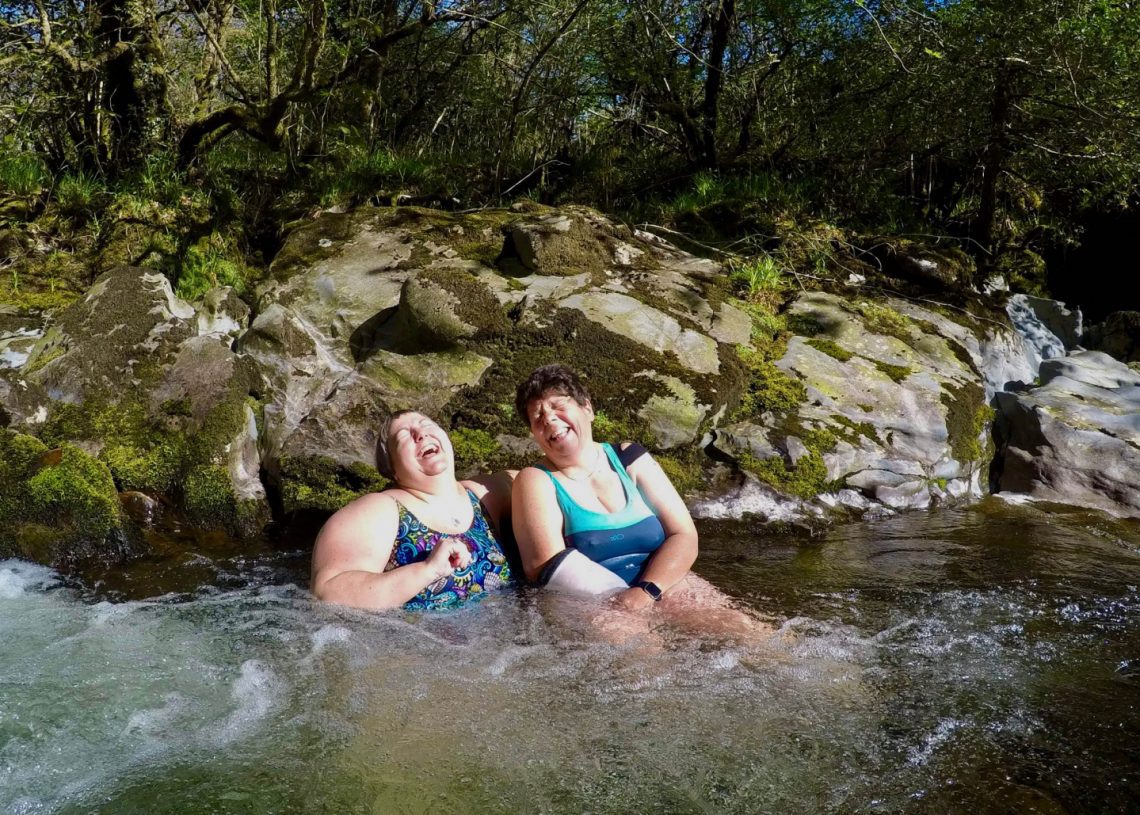
“It’s like that sort of playground mentality – people use that word ‘banter’, but it’s that bonding,” he says. “A whole lot of faffing takes place. And the giggles start from everybody getting together. When we’re sharing that space, it’s that release, the laughter. You can just relax, be yourself.”
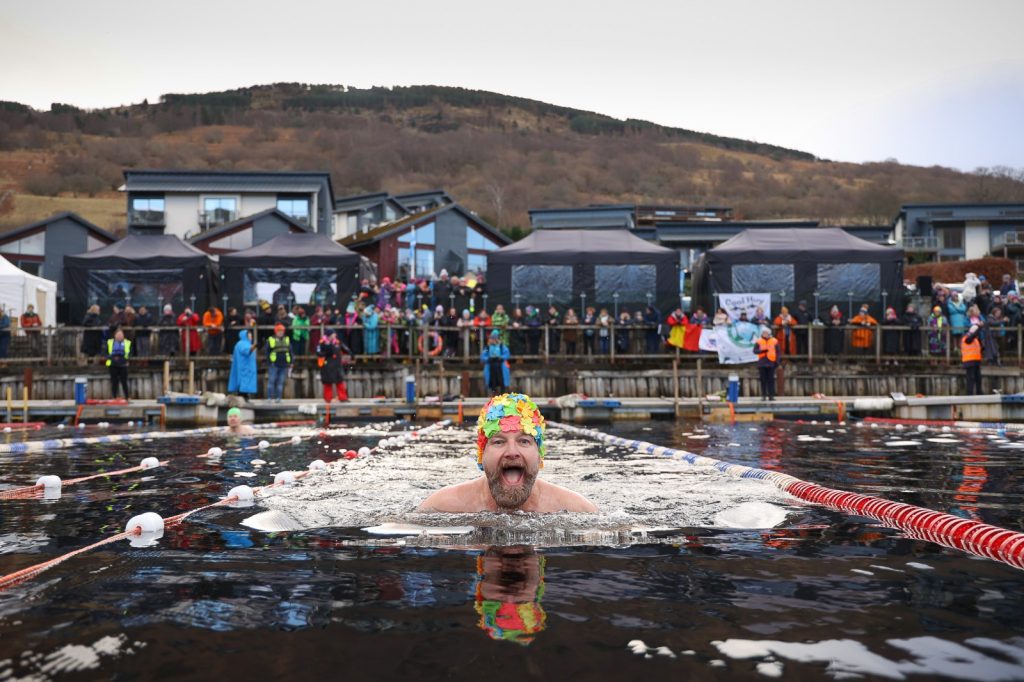
We know many outdoor swimmers cite their community as a major factor in their love of the activity. But how we bond with each other as swimmers is very interesting. As Johnny says, it’s that playground mentality, or a deep nostalgia for uncomplicated, playful relationships, that cast our swimming friendships into a different category from other relationships. They transcend age, gender and background by tapping into a bond built from implicit trust and shared interests.
What makes this bond especially interesting is the way it forms between swimming strangers. Reminiscent of the holiday friends you made on a French campsite as a child, you can bypass the adult small-talk and get straight into it with people you’ve never met before – you like swimming, I like swimming, let’s go.
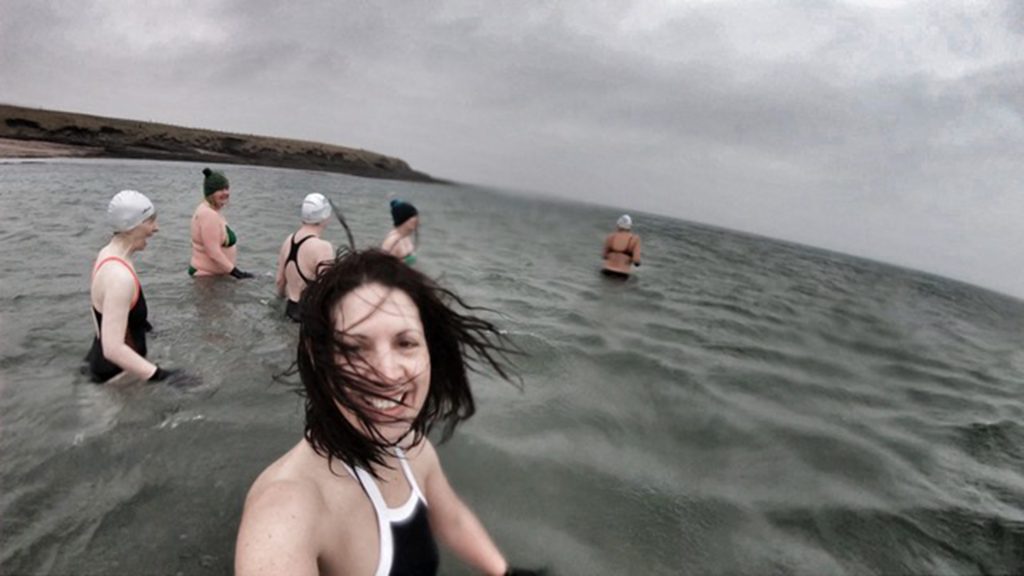
“You meet a random bunch of strangers, and the water’s just bonded everybody together,” says Johnny, who took his wife to swim with a group of people they didn’t know for summer solstice. “There were 67 people at the solstice sunrise swim and before you know it, you’re just bouncing around in the waves, giggling and laughing with somebody – you’ve not got a clue who they are. And we might never meet each other again. But those moments and those memories are just phenomenal.”
Let’s go on an adventure
Part of the reason we bond so deeply with our swimming friends comes from the risk-taking, experimenting, boundary-testing element of play-swimming. As we grow up, not only are we told to stop messing about, but we also become more risk-averse, aware of danger which can make us overly-cautious. But, when we swim together, we embolden each other to make space for taking more risks – and that brings huge personal benefits.
“You have a bit of risk and challenge, crossing a lot of boundaries in your own mind and I enjoy that. That’s my sense of adventure,” says Norma McCleod who runs Immerse Hebrides. “Growing up here, we were always told, don’t go into the sea because there’s been a lot of tragedy here, going back to the First World War even, and because it’s a small island, people don’t forget tragedy. And then, all of a sudden, here we are having fun and frolics in the sea, heading off away from beaches and round headlands. I think for local people here, it’s given them a new lease of life. The home that they grew up in has suddenly become an adventure playground.”
So, what’s the advantage of taking risks and pushing boundaries? The simple answer is growth. Beyond childhood and adolescence, adulthood can seem like a fixed, immutable state. But continual growth and development enables us to be more resilient, to bounce back from setbacks and failures, learn from our mistakes and, in turn, that helps us cope better with tough times.
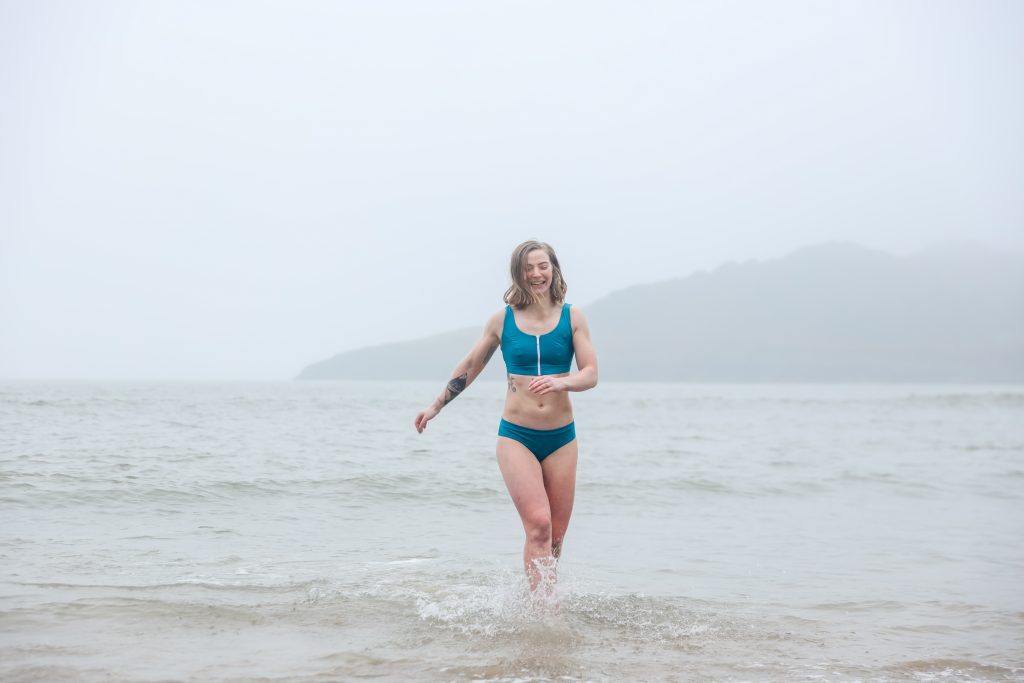
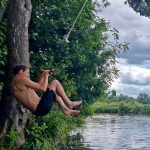
As outdoor swimmers, pushing out of our comfort zones and challenging ourselves is a huge part of what we do. Sometimes that does feel like playtime – jumping off rocks into deep pools, skipping over waves, but it can also feel like adventure or challenge. As we always take risks, experiment with our physicality and test our physical, mental and societal boundaries, even the most serious forms of swim training constitute as risky play.
“The benefits of risky play are getting a lot of airtime at the moment because if you introduce it to children when they’re small, they can use it to solve problems, for character development, to navigate the world while also having that level of risk that we’re so terrified of,” says Michaela, who runs a group for teenage girls called Girls to the Front. “So, with teenage girls at the start, they’re a bit like, I’m told not to do this. I’m told I need to act in a certain way. But the minute you give them that freedom, you see a totally different side to them. They lose those expectations and just become themselves and it’s just awesome.”
Our childhood selves
In the same way, outdoor swimmers say that immersing themselves in open water makes them feel like themselves. This could be because it somehow fosters a connection to our childhood selves when we were less constrained by rules and expectations. Perhaps this comes from a nostalgia for our past experiences, or because when we’re in nature, we strip away the many, complicated layers of adultness.
“I grew up in here the Lake District and I have pictures of me as a toddler in lakes. I also went to a school that had an outdoor pool that was never heated and was full of leaves,” explains Laura, who’s training to swim the English Channel. “I always think when I’m swimming, I feel like me now because as a kid, that’s what I did. I still feel like that in a pool. I still feel like that in a training session. It’s what comes naturally.”
That core sense of self is fascinating. Psychologists refer to it as the inner child, the subconscious part of you that holds memories, emotions and beliefs as well as dreams for the future. So, when swimming outdoors helps you tap into your childhood memories or emotions, that can be incredibly valuable to your sense of self and therefore your self-esteem, confidence and true values.
“I just get this magical energy, like this special feeling inside,” says Tam, who runs The Wild Swim Store with her brother Jay. “Because we grew up swimming, it’s this kind of muscle memory that makes you feel, this is where I am, this is who I’m meant to be. Knowing that has been really important for my health; finding your true self and really trying to connect with that. It’s always felt like a bit of a secret weapon.”
A sense of wonder
For author Wyl Menmuir, it’s also about the awe and magic of nature. Travelling around Cornwall and the Isles of Scilly, he tried out many different ways of playing in, on and under the sea for his book, The Draw of the Sea, engaging with those childhood feelings of amazement and wonder.
He has experienced wonder in so many ways, from being joined by a dolphin on a dawn swim near St Ives to encountering a playful seal while free-diving near Falmouth. But, his experience that best sums up that feeling of pure awe, was while at a literary event in St Mary’s on the Isles of Scilly, when a swimmer invited him to join her group for a night swim at Porth Cressa beach.
“She just said, right, we want you to dive down into the water and just wave your arms around. So, I dived down and it was like fireworks – there was phosphorescence everywhere, like little fireworks coming out at the ends of your fingers,” he says. “We were swimming, splashing, playing, getting people to dive down and splash around in the water. And then the most magical thing was diving down seeing all this phosphorescence and then coming back up to the surface and lying back looking at the stars.”
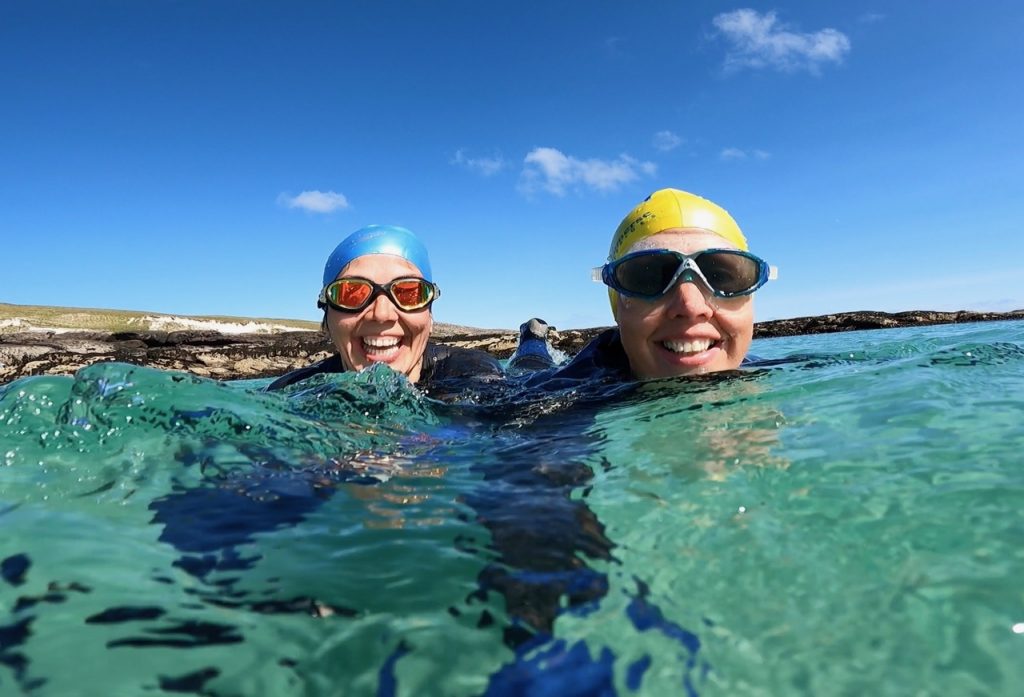
With a sense of awe comes a sense of perspective. As outdoor swimmers, we find the sheer size and majesty of natural bodies of water helps us to step back from our own troubles. We seem to take comfort from being made to feel smaller, more simple and more insignificant in the grand scheme of the world.
Again, this is about connecting with our inner child. Our response to being in the sea is intensely emotional and this translates into our adult lives in many different ways from inspiring creativity and social connections, to becoming coaches and swim guides or taking on adventures and challenges.
It also taps into the part that dreams for the future. For Wyl, as for so many outdoor swimmers, divers, surfers, sailors, the wonder and awe he’s felt from being by the sea has stoked a passion for protecting it from pollution and exploitation.
“Whether it’s swimming or free-diving or surfing, when you experience that joy you might then want to do something about protecting that environment,” he says. “Because you realise it’s doing so much for us, and it’s such a special place regardless of whether we’re there, you then feel compelled to do something about it and if there’s something I want from the book, that’s it. I want people to then choose to protect the thing that they love.”
Children of the future
Perhaps, if we could all tap into our inner child and see the world afresh with awe and wonder, we would be better placed to protect it. But, from large-scale environmental benefits, through social bonds to individual benefits for self-esteem and mental health, what is clear is that growing up isn’t all that.
“Even the people who are surfing at the highest level, really what they’re doing is playing,” says Wyl. “What we’re doing when we go down to the sea is playing and it reminds us that we’re playful creatures. I think so much of life tries to teach us that life is serious and intense and we ought to be stressed, but when I’m in the sea I don’t think about those things.”
We’re onto something, outdoor swimmers. So, let’s keep on marvelling at how big the sea is, let’s keep on whooping and screaming into the water, let’s make space for fun, let’s be silly, free and full of joy. Let’s play.
Photos: Deakin & Blue, Jumpy James Photography

Outdoor Swimmer
Outdoor Swimmer is the magazine for outdoor swimmers by outdoor swimmers. We write about fabulous wild swimming locations, amazing swim challenges, swim training advice and swimming gear reviews.