
August 2023,  EXPLORE,  EXTRA,  Premium

Sea pool sanctuaries

Register to get free articles

No spam Unsubscribe anytime

Want unlimited access? View Plans

Already have an account? Sign in

Architect, urban swimming expert and now author, Chris Romer Lee has made waves in outdoor swimming for a decade and this month his book, Sea Pools: 66 Saltwater Sanctuaries from Around the World, is published. Ella Foote met Chris at his daily swimming spot, the London Serpentine.

Back in 2013 Chris Romer Lee accidentally designed a tidal pool for the River Thames in central London. A decade later the Thames Baths project is ongoing and Chris is now an urban swimming expert with a new book about sea pools published this month. “I have always loved water,” says Chris. “I realised this when I started the Thames Baths project. My parents always took us on holiday where we were in or around water. None of us are massive swimmers, but we always loved the water. It wasn’t conscious but wherever we were, Cornwall or Central Europe, we always ended up at the water.” 

Chris is an architect and co-founder at Studio Octopi, an architecture practice that works on residential, commercial and public projects. In 2013, Chris responded to an open call from the Architecture Foundation for ideas to develop Thames Bank at Blackfriars in Central London. “I was on holiday in Zürich, Switzerland, at the time of the open call,” says Chris. “It was bonkers, people swimming in Lake Zürich in the city. Why can’t we do that with the Thames in central London?”

Chris designed the Thames Baths as a response to the open call aiming to reconnect Londoners to the River Thames. The plan included a swimming place on a floating dock with enclosed sections of river water refreshed and filtered by the tide. “I hadn’t realised that I had designed a tidal pool back then or properly engaged with the idea that there are loads of them around when you start to look,” he says.

“Fast forward seven years and I have become more interested by these constructions along the coast and started to realise they were everywhere. They were also overlooked and taken for granted. If you look at Walpole Bay tidal pool in Margate, Kent as an example, the engineering to construct that is brilliant. The largest in the UK, it is enormous and made with concrete blocks which are interlocked with railway sleepers to hold them together. The geometry is brilliant too. When you stand at the top of the prom looking down it looks like it gets narrower as it goes out to sea but then looking back from the shore, it looks square because the perspective works the other way. It is a wonderfully complex piece of engineering.”

Making sea water dips more accessible

Chris started collecting more and more information about sea pools and around the same time a new book came out about lidos, their history and design. “Christopher Beanland’s Lido was a cool book, I did a review of it for Architecture Today,” says Chris. “It got me thinking about a similar book for tidal pools, so I pitched the idea to the publisher, and they replied within a week to say yes! That was how it all started and then it was all about research, which I really enjoyed.”

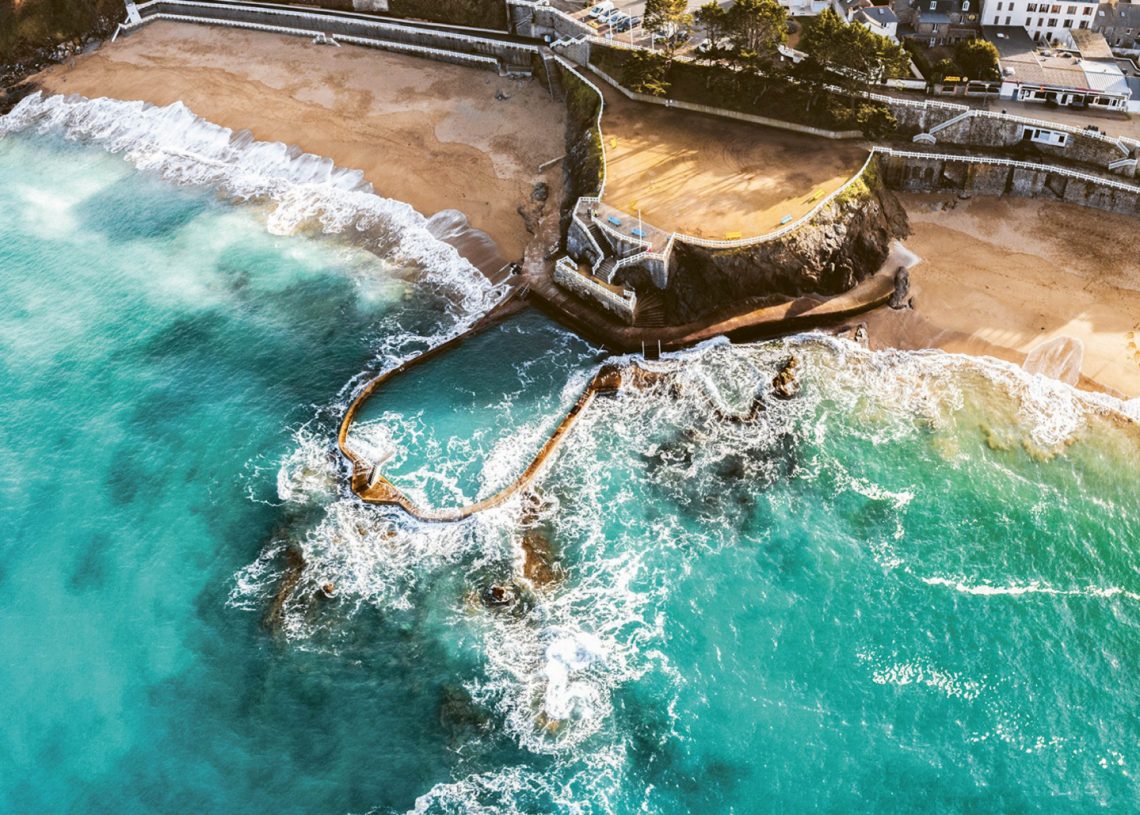
After some thought about focusing on the UK it quickly became a global book, with some places easier to research than others. Australia had a decent archive but places like Portugal not so much. “I couldn’t believe how many I found on the west coast of France,” says Chris. “I knew about pools along the coast at Normandy and Brittany, pools like Saint-Malo, but they just keep going. At first, I thought it was bonkers but I soon started to understand why they were built and where they were built. Tidal sea pools are built where the coastline is difficult and a challenge to get into the water, Cornwall is a good example. Or they are built because you have a large tidal movement, so a pool will capture the water and makes the location a tourist destination and more accessible. The third reason is where there are dangers in the water like sharks, riptides and jellyfish, Australia and South Africa are good examples.”

I tell Chris that when I was a kid the idea of a tidal pool horrified me, they were something that captured everything that came in on a high tide and swimming in one would guarantee unwanted encounters with wildlife. But this is exactly the beauty of sea pools, they are a space to engage with nature. “When I spoke to Lisa Beasley, an environmentalist in South Africa, about St James tidal pool in Cape Town she explained how she has campaigned to stop local authorities using chemicals to clean the pools and toxic paint at the bottom of the pool and the edges,” says Chris. “She explained that these pools are a chance to see what’s happening in the sea and below the surface, especially for kids. Now cleaning has stopped at a number of famous pools, they have come alive. Rainbow coloured fish and creatures live there, so kids come down to use the pools for snorkelling and science classes, not just for leisure. They provide a place to look at the sea safely.”

The next generation of sea pools

It is ideas like this that inspires Chris to consider what the next generation of tidal pools might be like. Chris and Studio Octopi have been integral to the future of outdoor pools in the UK and across the world. “Architecturally they can provide more than just a place for leisure,” says Chris. “Like Shoalstone Seawater Pool in South Devon, which is heavily painted and in need of investment. What would it look like if you just let it go a bit? If it stopped trying to look like a pool and became more natural? Do you get universities and other educational opportunities? We are having similar conversations with a tidal pool on the Isle of Wight looking to offer exactly that, providing more than leisure but education too. The same with Devil’s Point pool in Plymouth, if the city council invest in it why not make it marine park for rock pooling and swimming?”

Chris’ passion for outdoor pools and urban swimming has led him to form a Future Lidos network with Michael Wood of Northumbria University and Tynemouth Pool and Deborah Aydon of The People’s Pool. The group was inspired by the National Lido Conferences convened by The Lido Guide authors Emma Pusill and Janet Wilkinson and is now an informal network of community-led projects and campaigns around the UK and Ireland, dedicated to reviving outdoor pool swimming in our communities. Future Lidos projects include the revival of listed heritage pools like Grange-over-Sands Lido and Bath’s Cleveland Pools. Chris and Studio Octopi are also involved in the restoration of Saltcoats Bathing Pond and Tarlair Outdoor Pool in Scotland. “The Future Lidos group are currently creating a toolkit for future lido projects which will support new campaigners who are trying to get council or community support,” says Chris. “People will be able to get basic information about planning like how much space you might need for a 50m or 25m lido, it will give people a starting point. We want to empower communities to put forward campaigns to their local authority.” 

Pool restoration isn’t where Chris imagined he would find himself when he explored studying art when he was a young adult; and when Chris first started dipping his toe in pool restoration, he still needed to consider the fact that Studio Octopi was a business. “I have spent a lot of time talking to campaigners about what the possibilities are, sometimes these turn into paid work projects,” he says. “It isn’t big business, but there is a change happening. There is a new focus on blue spaces and outdoor pools which makes the future potential massive. With Future Lidos we have all these people around us who are buzzing with excitement and sharing information. There are communities making progress, you just need to look at the success stories.”

Sea Pools by Chris Romer-Lee is published by Batsford and is out 3 August.

Photos: Piscinas Naturais De Porto Moniz, Madeira, Portugal; Massimo Vitali (main); Tunnels Beach Tidal Pools, Ilfracombe, Devon; Aga Tomaszek Photography; Chapel Rock, Perranporth, Cornwall; Carl Brightman; Piscine D’Eau de Mer de Saint-Quay-Portrieux, Brittany, France; Thibault Poriel.

Stay up to date with The Dip, our free weekly outdoor swimming newsletter.

Ella is renowned outdoor swimmer and journalist. As well as leading the editorial, digital and experiential outputs for Outdoor Swimmer she is also Director of Dip Advisor, a swim guiding business helping people enjoy wild water. Ella also teaches swimming to children and adults, is an Open Water Coach and RLSS Open Water Lifeguard.