A Life Aquatic
Hannah May shares her memories of swimming as a family and discusses the merits and methods of introducing young children to open water.
The word ‘connection’ has become synonymous with wild swimming. All of us who immerse our bodies into the liquid outdoors are hyperaware of the sense of connectedness it affords, whether with nature, others, or our self. But there’s another way to connect while in the water: with family.
For me, swimming in any aquatic space – especially outdoors – has always been a family affair, one that combined learning to swim with discovering the natural world in a way that was entirely organic, and left a permanent imprint.
My earliest memories are watermarked. Family trips to the beach on weekends, after-school dips with my four siblings off our town’s Battery Rocks, plunges into the river of the valley where we walked the dogs with our grandparents, sinking into the leafy green of the lake with our dad; the aquatic landscapes of my youth were myriad, and sewn into my being from its start.


Our culture and topography demanded that we swim. Being Cornish and surrounded by the ocean meant that sea swimming was something that us locals simply always did. The sea was a space of creative – as well as physical – mobility and abandon. Storytime was saturated with Cornish fairy tales and aquatic nymphs like the Mermaid of Zennor, Bucca, the Lost Land of Lyonesse and the Lady of the Lake. Growing up, the otherworld and underworld rose to the surface of the water: the realm of fun, imagination and discovery, and where much of our Cornish sense of community, of wider family, resides.
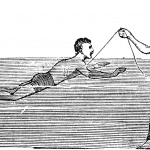
Like walking, or talking, I don’t remember learning to swim. Our family tradition of teaching your own meant that my parents and grandparents lovingly took the helm. My thirst and affinity with water began at babyhood and now filters into future generations through my role as a Swim England teacher of babies, toddlers and children – including my own.
The benefits of swimming as a family
Starting outdoor swimming at an early age, especially with an emphasis on family, has a host of benefits. It generates respect and trust (between child, guardian and the water), confidence (both of water and body), bonding, strength, resilience and safety, all of which morph into what we – as adults – experience every time we take the plunge: mental and physical wellbeing.
An ability and desire to swim becomes normalised. Nothing was – or still is – more natural for us as a family than to go swimming together, anywhere and at any time. Precious and joy-filled moments shared with since departed family members that I can connect to still whenever I drift through open water. Anodyne for my grief and memory-making with my own children, who have inherited the same innate passion and skills of many an aquaphile before them.
Yet it doesn’t matter whether you have ready access to open water or come from a swimming family, since the heart of swimming is, as with many things, a love for it.
I’m often asked at what age children can be introduced to outdoor swimming, and though opinions vary, there are no definitive rules or guidance on when to do so. Current NHS England advice states that: “You can take your baby swimming at any age, both before and after they have been vaccinated”; which might imply, but doesn’t specify whether this applies to just the pool, or also includes outdoors.
Either way, I’d definitely recommend baby, toddler or child swimming classes indoors as soon as possible. They’ll develop the range of core aquatic skills (eg, buoyancy, balance, breathing) needed for outdoor swimming, and you’ll learn how to safely hold and support them in the water. Many of my in-class activities are transferable – taking the skills, confidence and positivity of learning to swim outdoors.
Babies and the ‘swimming reflex’
Babies instinctively possess the ‘swimming reflex’, whereby if placed belly-down in water (with their head up) they’ll automatically move their arms and legs in a swimming motion. Moreover, the embryonic quality of seawater (amniotic fluid has about 2% salinity, oceans about 3.0-3.5%) makes it the perfect transitional space from womb to world. You might also have heard of the ‘dive reflex’ where babies can hold their breath underwater if prompted correctly, though this diminishes at about six months and isn’t helpful when learning to breathe aquatically, which requires them to exhale safely underwater instead.


Some organisations and paediatricians don’t recommend open water to babies under two (or even six) months due to their lack of immunity against oceanic bacteria. An opposing school of thought advocates exposing infants as young as possible to natural spaces and their microbes to bolster immunity. I’d argue that if they’re not imbibing the water, it’s perfectly safe to slowly introduce their bodies (not faces) at any age. For example, I dipped both my daughters’ legs in seawater at about the ten-week mark – though it was during warm late springtime days, so you need to consider the water and weather states, as infants can’t thermoregulate.
Some three-month-olds are weighty and robust, while premature babies will be smaller and more vulnerable. So after factoring in their size, health and the external conditions (especially water and air temperature), I’d suggest starting by placing them in an upright position with skin-to-skin contact sitting against your chest for a quick foot, leg or lower body dip, and progress from there. Consistency is key, along with positive reinforcement (lots of eye contact, ‘oohing’ and ‘aahing’) and allowing them, whenever possible, to (safely) take the lead. Note: submersion should always be child-led, and you should never forcibly dunk infants underwater. (And please avoid self-rescue swimming).
Bath (and shower) time is a brilliant way to promote children’s water literacy and build toward outdoor swimming. Experiment with cooler and deeper water to help them become more comfortable and acclimatise to exposure, and to practise their core aquatic skills.
Seek out warmer outdoor water, such as while holidaying abroad, or via shallow, sun-trapped paddling and rock pools, and tepid rivers. Be suitably prepared for the environment with wetsuits (though I remain a firm believer in nude bathing, whenever appropriate), blankets, sun lotion and provisions. Feeding little ones post-swim is a good idea. Warm milk and cradling will heat them up and send the perfectly restorative and supporting message of calm.
Focus on fun and creativity
With my daughters I focussed on fun and creativity. They’d have cool bucket baths outside in summer, would strip off and wallow in the waterline during winter beach walks, and paddle in the river in spring. Even puddle jumping on a freezing day allowed them that thrilling (if minor) cold shock feeling. It didn’t take long for them to magnetise toward the water’s edge, where we’d constantly monitor them from sitting and splashing to wave jumping, doggy-paddling and now – aged five and seven – gleefully swimming at every opportunity.
Always remember that safety is the priority. Take a gentle approach (don’t force them in the water if they’re resisting or unwell) and choose clean water with calm conditions, which you should test first for hazards (eg, jagged rocks, currents). Exercise caution at all times, and never leave children unattended in or near water. Drowning remains one of the leading causes of death in under-fours (and ages 1-14) globally; and is a risk even for competent swimmers. Remain in your depth and be vigilant for changes in environmental conditions – as well as in your child’s behaviour or appearance, which could be a warning sign of hypothermia.
The legacy of being present and proactive in our children’s outdoor swimming journey – of the gift of our undivided and ‘unplugged’ attention – is a powerful one. I feel as connected to my childhood and family now as ever, the sea-blue tint in my daughters’ eyes revealing snippets of swimming time past, and of many futures yet to come.
Hannah May is a Cornish writer, swimmer and swimming teacher born, raised and living in the far west of the county. She is an ex-national level competitive swimmer, ‘lifer’ sea swimmer, and specialises in teaching aquatic pre-fundamentals. See Swim Start Cornwall.
Photos: Thomas Foreman Photography, Hannah May