
EXTRA,  FEATURES,  Features,  March 2023,  Premium

Making time: a history of timekeeping

Register to get 3 free articles

No spam Unsubscribe anytime

Want unlimited access? View Plans

Already have an account? Sign in

From stopwatches and Channel hardy waterproof pocket watches to the Swim-o-Matic, a semi-automatic timer accurate to one-thousandth of a second: Elaine K Howley delves into the history of timekeeping in swimming. 

Every March, the United Kingdom and many other countries around the world, ‘spring’ forward one hour as longer days return to the northern hemisphere. While an hour might not seem like long enough to cause any real harm, this adjustment has been linked to a small but measurable increase in rates of heart attacks, strokes and traffic accidents. Clearly, a lot can happen in just an hour and during the minutes, seconds and fractions of seconds therein. But measuring those fleeting moments hasn’t always been possible.

Shrinking moments 

The ancient world’s sundials and water clocks offered a fairly good approximation of time in larger segments, but our ability to identify and track seconds and increments of seconds only began developing during the Renaissance with the invention of the first mechanical clocks.

According to the Seiko Museum Ginza, these clocks began appearing around 1300 in central Europe. Built into tall towers, these timekeepers didn’t have dials or hands, but told time with the striking of a bell atop the structure.

They had to be so tall because “a weight connected to the end of a cord would be wound up, and the force generated from the descent of the weight would be used to drive the clock. This mechanism, however, required some height.”

Replacing those weights to provide a power source to a smaller, more portable timekeeper evolved throughout the 1600s. Though much smaller, early portable clocks were still quite large and typically worn as pendants around the neck, à la rapper Flavor Flav.

If technological improvement does one thing consistently well, it’s shrinking the components; over the following century, clock mechanisms got smaller. As the concept of measuring small increments of time also gained importance among some professions, the need for more precision in a handheld package increased.

That’s what led English master horologist Samuel Watson to make an early prototype stopwatch in 1695. Built for an English physician named Sir John Floyer, Watson’s watch helped the doctor accurately measure a patient’s pulse rate down to one-fifth of a second. A stopper on the watch paused the hands, allowing the physician to ‘capture’ the instant in a way that had never been possible before.

Louis Moinet’s Compteur de Tierces

In 1816, Louis Moinet, an artist and watchmaker from Bourges, France, developed a much more exact instrument called the compteur de tierces, or counter in thirds. That watch’s internal mechanism vibrated 216,000 times per hour, good for measuring down to one-sixtieth of a second.

But Moinet’s device didn’t catch on. Instead, in 1821, fellow Frenchman Nicolas Mathieu Rieussec invented a device that measured to one-tenth of a second. It was long thought to be the first stopwatch, and came about at the behest of King Louis XVIII, who needed a more accurate way of timing horse races. It grew in popularity and became the first commercially available stopwatch.

A desire for ever more precise timekeeping in leisure pursuits grew alongside the rise of sports, and in 1916 watchmaker TAG Heuer entered the market with its Mikrograph. That stopwatch could measure down to one-hundredth of a second.

Sporting timepieces

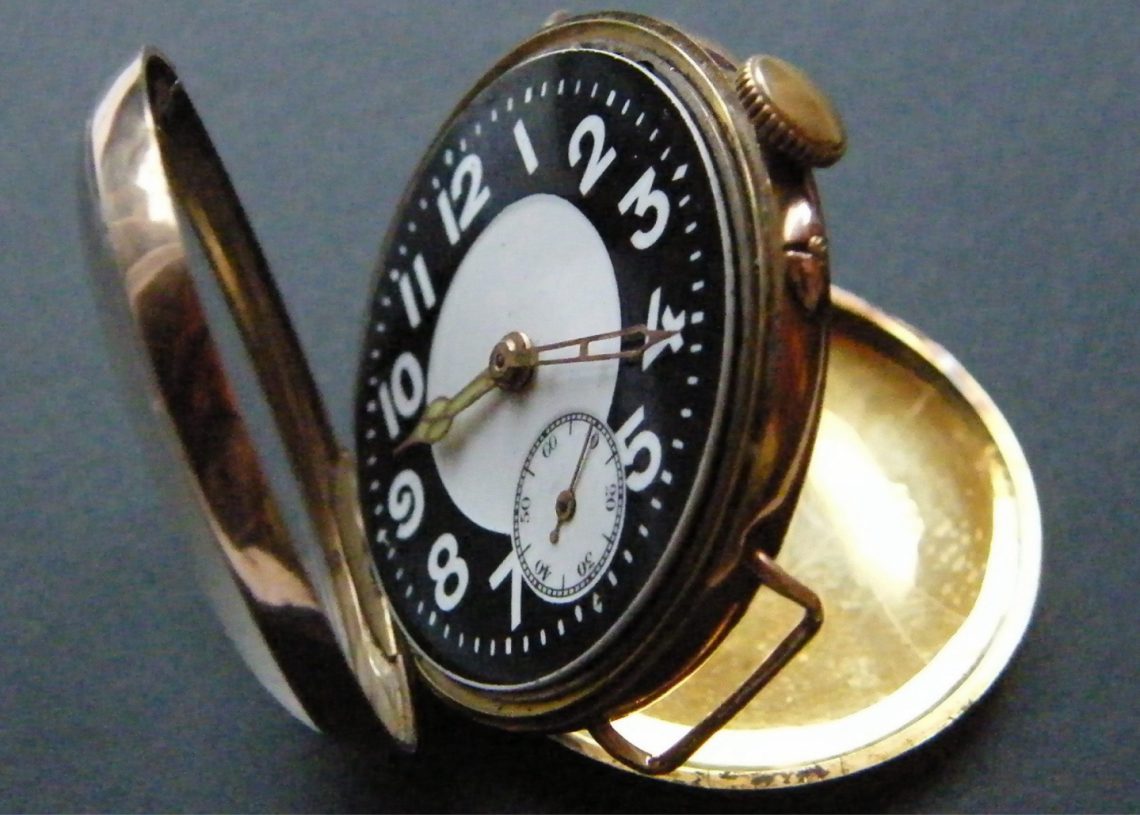
For much of their early adoption, portable watches typically inhabited a pocket on the wearer’s garment. Indeed, during the Victorian era, every gentleman of a certain bearing carried a pocket watch, often elaborately decorated and secured via a length of chain. But World War I and soldiers’ need to coordinate troop movements to the second led to the widespread adoption of the wristwatch as a functional piece of equipment; prior to that wristwatches were primarily worn as fashion jewelry by women.

Soldiers also found that conventional timepieces were subject to dysfunction in the trenches’ damp conditions, and a push for waterproof watches grew. Luxury watchmaker Rolex debuted its waterproof Oyster watch in 1926, following decades of evolution in waterproofing time-telling. 

But it took marathon swimming to bring Rolex’s innovation to the masses. On 7 October 1927, London typist Mercedes Gleitze set off from Cap Gris Nez aiming for the English shore and the history books. After 15 hours and 15 minutes of hard swimming, Gleitze became the first Englishwoman and only the third woman ever to swim solo across the English Channel.

Gleitze’s feat was hailed as heroic, but before she’d had time to celebrate, another woman, Dorothy Cochrane Logan, who swam under the name Mona McLelland (or one of several alternative spellings), claimed to have swum the Channel just three days later in 13 hours, 10 minutes. Though that swim was eventually revealed to be an elaborate hoax – and led to the formation of the Channel Swimming Association to authenticate future cross-Channel swims – the ordeal cast a pall over Gleitze’s swim. In an effort to clear her name – which had been sullied by sheer proximity in time to Logan’s swim – Gleitze announced she would undertake a second Channel crossing on 21 October 1927.

In a 2003 article in International Wristwatch Magazine, John E Brozek wrote that Gleitze’s so-called Vindication Swim attracted the attention of Rolex’s co-founder and managing director, Hans Wilsdorf, who saw an unparalleled chance to highlight his product by leveraging public interest in Gleitze’s struggle for legitimacy.

Wilsdorf wrote to Gleitze, offering to give her a wristwatch if she’d wear it on her upcoming swim and provide a testimonial. She accepted, and set off into very chilly water with an entourage in tow to witness her undertaking.

Sadly, the swim wasn’t successful; the London Times reported that she lasted about 10 hours before being removed from the sea with hypothermia. While she didn’t make landfall, the swim satisfied critics that her previous effort had been above-board, and she was cleared of any suspicion cast by Logan’s faux finish.

And Wilsdorf’s bet paid off. After the swim, a reporter noted that, “hanging ‘round her neck by a riband on this swim, Miss Gleitze carried a small gold watch which was found this evening to have kept good time throughout.”

Mercedes Gleitze at the start of her Vindication Swim. her Rolex Oyster watch dangles from a chain around her neck

Gleitze followed through on her promise, writing a letter to Rolex that said: “You will like to hear that the Rolex Oyster watch I carried on my Channel swim proved itself a reliable and accurate timekeeping companion even though it was subjected to complete immersion for hours in sea water at a temp of not more than 58 and often as low as 51. This is to say nothing about the sustained buffeting it must have received. Not even the quick change to the high temp of the boat cabin when I was lifted from the water seemed to affect the even tenor of its movement. The newspaper man was astonished and I, of course, am delighted with it.”

Splitting seconds

While Gleitze’s pioneering use of a waterproof watch certainly made a splash, it didn’t fundamentally change the way open water swims were measured; since Webb’s first effort in the Channel to today, marathon open water swims are typically recorded with hours and minutes, and sometimes seconds. To split seconds beyond that can be challenging in the wilds of solo open water swims.

However, in the pool, times were a-changing. But not without the occasional controversy. One memorable timing issue arose at the 1960 Olympic Games in Rome, when James Devit of Australia was declared the winner of the men’s 100-metre freestyle in a dead heat with American swimmer Lance Larson.

Larson had put on a surge-from-behind performance, closing in on the Australian swimmer with just 10 metres to go. From the stands, it looked like Larson had won. The three timers standing at the end of his lane and three timers overlooking Devit’s lane – all using handheld stopwatches – recorded that Larson had edged out Devit by 0.1 second. But Devit was ruled the winner after a contentious decision by three on-deck place judges.

In a documentary produced by Omega Timing in 2018, Alain Zobrist, CEO of Swiss Timing, said that “the judges made the call on who actually won the race despite the fact that the handheld stopwatches and the backup electronical system showed other results.” It seems the judges opted to believe their own eyes from a position that might not have been optimal rather than the timing equipment powered by at least six people and one machine.

A lengthy debate among the officials ensued and, several months later, they announced that Devit would retain the gold medal, but Larson’s official time, 55.1 seconds, would be recorded as an Olympic record. The runner-up’s time was faster than the official winning time of 55.2 seconds posted by the gold medal winner – a head-scratcher, to be sure.

This debacle led Omega to seek a more objective way to record times than relying on deck-side, handheld timers and place judges – all with fallible, human eyes and reflexes. Over the next few years, Omega developed an electronic touchpad system that allows the swimmer to stop the clock at the end of the race himself. They debuted the system at the Pan American Games in 1967. Touchpads have since become ubiquitous at virtually all pools that host competitive swimming events.

In 1975, Omega debuted an electronic timing system called the Swim-o-Matic, a semi-automatic timer accurate to one-thousandth of a second. But it was actually too precise, the Blackbird Automotive Journal reports, “since swimming pool architecture cannot guarantee that each lane is the exact same length…. For that reason, FINA decided to use it to measure only to the nearest hundredth of a second.”

That’s nearly always plenty exact enough. But even so, today’s touchpads occasionally refute what your eyes tell you. Case in point, the unforgettable 100-metre butterfly race between Michael Phelps and Milorad Čavić at the 2008 Beijing Olympics. Seen from a variety of angles, it sure looks like Čavić hit the wall before Phelps, but the clock – attached to a highly sensitive, 12-millimetre thick touchpad affixed to the pool wall – showed otherwise. The pad must be depressed 2 millimeters with at least 1.5 kilograms of pressure to stop the clock. Čavić must have done that first.

But somehow, miraculously, in the very last instant, Phelps got there first, edging out the Serbian superstar by the literal slimmest of margins – 0.01 seconds – to secure his seventh of an eventual record eight gold medals.

In elite open water races, touchpads have also replaced visual timing systems. In FINA events, racers must reach above them as they cross the finish line and smack the hanging timing plate to register their finish time. But even that can be complicated, if the finish of the women’s 10K marathon swim at the 2016 Rio Olympics can stand as testament.

In that event, after nearly two hours of hard racing, France’s Arielle Muller and Italy’s Rachele Bruni came screaming in toward the touchpads together. While Holland’s Sharon van Rouwendaal had sealed the deal for first place, Muller and Bruni were battling for second. In the rush to out-touch her opponent, Muller dunked Bruni, preventing her from hitting the pad. Muller was disqualified for unsporting behaviour and Bruni was promoted to second place. Polina Okimoto of Brazil earned the bronze medal.

In her effort to gain a split second and a spot on the podium, Muller lost thousands of hours, millions of minutes and untold billions of seconds worth of hard work – an unfortunate result no matter how you measure it.

This article is from the March 2023 issue of Outdoor Swimmer. Click here to subscribe to the magazine.

To see all the online content from the March 2023 issue of Outdoor Swimmer, visit the 'Hemispheres' issue page.
Stay up to date with The Dip, our free weekly outdoor swimming newsletter.

Outdoor Swimmer is the magazine for outdoor swimmers by outdoor swimmers. We write about fabulous wild swimming locations, amazing swim challenges, swim training advice and swimming gear reviews.