Daniel Start
April 2024,  EXTRA,  FEATURES,  Premium

Daniel Start: Wild Thing

Register to get free articles

No spam Unsubscribe anytime

Want unlimited access? View Plans

Already have an account? Sign in

Rowan Clarke meets adventurer, photographer, author and publisher of some of our favourite adventure and wild swimming books, Daniel Start

From his Huckleberry Finn childhood to sharing the joy of immersing in the natural world through his brilliant books, Daniel Start’s career revolves around adventure. Beginning in the Wye valley, travelling the world, venturing into the remote, wild and occasionally perilous, he brings us some of the most well-thumbed adventure titles on our bookcases.

When Daniel first travelled the UK, exploring and photographing inland swimming spots for the first Wild Swimming Guide published in 2008, the term ‘wild swimming’ had barely been coined and discretion was the watch word. Water quality and access were little talked about issues.

But all that was about to change.

“We got so many laughing rejections from publishers saying, can you really imagine a family from Islington driving to North Wales to throw themselves into freezing cold plunge pools?” he says. “But, in the end, we did get it out and it was the first photographic travel guide to wild swimming.”

Daniel Start

It now seems funny that publishers couldn’t imagine that scenario. But, while Daniel couldn’t have predicted quite how popular outdoor swimming would become, he recognised how the joy could seep into your soul, how it could elevate your physical and mental health, and how a reciprocal relationship between humans and our environment could benefit both.

And so, he persisted, going on to found Wild Things Publishing with his wife, Tania Pascoe. Together, they’ve published an amazing 52 titles about wild swimming, walking, hiking and cycling mainly in the UK, but also beyond, each one conveying and extraordinary level of playfulness, passion and personal detail.

A wild start

That level of passion comes from a lifetime of being immersed in nature. Daniel’s earliest memories are imbued with outdoor adventure.

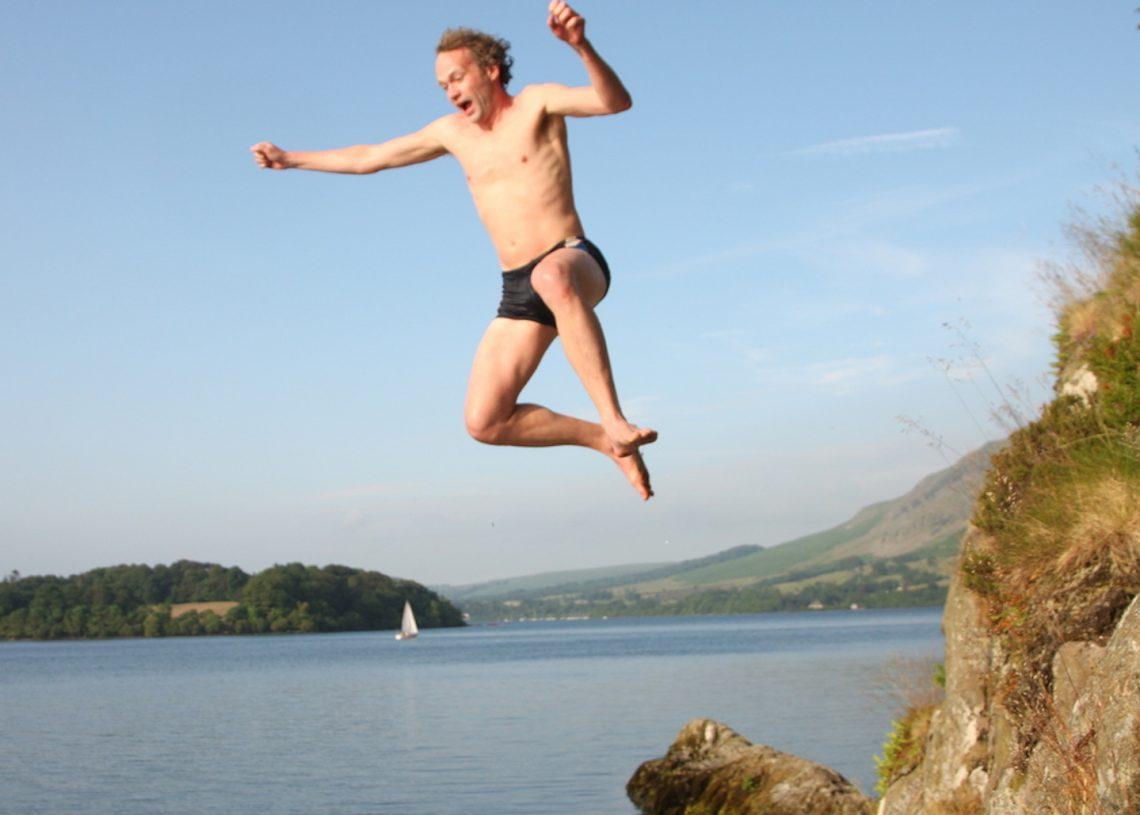
“I was brought up with my grandparents in Herefordshire and next door there was another family. We were one big gang,” he says. “We would cycle off to the river and build rafts and dens, put up rope swings. I learned to swim in the river Wye. When we moved to London when I was ten, it was a bit of a shock. But I had those formative years of outdoor adventure and that’s where my love of adventure comes from.”

Daniel Start

Even at school in London, Daniel continued adventuring through cycling clubs and the Duke of Edinburgh’s Award. As soon as he left school, he took a year out, working with chimpanzees in Uganda.

“I had a lot of desire to go on a big adventure,” he says. “After my year out, I joined the explorers’ society at university where self-organised groups of students would go off around the world doing research projects. That’s where I got the idea that I wanted to go to Indonesia to map the icecap mountains in the tropics, partly inspired by the time I’d had in Uganda. I wanted to work in conservation, tropical forests, overseas conservation, spend time in all these beautiful, wonderful places around the world and try and preserve them with the local people.”

It was Daniel’s interest in the ice-capped mountains on the equator that took him to an unchartered part of New Guinea and into a perilous situation that changed his life.

“I discovered this place in New Guinea that was one of the most biodiverse places on Earth but no one had been there to study its biodiversity since just after the First World War, no one had been allowed,” says Daniel, who spent most of his university career organising to go there, to document the biodiversity in the hope of getting World Biosphere status and protect it from the mining activity that was destroying it. “It was this incredible lost world of ravines, misty mountain jungle and communities of tribal peoples untouched by the outside world. We spent several happy months working with them documenting the
flora and fauna.”

Daniel Start

But, at the time, there was huge tension between the Indonesian government and resistance movement. Even though the latter saw the project as useful for raising awareness, a rebel group thought that they would be more useful as hostages than scientists. Along with his colleagues and some other international scientists, Daniel would spend the next five months as a hostage in what he describes as an ‘open cage’.

“Although we could never escape because it was many days’ walk over the mountains or across crocodile swamps, I was allowed to wander off,” he says. “It was a kind of Eden in hell. I would follow the rivers and find pools and waterfalls. I got to know every valley, every set of waterfalls, every tributary, incredible pools lined in pink granite boulders, so clean you could drink the water. All I would do was swim and it was my salvation.”

Exploring and publishing

In 1997, Daniel had his first book published. The Open Cage: The Ordeal of the Irian Jaya Hostages in tribute to those hostages who lost their lives. But it would be a whole decade before he started on his next book.

After ten years of working around the world in international development, Daniel became homesick for the UK and worked in London for a while, but his craving for water was unquenchable.

“I was stuck in the 17th floor of this tower block during one of those incredibly hot summers wondering how I’d ended up in a city, dreaming of waterfalls,” he says. “So, I quit. At my leaving do, somebody gave me a camping book. And I said, this is amazing because I was thinking of writing a book like this but about wild swimming places.

“I decided that I would document all the waterfalls that I had been dreaming of that summer because there was nowhere to find information about where people swam,” he says. “I was thinking about the river where I grew up, the waterfalls in Snowdonia and I thought that there must be other amazing places, but where? So, inspired by Roger Deakin, I went off with my camera and documented the bathing places of Britain, made a map and helped people to go and find them. It ended up being quite a practical photographic travel guide, which came out the following year.”

Wild guides

That first Wild Swimming guide was soon joined by Wild Swimming Hidden Beaches (Daniel’s favourite), and then the Wild Guides series, which take you all over the UK and Europe and even to Australia. While other adventurers have written some of the titles, Daniel and Tania work closely with all their authors bringing that same personal, passionate and playful detail.

Daniel Start

But Daniel is also acutely aware of his responsibility as a publisher to encourage readers to look after the landscapes we enjoy. With that, each title also conveys a sense of environmental stewardship, responsible adventuring and reciprocating the benefits we get from the water.

“I like to think that there are enough places for everyone and that by opening up the number of places available, people will stop going to the overcrowded spots and visit lesser-known ones perhaps more local to them, do less driving and spread the impact out more broadly,” says Daniel. “There’s no better example than what’s going on around river pollution at the moment. There have always been CSOs and river pollution, but look at the awareness around it. Look at the Private Member’s bills in Parliament, at how much press attention and scrutiny there is. We’ve got real change that wouldn’t be happening without a big movement around wild swimming.”

Over the 16 years since those laughing rejections from publishers, the change Daniel Start’s books have seen has been incredible. Not only has it become perfectly normal to pack our Wild Swimming Walks Eryri Snowdonia Wales to go for an immersive adventure there, but there is also a movement, drive and desire to protect these special places.

“The idea is that swimming in your river is a human right. Not done by weirdos, it’s something that we should all aspire to, to be able to feel safe, to let our children paddle in a river without worrying about E.coli poisoning, or worse,” says Daniel. “We have increasing number of places getting bathing water status, and so I think we’re changing things for good.”

Stay up to date with The Dip, our free weekly outdoor swimming newsletter.

Outdoor Swimmer is the magazine for outdoor swimmers by outdoor swimmers. We write about fabulous wild swimming locations, amazing swim challenges, swim training advice and swimming gear reviews.