

Immersive journalism
Two reporters steeped themselves in marathon swimming to deliver the tales of this waterlogged sport. By Elaine K Howley.
Over the years, quite a few journalists have caught a story about an open water swim or a marathon swimmer’s latest exploits – these stories make great human-interest pieces for local news broadcasts and newspapers. But few reporters have been as uniquely immersed in the documentation of the sport as Julia Harpman and Joe Grossman. These two journalists leveraged their talents to cover the sport in an immersive way that has left a lasting legacy for others seeking to cover the sport and its most interesting stars in a meaningful and accurate way.
Gertie’s Ghost
Memphis, Tennessee, native Julia Harpman cut her cub reporter teeth covering courts in Knoxville, Tennessee. But she had big dreams of succeeding in the big city and headed to New York, where her superlative reporting skills and the needs of a fledgling publication collided.
The New York Daily News had launched just eight months prior on 26 June 1919, and Harpman was among the first women reporters hired, brought in by hardboiled Philip Payne. He wasn’t overly hindered by societal norms; instead, he offered her a trial story but neglected to tell her two other reporters had already failed to get the information needed to report on the topic. When she came back with not just that story but another scoop, too, her career was launched.
In her 1936 book Ladies of the Press, pioneering reporter Ishbel Ross writes that Harpman’s hiring “was a significant step in the history of women in American journalism” because finally, women had a “new place in the city room.”
Harpman proved herself to be an able and agile crime reporter, writing about Jazz Age murders, mysteries and mayhem from the Big Apple to sleepy backwaters around the country. “Miss Harpman covered crime with such thoroughness and skill that she left her competitors trailing far behind,” Ross notes.
In fact, Harpman’s work helped the new paper reach a staggering daily circulation of 1,350,000 in just six years. The Daily News innovated the tabloid format, with titillating text and large, bold photos. One particular story – that of the double homicide and attenant scandal of Reverend Albert Hall and his lover, Eleanor Mills, in New Brunswick, New Jersey – gave Harpman room to flex her investigative and storytelling muscles.
Harpman was the epitome of the dogged reporter, sex be damned. “One night she slept in a filthy shack while a man suspected of a famous murder stirred restlessly in the next room. On another occasion she trudged eight miles through snow above her knees to get the story of a woman who had been thrown into jail as a spy,” Ross writes. Across her tenure with the thriving tabloid, Harpman “froze and got soaked to the skin and survived feats of endurance that seem incredible in retrospect.” She also survived a plane crash off Sandy Hook, New Jersey.
Harpman didn’t shy away from the gristly details of any case she pursued, either. “She watched a murdered man’s body being grappled out of quicksand swamp and the bones of a baby being scraped from forest soil eight years after his disappearance.”
It was that unflinching stamina and female gender that got her assigned to one of the biggest stories of the 20th century – that of the first woman to swim solo across the English Channel. The Chicago Tribune and the Daily News had bought the exclusive rights to Gertrude Ederle’s story, and Harpman was the natural choice to accompany Ederle and report about her progress and the heated race among four women – Ederle, Lillian Cannon, Millie Gade Corson, and Clarabelle Barrett – each of whom was striving to become the first female to swim the English Channel.
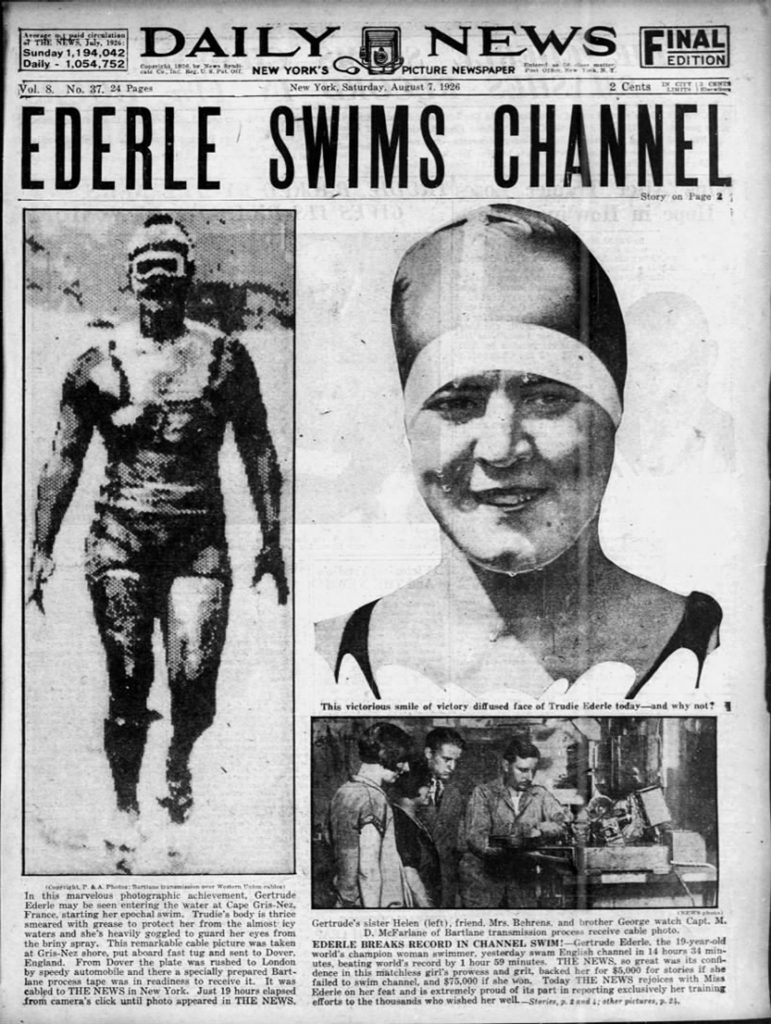
“Protocol dictates that it would have to be a female writer who accompanied the unmarried Ederle, so she could be portrayed as the swimmer’s chaperone. One candidate stood out above all others, 31-year-old Julia Harpman,” writes Gavin Mortimer in his 2008 book The Great Swim.
But there was more to it that, Ross notes. “She was that paradoxical creature – the feminine reporter with the masculine touch on news.” She could deliver the story while also winning the trust of the young and naïve Ederle, who was a bit overwhelmed with all the attention being shown her during that summer of 1926.
Not just the intrepid reporter, Harpman actually ghostwrote many of Ederle’s first-person dispatches from France before the swim, and from aboard the accompanying tugboat, Harpman charted Ederle’s progress on a nautical chart that would find its way to Ederle nearly 30 years later.
Harpman retired from journalism not long after her adventures with Ederle concluded. She died in 1955 at age 52 of a heart attack while on vacation in Italy with her husband, the noted journalist Westbook Pegler, leaving a lasting legacy for other would-be female reporters.
The Worldly Wordsmith
Josef Grossman was born 13 October 1923 in Atlantic City, New Jersey, into the teetotaling era known as Prohibition. The draconian federal mandate eliminated the manufacture and sale of alcohol in the United States, giving rise to speakeasy culture soaked in illicit booze. Atlantic City was ground zero for this lifestyle; its prime beachfront situation and proximity to both New York City and Philadelphia along with local authorities’ lax enforcement of Prohibition made it an ideal location from which to run rum.
Against that colorful backdrop that had a view of both the water and the outside world, Grossman grew into a young man who would have adventures around the world as a foreign correspondent and public affairs officer.
He served in the Air Force during World War II and later graduated from Rutgers University in New Jersey before becoming a reporter with his hometown paper, The Press of Atlantic City. According to his obituary in that same paper, Grossman soon became widely known as “an expert writer of feature stories,” and “was considered one of the speediest of South Jersey’s newsmen at a typewriter.”
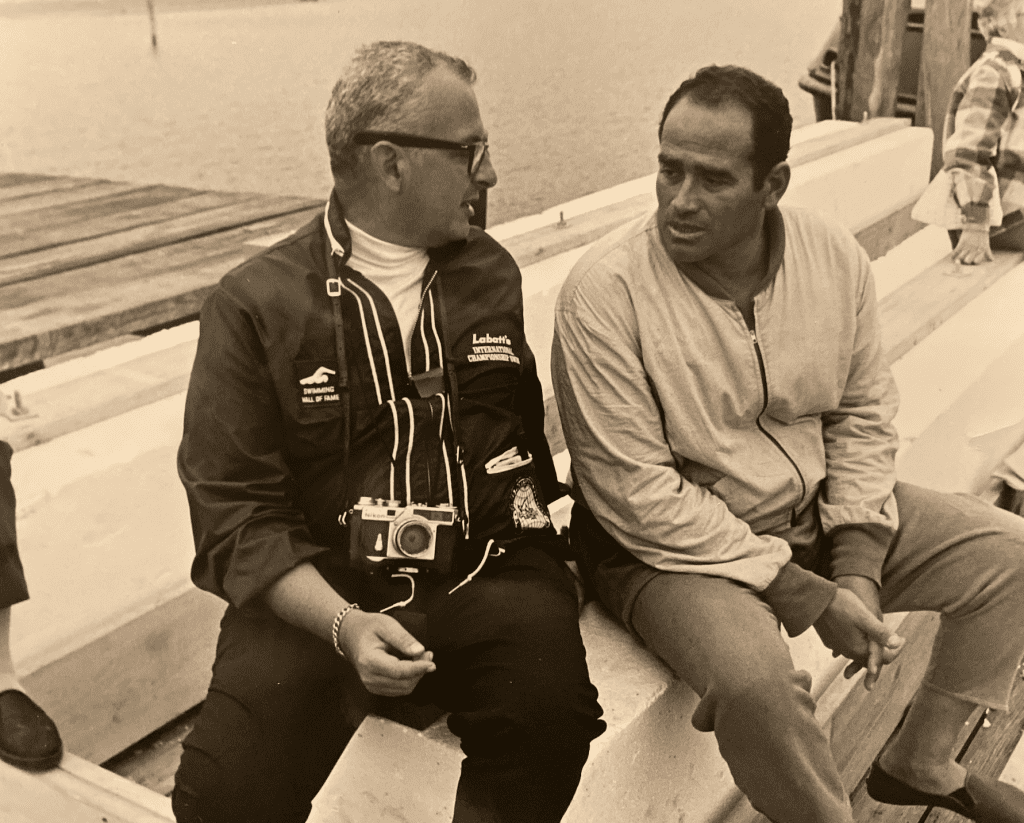
As a journalist, Grossman covered a wide range of topics and places, from life behind the Iron Curtain at the height of the Cold War to a salacious exposé of a New Jersey nudist camp. In 1963 he even traveled to the South Pole to cover a scientific expedition called “Operation Deep Freeze” that found tiny wingless insects thrive at Earth’s southernmost point. Grossman also frequently covered the Miss America beauty pageant that took place annually at Atlantic City, and wrote for outlets besides the Press including TIME magazine, the New York Herald-Tribune, and the United Press.
In the 1960s, Grossman left The Press of Atlantic City to serve as an administrative aide in Washington, DC, for House of Representatives member Thomas C McGrath, a job that took him to India, Israel, Vietnam and many other far-flung locations.
While Grossman traveled the globe, he never lost touch with his hometown on the Atlantic coast. There in the 1950s and ’60s, marathon swimming was experiencing a heyday, thanks in part to the internationally famous Around Atlantic City Swim.
The 36.6-kilometre professional race that attracted all the top swimmers of the era – Abu Heif of Egypt, Hermann Willemse of Holland and Canadian superstar Marilyn Bell, among many others – launched in 1954 to celebrate the 100th anniversary of the founding of Atlantic City. The enormously popular event quickly became an annual stop on the FINA Grand Prix circuit through 2005. Grossman was heavily involved in both the running and promotion of the marquee race.
Grossman was a key part of the marathon swimming community as a journalist documenting swims, an administrator helping maintain opportunities for swimmers and as a coach. Perhaps his most famous client was Greta Andersen, the Danish-born American swimmer who beat all the men in open water and owned several records in the English Channel.
In addition to all that on-the-water, Grossman also served as the secretary of the World Marathon Swimming Association, a precursor of FINA’s Open Water Committee. In that dry-side post, Grossman leveraged his research and writing skills to dig into the history of the sport and compile a mountain of notes.
That stack of research and scribbles eventually became the 540-page tome A History of Marathon Swimming, edited by marathon swimmer Steve Walker and Dale Petranech, a fellow Atlantic City native and administrator who served as chairman of the FINA Open Water Swimming Commission and led the International Marathon Swimming Hall of Fame from 1998 to 2010. It was published by the International Marathon Swimming Hall of Fame in 2017.
Grossman achieved all of that and much more in just 49 years; he passed away from a heart attack on 13 April 1973 during a visit home from his work with the Information Agency of the Foreign Service in Accra, Ghana. A remembrance of Grossman written by columnist Sonny Schwartz in the Press noted that “Joe Grossman exuded humor. He was a ‘laugh-a-minute’ guy. In the truest sense of the expression,” and that his ability
to turn a clever phrase and sharply observe life, even when it was grim, helped “make the darkest moment seem bright.” Smoking a pipe while applying a thick layer of channel grease to the broad shoulders of the world’s most impressive marathon swimmer certainly lends credence to the idea that Grossman didn’t take himself too seriously but was a serious supporter of marathon swimmers.
Journalism is for the birds
In the times before smartphones running on global cellular networks made connecting with anyone anywhere in the world at any time as simple as pressing a button, a lot of effort went into reporting on events near and far. And one of the more unusual ways that folks on shore learned of how swimmers were faring in attempts to swim across the English Channel was announced on 6 September 1927.
According to a brief report from the United Press, “a new method of reporting the progress of channel swimmers was adopted successfully today by the United Press when Mrs Clemington Corson of New York began her attempt to swim from England to France. Reports of Mrs Corson’s progress were being brought to shore by carrier pigeons. … At intervals, the birds were released with bulletins of Mrs Corson’s progress written [by UP staffer Sydney Williams] on tissue paper and fastened in tiny aluminum cases attached to the birds’ legs. The pigeons fly as fast as 60 miles an hour.”

The birds, well trained to fly back to their home roost carrying whatever important missives their handler wanted someone at the other end to receive, could fly as fast as 60 miles per hour. Some individual birds used on Corson’s Channel swim were racing champions, “including the winner of races from France to Spain.”
When the pigeon arrived at its homing perch, another reporter would translate the notes on the tissue paper and send out the reporter’s dispatch over the news wires to papers and radio stations around the globe.
Leveraging these avian reporters’ speed and accuracy to report on swim events was actually an adaptation of an ancient way of sharing news across vast distances. Since ancient times, pigeons have been used as messengers by the likes of Genghis Khan, Julius Caesar, and Napoleon to tell of military or territorial victories and losses aboard that could affect citizens back home. Though Corson was not successful in that 1927 attempt to cross the channel, a hungry audience back on land didn’t have to wait long to find out, thanks in part to some plucky pigeon athlete-emissaries.

Outdoor Swimmer
Outdoor Swimmer is the magazine for outdoor swimmers by outdoor swimmers. We write about fabulous wild swimming locations, amazing swim challenges, swim training advice and swimming gear reviews.