

Learning the light
With her book, Apothecary By The Sea: A Year In An Orkney Garden out now, we asked Victoria Bennett what led her to Orkney, how she created her new life on the island – and to share her favourite recipes for outdoor swimmers
After almost two decades of caring for others, author Victoria Bennett answered the draw of light, folklore and edge-of-the-map island life, and moved her family to Orkney. Here, she discovered a greater connection to nature and to herself through nurturing her garden and swimming in the sea.
With her book, Apothecary By The Sea: A Year In An Orkney Garden out this month, we asked Victoria what led her to Orkney, how she created her new life on the island – and to share her favourite recipes for outdoor swimmers.
Living in the sea
We talk a lot about immersion in nature. But, speaking to Victoria, it feels as though Orkney redefines is phrase. An archipelago off the north coast of mainland Scotland, island life, its rich history and folklore, is characterise by the light, wild weather, and the ocean.
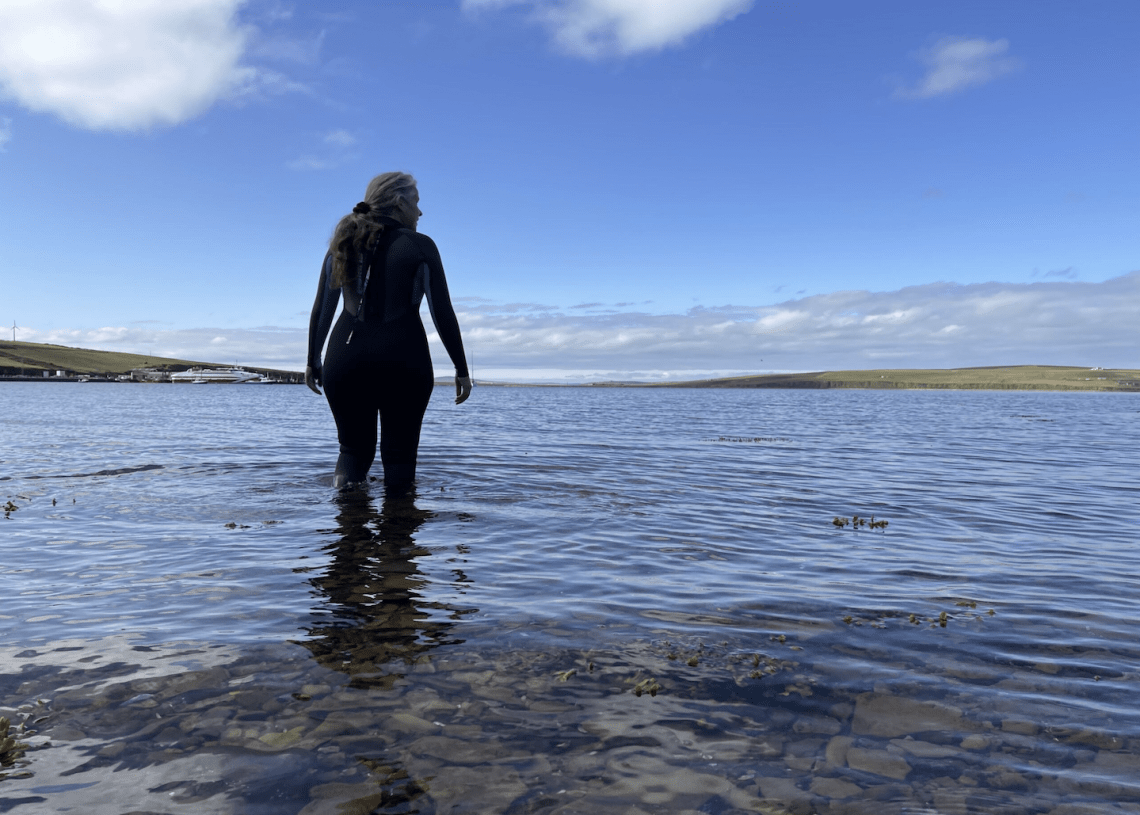
“It’s not just living by the sea, it’s living in the sea. That’s what it feels like,” says Victoria. “The light of the sky is the light of the sea – there’s barely any divide other than this tiny thin slither of green because the islands are very low-lying. Everything’s defined by the sea – my life is defined by the sea.”
Practically, this means being cut off from the main town during storms by the Churchill Barriers. But, for Victoria, the meaning is deeper. The ocean has reshaped her, taught her how to let go.
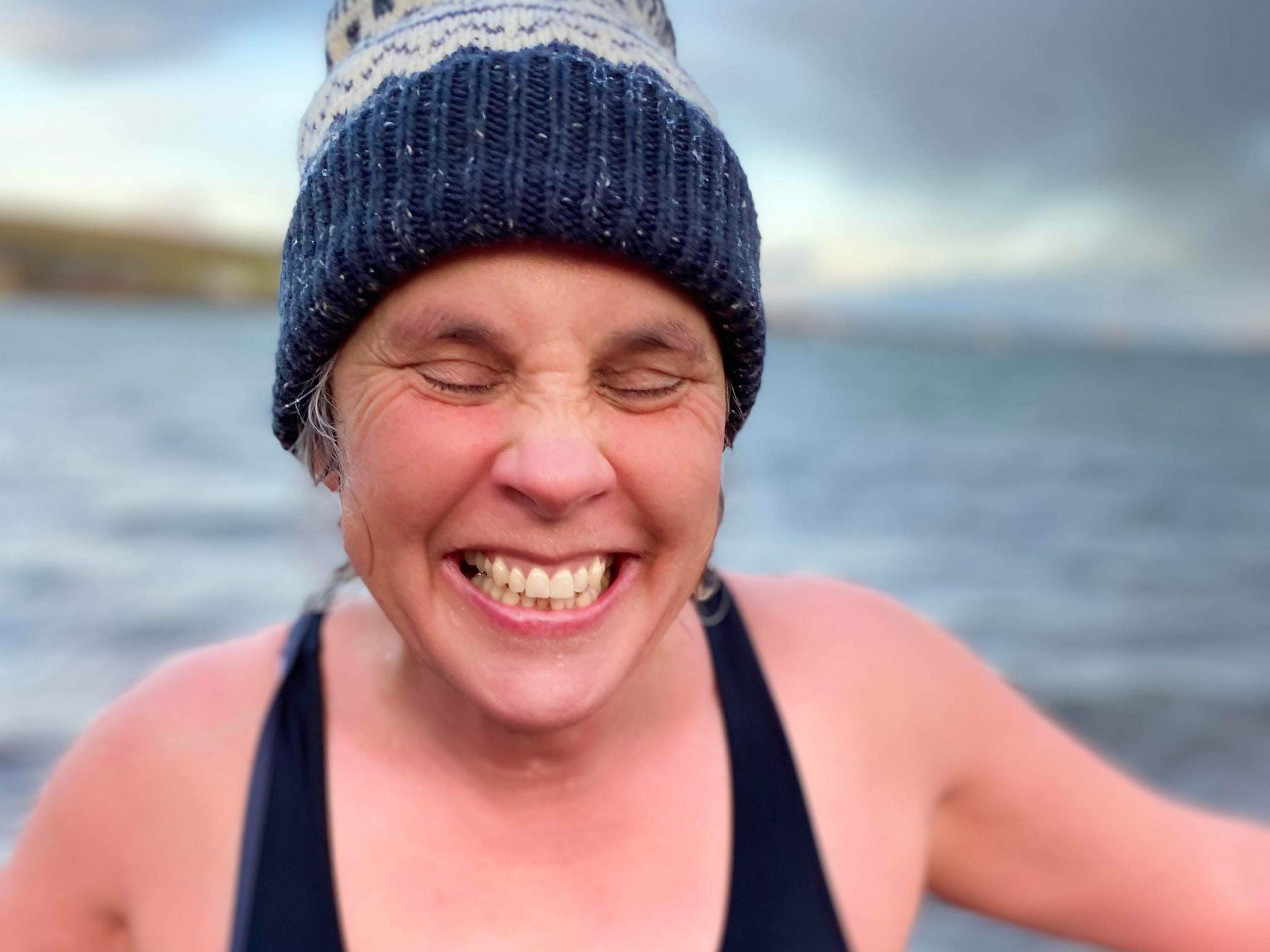
“There’s a curious balance, which I’m sure you understand – you have to release control to get into water, and acknowledge that it’s in control,” she says. “But you also have to be quite controlled in that letting go.”
This juxtaposition of letting go while retaining control is familiar to all of us outdoor swimmers – it’s a theme that threads through Victoria’s story. It speaks of her stage of life, her chronic illness, her losses, and relinquishing her responsibilities as a carer.
“At that point in life where you’re not needed quite as much, a space opens up,” she explains. “It’s a difficult space as well as a liberating one – who am I if I’m not defined by the needs of someone else? There’s a quiet when that intense caregiving loosens its hold, like the tumbleweed rolls in. I didn’t find it awful, but it was disquieting, and I didn’t want to be left behind in the world of ghosts.”
Following dreams
Before moving to Orkney, Victoria’s life in Cumbria had fallen into a pattern of caregiving. When her son was seven, she moved into her mother’s house to care for her. After she died, she slipped into the role of caring for her father.
“Like many people in their 50s, I was a fulltime carer,” she says. “I was a parent carer because my son had type one diabetes and I home-educated him, and I had cared for my mother through terminal cancer.”
Then, during Covid when their household had to isolate, something shifted. It began with a remark from her son that he would be going into the pandemic a boy and coming out a man, and ended with a life-changing move.
“After I’d had to put in care in place for my dad [during Covid], I realised that with a lot of organisation, I could be a long distance carer with my siblings, and have carers in place for my dad and he would be ok,” says Victoria. “I also realised that I’d been caring for other people for most of my son’s life, and he was going to leave home – blink, and he would be gone. I didn’t want to up sticks and change my life after that happened – it felt really important that we did it together as a family.”
The pull of Orkney
So, why Orkney? For many of the family’s friends and relatives, it seemed like a dramatic, out-of-the-blue move, but for Victoria, it felt natural and necessary. “It’s funny,” says Victoria. “I didn’t think it was dramatic – it was when everybody else went, ‘wow, you’ve done what?’ that I thought, oh yeah, maybe that was quite a big thing to do.”
Before their son was born, Victoria had applied for a job in Orkney, fallen in love with the place, and it had stayed with her. While Orkney’s draw was partly practical – for a creative couple on insecure incomes, and with Victoria being a disabled person and a carer, affordability was important – it was her deep connection to the place that pulled them there.
She describes this connection as creative, enduring through music, photographs, film, paintings, and poetry. She had the poem Orkney / This Life by Andrew Grieg pinned to her wall, and she describes how, in a state of grief after her mother’s death, it spoke to her.
“Without really being able to put it into words, it was a place I knew I needed to be,” she says. “I was at this point of change – post-menopausal, my son was soon going to be leaving home, my dad had entered a late stage of his life, and it just felt like I needed to come here. I needed to find something of myself here, and also make a home that my son could come back to.
“There was a house for sale in a village where we knew someone,” she says. “We drove up, caught the ferry over, had lunch with our friend, looked at the house, put in an offer and went back on the ferry. That was it – we suddenly had to pack up our lives and move.”
But, as natural as the pull to Orkney felt, they had to leave Cumbria behind, which Victoria describes it being like ‘ripping off a plaster’.
“Everything we knew was there. My family, our friends, our work network,” she says. “We got married there, and my son was born there. But also, all the ghosts were there.”
Connecting through landscape
Having left both ghosts and her support network, Victoria focus become laying down roots in Orkney, which did through earth, wind and water.
“One of my acts of connection wherever I am, is to learn the local names and uses of what grows there,” she says. “It’s an act of respect, of acknowledging that I’m part of a long line of people who have been in a relationship with these plants. Plant names can tell us a lot about how people used them, and what part they played in their lives.”
She began to grow plants in her garden, learning how the wind can leave a trail of brown plants, dead from salt burn, and how there’s no point in trying to grow tall, spindly plants like field poppies. But, she was also learning how just elemental life on Orkney really was – and how to let go.
“There was definitely a letting go of my expectations of what a garden might be or what I can grow in it. I really love hawthorn, for example, as a signifier of spring,” she says. “But because it blossoms in the stormy season, it just gets blown away.
“While the wind defines the shape of the garden, the light defines our year. People here don’t so much talk about the weather as the light,” she says. “So, I’ve had to relearn the seasons. And then there’s the whole thing about letting go in the sea, which is a completely different letting go.”
The draw of the sea
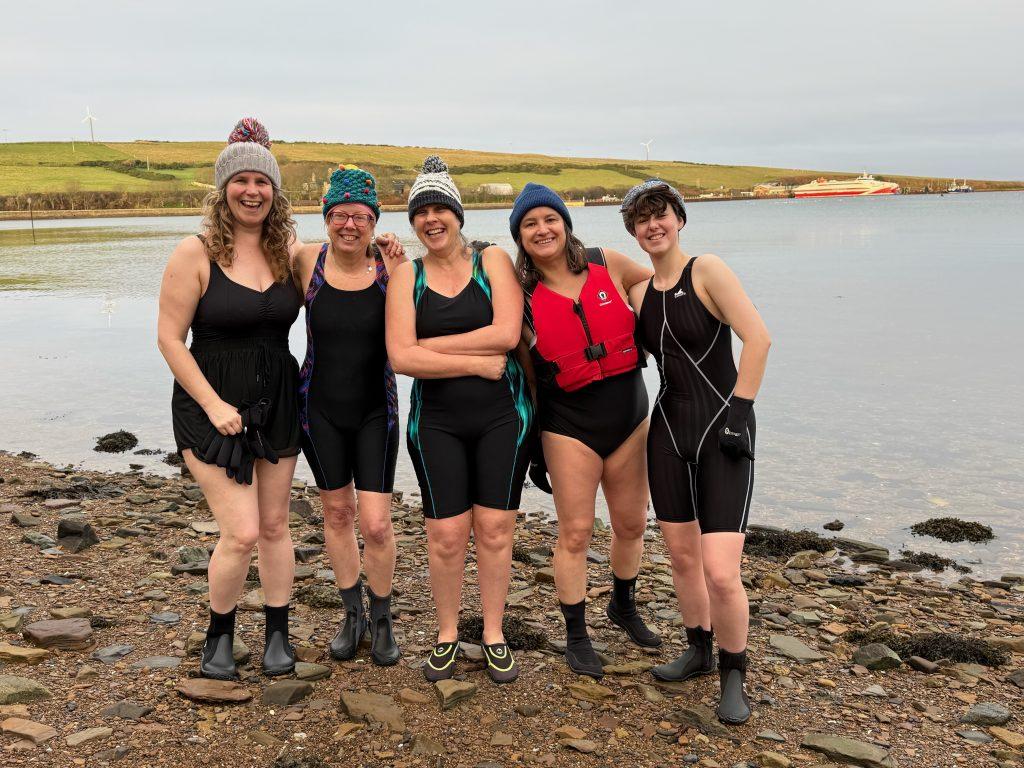
Although Victoria wasn’t a year-around outdoor swimmer before she came to Orkney, living by the sea was a huge part of its draw.
“I’ve always wanted to live by the sea. I think I’m probably one of a long line of women of a certain age who suddenly fling their world apart and go, I’m moving to the sea. I finally admit it, I’m a seal,” she says.
“My mum always wanted to live by the sea. She was an artist and she painted it all the time,” says Victoria. “After she died, I started writing her name on every beach I went to so it felt like she travelled off in the sea and then she could keep travelling.”
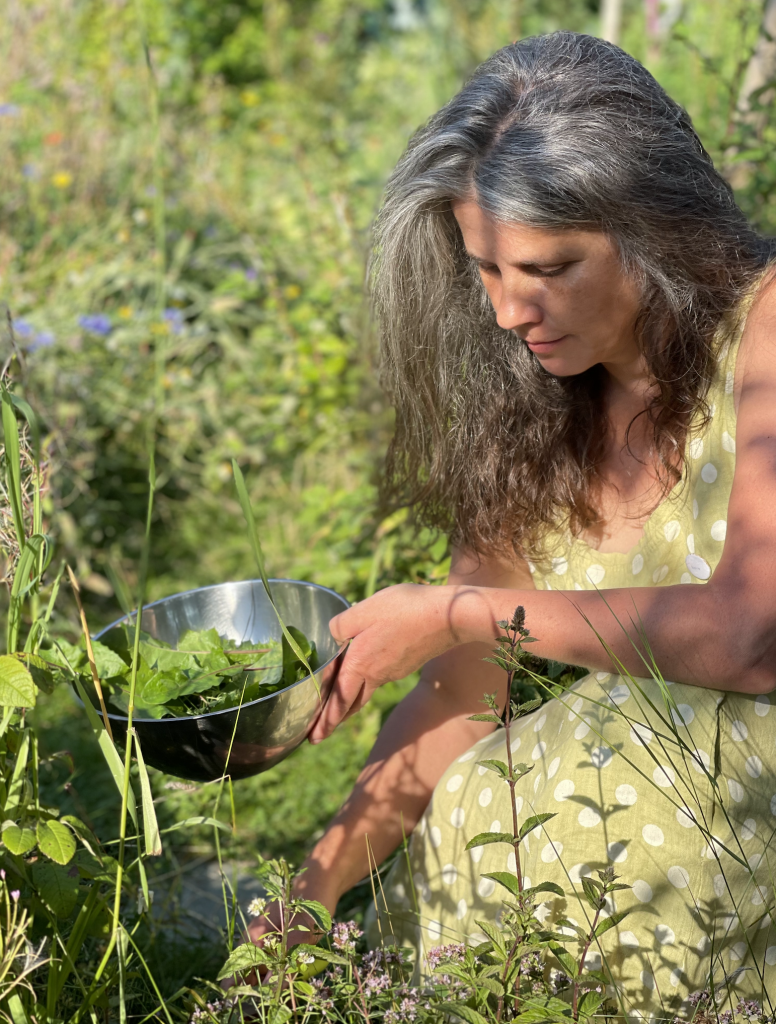
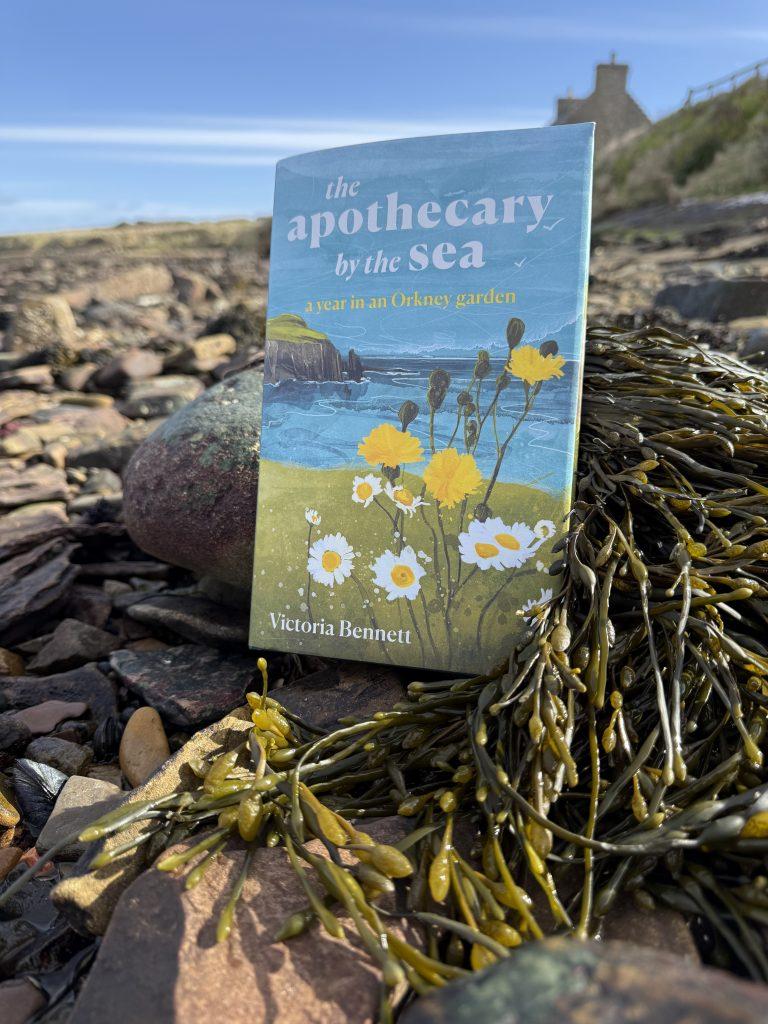
Foraging on the shoreline, it wasn’t long before Victoria went into the water. Here, she found relief from inflammatory joint pain associated with having Ehlers-Danlos syndrome and haemochromatosis, especially after a day gardening. But it also help to face the ghosts of her past.
“There are two sides to chronic illness: One is the learned control that comes with trying to keep going, to manage, and achieve what everybody else is doing, even though it feels shocking. And then there’s having to control resource expenditure in terms of energy,” she says. “Caregiving is also a huge amount of control in a situation that is completely unpredictable.
“And then of course, there are all the things that are completely out of our control. I had experienced a series of bereavements in quick succession in my son’s early life. My sister drowned just before he was born,” says Victoria. “I think that this place, its elemental nature, the sea and the weather, fits with what I understand about life and my body. That I’m not in control, but in order to be able to live with it, I need to I need to listen to it and operate within its nature.”
Once a fair-weather swimmer, Victoria is now a year-round swimmer, which is no mean feat in Orkney.
“Oh, it’s quite warm,” she says. “No, it’s just that you’re already freezing! I mean, honestly, if somebody had said to me before we moved here, you’ll end up swimming in the sea in Orkney throughout the year, I’d have laughed them out of the room.”
While she’s found benefits in yielding to the sea’s vast power and unpredictability, she’s also had to balance it with learning discipline, finding a balance between keeping herself safe and letting go, learning to trust water again after her sister’s death. She has also found a balance between the friendship and support of her sea swimming group, the South Ronaldsay Polar Bears, and the deeply personal experience of solo swimming.
“I mostly swim in the local bay because I know how many times I can swim up and down,” she says. “Even if it’s beautiful and the seals have come, I know when I have to get out the water. So it’s that kind of balance of release and control that comes with sea swimming and comes with gardening here that fits with where I am.”
‘Apothecary by the Sea’ is published by Elliot & Thompson and available from bookstores from 30 April.
Victoria’s recipes for outdoor swimmers
Victoria’s beautiful book, Apothecary by the Sea contains recipes for remedies, tinctures and teas. We asked Victoria to share her favourites for outdoor swimmers.
Hot Toddy Brew
1 tbsp dried apple
1 stick cinnamon, broken up
1 tsp dried orange peel
3 star anise, broken up
4 cardamon pods
2 tsp crystalised ginger
Victoria says: “Blend and use a couple of teaspoons in a small pot, add boiling water, and cover, leaving to steep for 15 minutes. I use crystallised ginger for a slightly sweeter taste, but you can just use root ginger if you don’t want the sugar.”
Selkie Bath Soak
8 tbsp dried or a couple of large handfuls of fresh bladderwrack
4 tbsp dried chamomile flowers or a large handful of fresh flowers and leaves
10-12 bay leaves
3-4 springs of rosemary
1 tbsp dried or a large handful of fresh horsetail fern
A handful of gorse flowers (optional)
4 tbsp rolled oats 8 tbsp Epsom or magnesium salts
Victoria says: “I make sure I take out anybody that’s living in the seaweed before I take it home, and then I soak it in cold water to clean it off, then put it in a muslin bag and I’ll just hang it under the hot tap. It’s really rich in collagen, magnesium and iodine. So it’s brilliant for pain relief, relaxation, helping sleep, skin tone, you can wash your hair in it.”
Storm Steam
4 tsp dried or 2 tbsp fresh thyme
4 tsp dried or 2 tbsp fresh spearmint
4 tsp dried or 2 tbsp fresh rosemary
4 tsp dried or 2 tbsp fresh yarrow
4 tsp dried or 2 tbsp fresh meadowsweet flowers
1 tsp sea salt
Victoria says: “Put the ingredients in boiling water and breathe in the steam. Without the salt, you could equally use the dried mixture in an oil as incense in a burner with a little water and a candle underneath.”

Outdoor Swimmer
Outdoor Swimmer is the magazine for outdoor swimmers by outdoor swimmers. We write about fabulous wild swimming locations, amazing swim challenges, swim training advice and swimming gear reviews.