

Where black water meets sky
In this reflection for Outdoor Swimmer, John Lewis-Stempel, the prize-winning nature writer and Herefordshire farmer, draws on a lifetime of rivers, fields and night wanderings to explore how swimming after dark unsettles the senses, dissolves human certainty, and returns us to our first, tidal origins
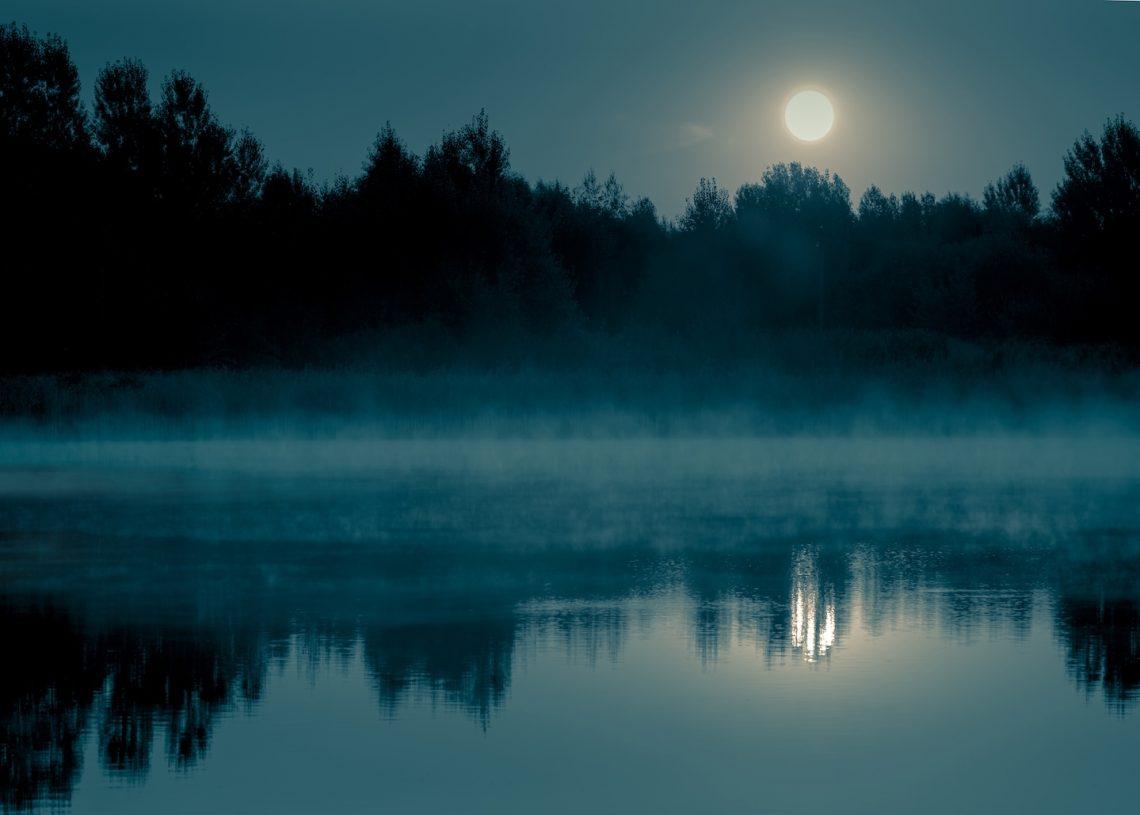
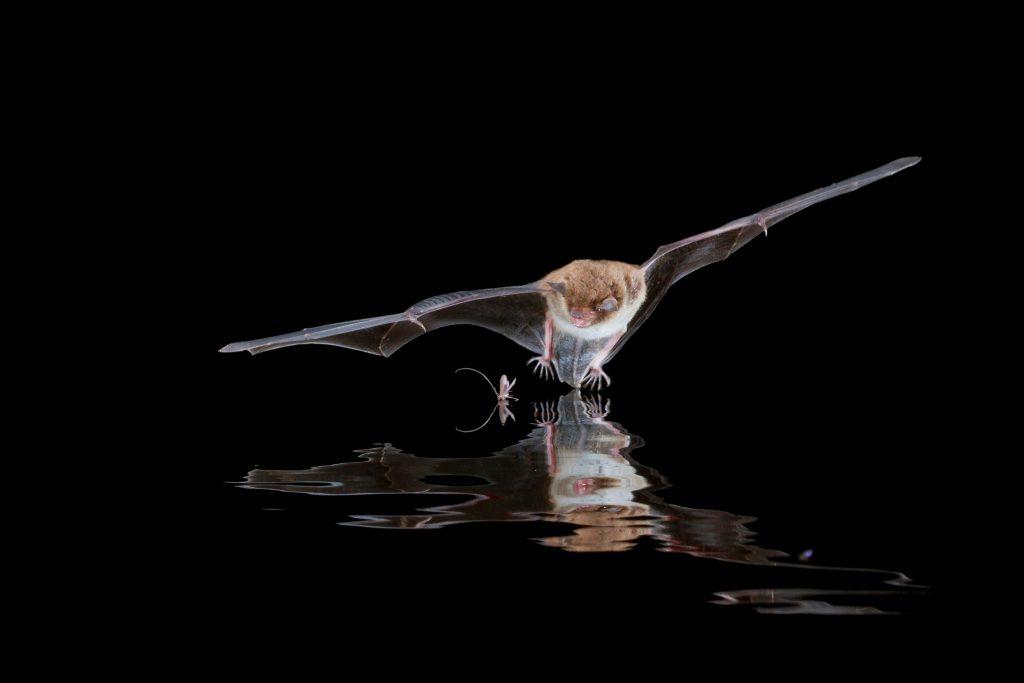
I am not a swimmer. I am not amphibious. But I do know water at night. I grew up on the banks of a river, the Wye in far west and away Herefordshire, laying nylon lines to catch eels in dim teenage torchlight, the river itself flowing quiet, thick and black through our hands. At 16, when the congenial village pub that sold Wadworth’s 6X to the underage was not, alas in my village, but three miles away, I walked home along the river’s banks in darkness, and knew all the river’s nocturnes. In spring, the awakened Daubenton’s bats whirled so close to my head I felt the breath of their leathery wings. In summer, the moonlight lay on the water in impossible romance. In autumn, wild geese from the north landed under starshine. In winter, the carnage of the flood water was either the fearsome beginning of things, or their end.
No, I am not naturally amphibious, but then came the dares, from peers, to oneself: the dare to enter water at night, alien element in the alien time, humans being diurnal things. Thus, the drunken swimming party, exams done, in the river made shallow-end safe by summer drought, but with the strangeness of pale human limbs muscling amid the long silken streamers of water crowfoot. Later, going down to the sea at Portreath in Cornwell, the moonlight sufficient to silver the water, the effervescent phosphorescence of the breakers, silent seagulls spirit-drifting overhead, a swim out to the fishy depths; and the crawl back to shore, and the awareness of how night – especially the water at night – changes what it is to be human. I tell you this: emerge from the sea at night, alone, when it is sufficiently dark, no distinction between black water and black night, all is void, and you exit the womb, the first lifeform staggering ashore from the primaeval marine waters.
Or, this: I once swam inshore-wards at Portreath, exhausted with a desperate hand on an oak trunk clutched, to arrive like the helmsman of an Anglo-Saxon longship. Night allows imagination in a way that daylight never does. In the nighttime, the old and the new, the familiar and the unknown, become distorted. At night, as you glide river-downwards, the daytime irises lining the bank are transformed into the spears of a phalanx of Roman guards, the familiar trunks of alder turn into the stone-cold pillars of some lost civilisation.
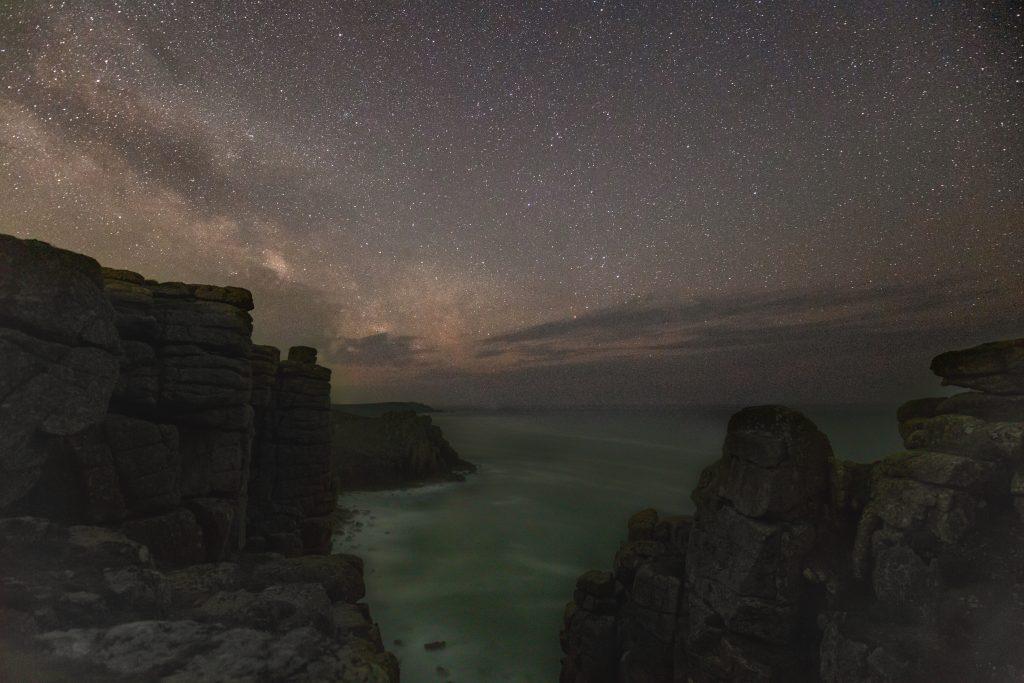
Once I was standing at midnight on the shingle shore of Cumbria’s Haweswater (probably the darkest place in England, just two habitations around the lake), under whose liquid surface are the drowned hamlets of Mardale Green and Measand. A rent appeared in the cloud, and through the lips of this hole stars fell on to the surface of the lake. They illuminated the depths in columns of light, and I saw shoals of silverscaled schelly, Haweswater’s rare salmonid fish, a glacial relic, spinning and swarming through the doorways and windows of the ruined cottages of the English Atlantises.
A fantasia, of course. In daylight I had stared at Haweswater’s slate-grey surface and gained no depths of knowledge. But in those seconds of star-provoked imagination was there not some form of truth?
You see, humans are beings of sight. It’s our primary sense. Which is why we say, ‘You see’ as statement of truth. But in darkness, our sight is diminished and the senses are re-ordered. The lesser senses, dormant, are invigorated. At night you feel the scrapeskinning, coarse, salt-buoyancy of sea water. Night alters perception of liquidity; water becomes, apparently, more viscous. What, in day, was emerald silk sea, at night is black velvet. At night your ears receive notes and tones undetected by purely diurnal beings; the ripple of salmon fins powering upstream, the definite ‘plop!’ of a water vole (‘Ratty’ in The Wind in The Willows) launching from bank into black fenny water; the licky-lapping of the water in the harbour. But it is the sense of smell that is the greatest revelation in the dark. Water and everything around it emit their aroma more potently at night, and your proboscis is more attuned to receive the reeks and the bouquets.
A simple experiment will suffice: swim a length of river or pool by summer’s day, do the same at night. At night your nose will fill with the smarting spice of water mint, and the oddly beery whiff of post-fecund vegetation. By day, your eyes were drawn to the sights, your nose merely at repose. There’s democracy in swimming at night. Humanity, across the latitudes of geography and the longitudes of time, has been united by looking up and seeing the stars, and pondering on the great themes, of God, of Existence. It is, perhaps, our one commonality. Then this, the democracy of the animals: Enter the darkly mysterious night-water, and swim in the medium where all life began and you are just one more creature among the countless trillions. Few walk by night, fewer still swim by night, but those who do so know the utter insignificance of humanity. Yet, paradoxically, what it is to be original and individual. Adam and Eve redux.
Always, of course, a certain frisson swimming at night; you will rarely, if ever, be more exposed and attuned to nature. The world at night still belongs to the animals; it is their time and place. Humans are unexpected, or at least, less feared as in daylight, as if the animals knew that our primary sense was devalued and our apex status reduced. The night is busy. Some 75% of the world’s animal species are nocturnal. The night is when the great migrations of British nature occur, the birds toing and froing from climate clemency to clemency, and the amphibians making their annual pilgrimage to the ancestral pond. The dark is a great hiding place from sighted-things, and those who want to know nature after dark will need their nose and ears.
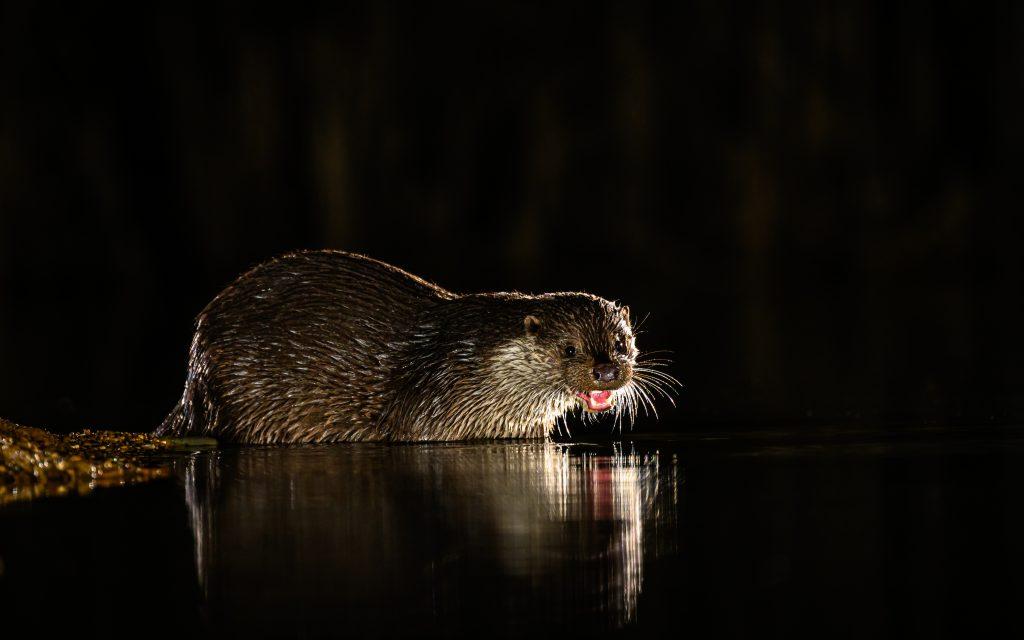
Otter spraint is, surprisingly, reminiscent of herbal tea, and a sympathetic ear may discern the squeak of pipistrelle or Daubenton’s bats (the two bat species likeliest to haunt UK waters) contact-calling. A very sympathetic ear, usually found in young children, may even be able to hear the bats’ clickety-click echolocation. Meanwhile, the ear trained by familiarity will distinguish the plop! of furry fatty ratty from the plip! of a frog entering the aqueous stuff. Otters slither in, stealthily. Swim in any freshwater at night, and you chance to come on animals, while largely submerged and hidden yourself (thus, an un-humaning), as they drink the waters. You are unlikely to forget an encounter with a deer lapping at a lake in starlight, your head on the deer’s level, eye to eye.
An arrogance, of course, to go swimming at night, and expect nature to perform its miracles and scenes for you. But when you do nightswim, you will, at the very least, encounter yourself.

Outdoor Swimmer
Outdoor Swimmer is the magazine for outdoor swimmers by outdoor swimmers. We write about fabulous wild swimming locations, amazing swim challenges, swim training advice and swimming gear reviews.