

Plunge into ice swimming competition
Ice swimming is no longer a niche pursuit reserved for polar adventurers. Across the UK, swimmers are bridging the gap between casual winter dips and official ice-swimming competition. Ice swimmer and open water coach Stephen Gould reports
The thrill of plunging into icy lakes, rivers, and coastal waters has long captivated enthusiasts, but today, swimmers are approaching cold water immersion with structure, purpose, and ambition. For those ready to move from tentative winter dips into sanctioned events under for example IISA (International Ice Swimming Association) rules, there is now a clear pathway – encompassing training, technique, safety, mindset, and community support.
Transition from dips to competitive
In the UK, many cold water journeys begin in rivers, lakes, or coastal waters as part of the ‘wild swim’ or ‘winter swim’ movement. At first, these swims are recreational – short, bracing dips that shock the system and leave swimmers buzzing with adrenaline. Over time, however, swimmers begin to see their cold water dips as deliberate preparation for competition.
Swimmers often start by logging swims: distances, water temperatures, durations, and their physical reactions. Autumn and early winter provide ideal conditions as lakes cool. Short benchmark swims of 200-500 metres in sub 6°C water help assess tolerance, while focused practice of stroke efficiency, straight-line swimming, and controlled breathing builds confidence and technique.
While local polar dips remain fun, they are usually too short and forgiving for competitive preparation. Structured exposure, gradual progression, and careful attention to recovery are key to moving from recreational winter swims to the demands of competitive ice swimming.
The governing bodies
Two principal governing bodies have emerged to oversee distinct forms of swimming in near-freezing conditions: the International Winter Swimming Association (IWSA) and the International Ice Swimming Association (IISA). Although their domains overlap in the promotion of swimming in low-temperature environments, their organisational aims, definitions of practice, and philosophical orientations differ markedly.
The International Winter Swimming Association (IWSA) was established in 2006 with the purpose of promoting winter swimming as a structured, health-oriented, and socially inclusive sport. The IWSA regulates competitions typically conducted in water temperatures ranging between 0°C and 5°C, although some events may occur in marginally higher temperatures. IWSA competitions are characterised by short-distance races – commonly 25 metres, 50 metres, 100 metres, or 200 metres with 450 metres being the ‘Holy Grail’ in distance terms – swum in lanes cut into frozen or semi-frozen bodies of water.
The organisation emphasises community engagement, safety, and physical wellbeing, positioning winter swimming as an accessible form of cold water recreation rather than an extreme endurance pursuit. The IWSA also administers the Winter Swimming World Championships, which are held biennially and attract participants from around the world. Merely entering means you automatically represent your country.
In contrast, the International Ice Swimming Association (IISA), founded in 2009 by South African swimmer Ram Barkai, governs the far more extreme discipline of ice swimming. The IISA defines an ice swim as any unaided open-water swim undertaken in water of 5°C or below, and as with the IWSA without the use of wetsuits or thermal protection. The IISA’s most emblematic challenge is the Ice Mile, requiring participants to swim a distance of 1,609 metres in these conditions.
The IISA’s activities centre on the certification and verification of such swims, adherence to rigorous safety and medical protocols, and the promotion of ice swimming as a form of extreme endurance sport. The organisation also oversees the Ice Swimming World Championships, first held in 2015, which provides a competitive framework for this specialised community of athletes up to 1K in distance, a brutal challenge. These events take place in long-course unheated lidos. Unlike the IWSA, competitors are rigorously selected based on proven age-group speed in ice swimming competition heats to represent their country.
Despite their shared engagement with swimming in cold environments, the IWSA and IISA diverge significantly in their orientations. The IWSA situates winter swimming within a social and recreational framework, promoting it as a disciplined yet broadly inclusive sport accessible to a wide demographic. The IISA, conversely, situates ice swimming as an elite and individualistic pursuit, foregrounding endurance, resilience, and the physiological limits of human performance. Thus, while both organisations contribute to the global development of cold-water swimming, they represent two distinct paradigms: one oriented towards communal sport and wellbeing, and the other towards extreme athletic achievement and personal challenge.
The process: qualifying
To become an official ice swimmer under IISA, preparation and compliance are essential. Medical clearance comes first, including a recent ECG and disclosure of relevant health history. Swimmers then complete a qualifying swim – typically 450 metres in ≤5 °C under observation – before attempting longer distances such as 1 km or the Ice Mile.
Membership with IISA or IISA-GB is required, along with submission of waivers, registration forms, and observer documentation. Safety is paramount. Every swim must have an observer, medical staff on hand, rescue support via boats or kayaks, and warming or recovery facilities. Swims must be unassisted: dive starts, tumble turns, or underwater push-offs beyond five metres are prohibited. All swimmers must wear a tow float belt for retrieval assistance should they black-out whilst in the water.
UK events like the Ice Mile at Hatfield under the auspices of Leon Fryer (IISA GB Chair) and SwimYourSwim provide domestic opportunities for swimmers to meet these standards. IISA also actively promotes para categories across all age groups and encourages younger swimmers (16+), while also attracting former Olympians and elite athletes.
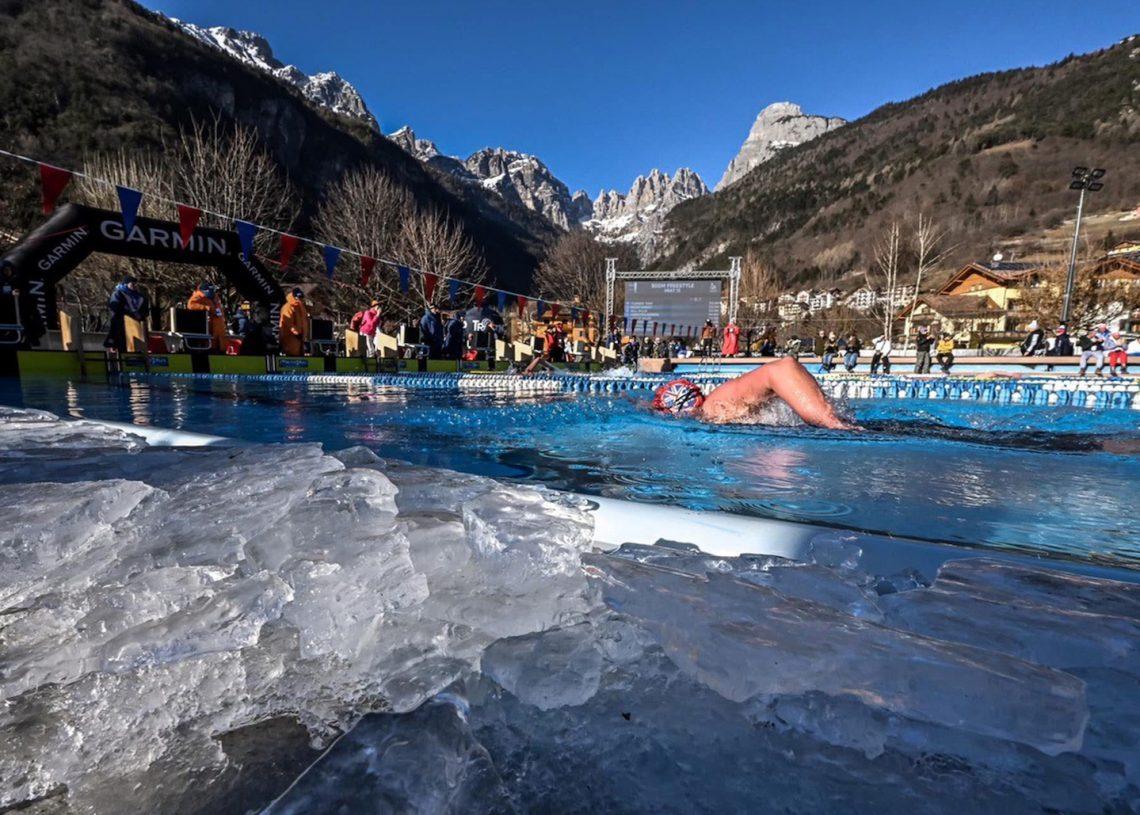
Remarkable feats highlight what’s possible. At the IISA World Ice Swimming Championships in Molveno, Italy, in January 2025, the men’s 100 metre freestyle was won by Keaton Jones from the USA in a new World Record time of 53.15 seconds in water of just 1.3°C, all under the strict rules. Such performances illustrate both the discipline and thrill of competitive ice swimming. This is no longer a sport for bearded old men having a (not recommended) swig of Jägermeister before a race in an ice hole. The sport is maturing: it’s moving from a fringe, adventure-focused activity to a serious, globally competitive athletic discipline, complete with world records, specialised training, and international rivalries. Indeed, driven by the IISA you can expect to see ice swimming included in the Winter Olympics in the not too distant future.
The training: preparing body and mind
Preparation for ice swimming is multi-faceted, involving cold adaptation, technique, endurance, cross-training, recovery, and mental resilience.
Cold adaptation begins gradually. Swimmers start with short exposures in 8-10°C water, slowly increasing duration and lowering temperature. Cold showers or preferably ice baths provide alternatives when outdoor conditions are unsuitable. Repeated exposure, ideally at least three times per week, helps the body adapt while allowing recovery.
Swimming technique and endurance are critical. Efficient strokes, high hips, and minimal over-rotation conserve heat. Open-water skills such as sighting, navigating currents, and handling chop ensure swimmers maintain speed and control. Pool sessions build aerobic endurance, which then translates to performance in cold water.
Cross-training strengthens resilience. Shoulder, back, and core conditioning prevents fatigue, while breathwork – including yoga or pranayama – aids in controlling the initial cold shock reflex. Heat-cold contrast therapy, such as sauna plus plunge, enhances vascular and mental adaptation. Recovery strategies include warm clothing, insulated layers, hot drinks, and gradual rewarming. Sudden heat can be dangerous, and attentive observation of the body’s signals is essential.
Mental preparation complements the physical. Visualisation, mindfulness, and progressive exposure foster a calm, controlled mindset. Acceptance of discomfort, rather than struggling against it, prevents panic and over-breathing, which are often more dangerous than the cold itself.
The community: clubs, coaches and races
The UK offers a vibrant and supportive ice swimming community. IISA GB serves as the national governing body, hosting events, maintaining records, and guiding swimmers through qualification pathways. NOWCA affiliated open-water swim venues, local wild swim and winter swim groups provide camaraderie, technical advice, and safety mentorship. Experienced coaches and observers offer one-on-one guidance, while workshops train newcomers in cold water safety, rescue, and observer certification. Online communities allow swimmers to share logs, coordinate swims, and stay motivated throughout the year.
The mindset: motivation and transformation
Why do people do it? Ice swimming is as much psychological as physical. Challenge, clarity, connection to nature, and social bonding all play a role. Many swimmers describe how immersion in icy water builds resilience, patience, and discipline while improving body awareness and stress management in everyday life.
The future of ice swimming
Ice swimming is evolving rapidly. The sport is becoming more regulated, safer, and more accessible, with increasing inclusivity for para-athletes and younger swimmers. For swimmers asking, “I’ve done the cold, now what?” the advice is simple: track distances and temperatures, complete qualifying swims, seek mentorship, invest in safety gear, and exercise patience.
Ice swimming demands respect for the cold, preparation, attention to safety, and resilience. The rewards – confidence, community, clarity, and a profound connection to natural elements – make the journey transformative. For the recreational winter swimmer, the plunge from fun dips to competitive ice swimming is not only achievable, but also deeply rewarding.
Other national winter swim events include:
UK Cold Water Swimming Championships (Tooting Bec Lido, London)
SLICE (Shaftesbury Lido Ice Championship)
The Really Cold Swim Championships (Rother Valley Country Park, South Yorkshire)
IISA British Ice Swimming Championships (Stonehaven Lido, Aberdeen)
IWSA Scottish Winter Swimming Championships (Oban)
FreezeFest (Brockwell Lido, London)
The Welsh Winter Swim (Llyn Padarn, near Llanberis, North Wales)
Polar Bear Challenge (Nationwide from 1 November to 31 March)
NOWCA (National Outdoor Wild Swimming Association)
Sub10 Club (Nationwide)

Outdoor Swimmer
Outdoor Swimmer is the magazine for outdoor swimmers by outdoor swimmers. We write about fabulous wild swimming locations, amazing swim challenges, swim training advice and swimming gear reviews.