Tuna Tunca
EXTRA,  FEATURES,  June 2026,  Premium,  Readers' Swims

Only rhythm remains

Gul Nur Tunca shares his son Tuna’s story of high performance and endurance in elite open water swimming and how it can exist alongside neurodiversity, without framing it as limitation.

When Tuna enters the sea, the world changes. The noise fades, his focus sharpens, and everything becomes simpler. What remains is a rhythm: stroke and breath. “I feel calm when I’m in the water,” he says.

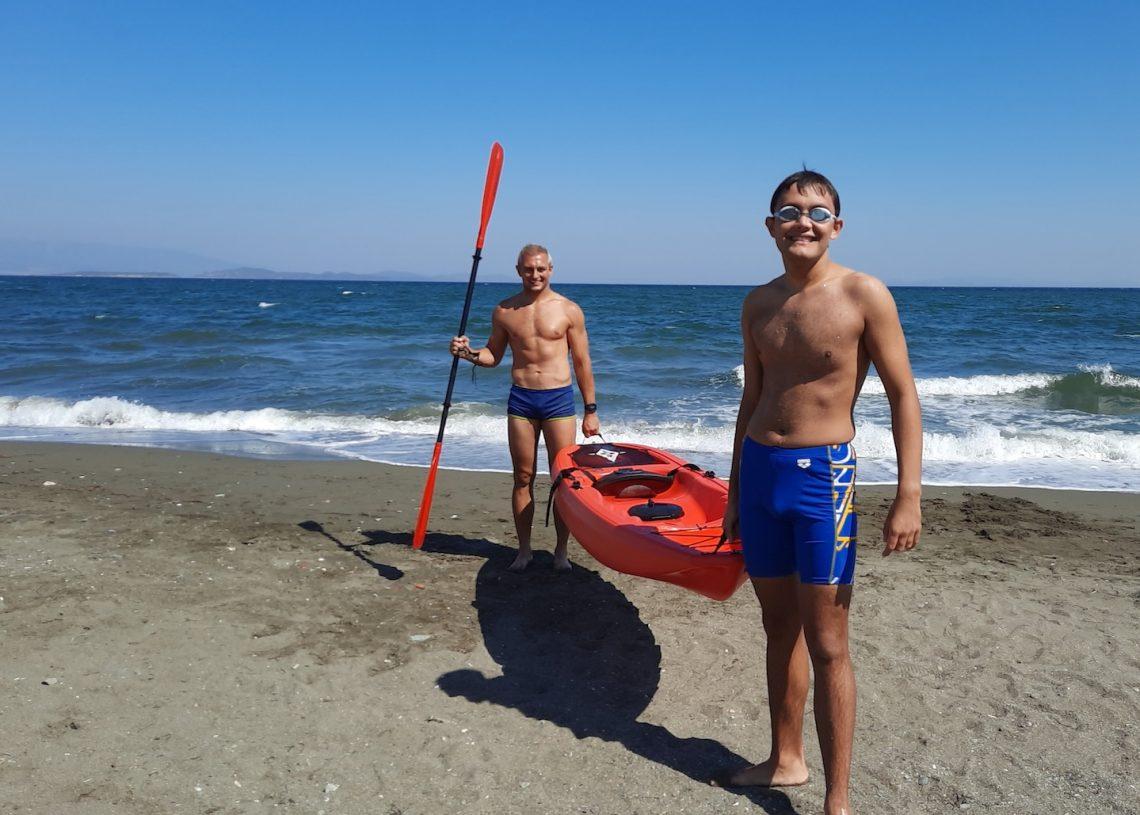
For Tuna, water is not just an environment. It is where he feels most himself. He was diagnosed with autism at the age of three and the sea has been his passion since childhood. Over time, long-distance swimming became a powerful force in his life shaping him socially, cognitively, behaviourally and physically. Tuna is an ultra-marathon swimmer, but what defines him is not distance, but his relationship with the water. For him, swimming is not only about reaching a destination. It is about maintaining a rhythm, repeating the same movement, with the same focus, over time. “I don’t get tired of doing the same thing for a long time,” says Tuna. His connection with the sea is simple and clear. There are no distractions only the present moment and the movement itself, “I don’t think, I just swim.”

Tuna’s relationship with swimming began at a young age and, over time, became something more than a sport. His love for the sea took him from the pool into open water. Distances grew longer, conditions became more demanding, but his focus never changed. He competed in international races in the Bosphorus and the Dardanelles, achieving podium finishes and building his experience in competitive open water swimming. In 2022, he completed a solo crossing between Chios (Greece) and Cesme (Turkey), an important step in his journey. “I love swimming in the sea,” says Tuna. In 2023, together with his coach Mert Onaran, he placed first in the duo relay category at the 36 km Capri–Napoli Ultra Marathon.

Tuna Tunca

His solo English Channel crossing became a turning point. During his first attempt in September 2024, everything was going as planned. But in the eight hour, weather conditions changed, and the swim was stopped by the pilot. All swimmers in the water that day were also pulled out. It was not easy, but it revealed something essential: respect for the sea. “If the sea does not allow it, you cannot swim,” says Tuna. But, Tuna came back. “I will try again.” On June 13, 2025, at 00:25, he started his second attempt. After 13 hours and 26 minutes, he completed the English Channel with a solo swim and became the first solo swimmer to complete the crossing that season. “I knew I would finish,” he says.

In the same year, he also completed a solo crossing of the Strait of Gibraltar, becoming the first marathon swimmer with autism in the world to achieve this. Tuna’s love for the sea, his focus, endurance, and his ability to adapt to cold water reflect the strength of his neurodiversity. Outside of his intense training schedule, he enjoys doing puzzles when he finds time. He also likes spending time in the kitchen, especially after long swims, when recovery becomes part of the rhythm.

There are new challenges ahead this year. In July, he will attempt a solo swim of the North Channel, followed by the Catalina Channel in September. His long-term goal is to complete the Oceans Seven. But for Tuna, the most important thing never changes: to stay in the water, to keep the rhythm, and to continue. “Because I love swimming,” he says.

Stay up to date with The Dip, our free weekly outdoor swimming newsletter.

Outdoor Swimmer is the magazine for outdoor swimmers by outdoor swimmers. We write about fabulous wild swimming locations, amazing swim challenges, swim training advice and swimming gear reviews.