

Just keep swimming: the year I went open water
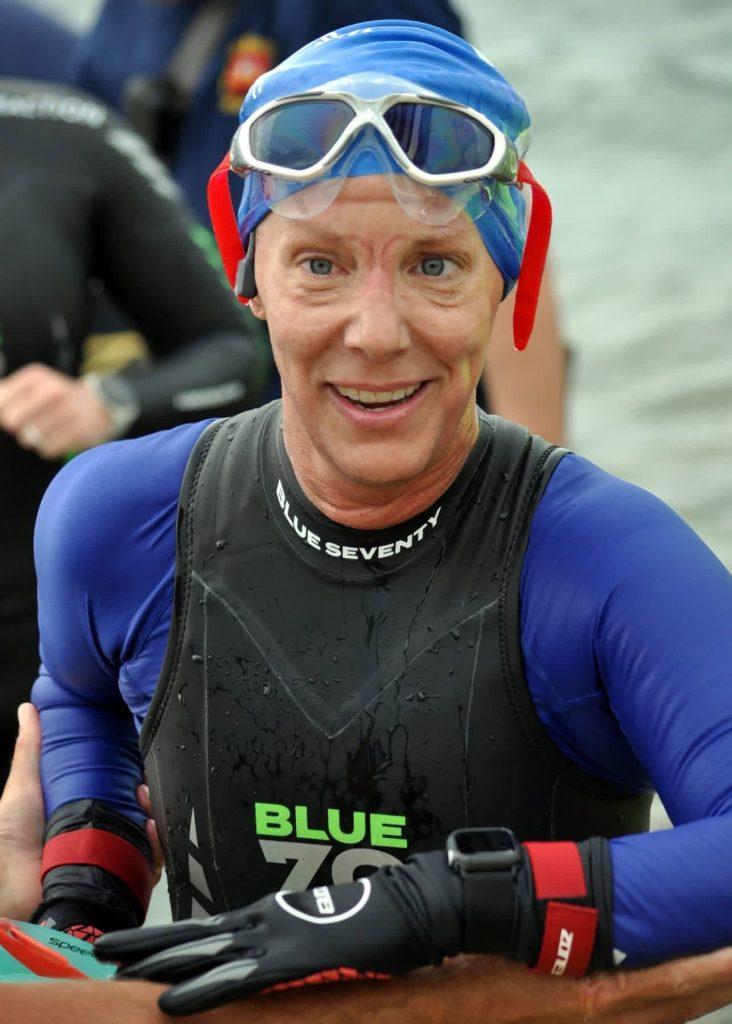
Todd Nissen had never swum more than 1,000 yards. Then, at 63, he decided to take on nearly five miles of unpredictable Great Lakes water. Along the way, he discovered the challenges, camaraderie and sheer exhilaration of the open water.
I’ve come to think of open water swimming as a stage play with three actors. There’s your brain. Your body. And the water. Sometimes the water decides to also take on the roles of writer and director. The result can leave me feeling like a mere spectator amid larger forces.
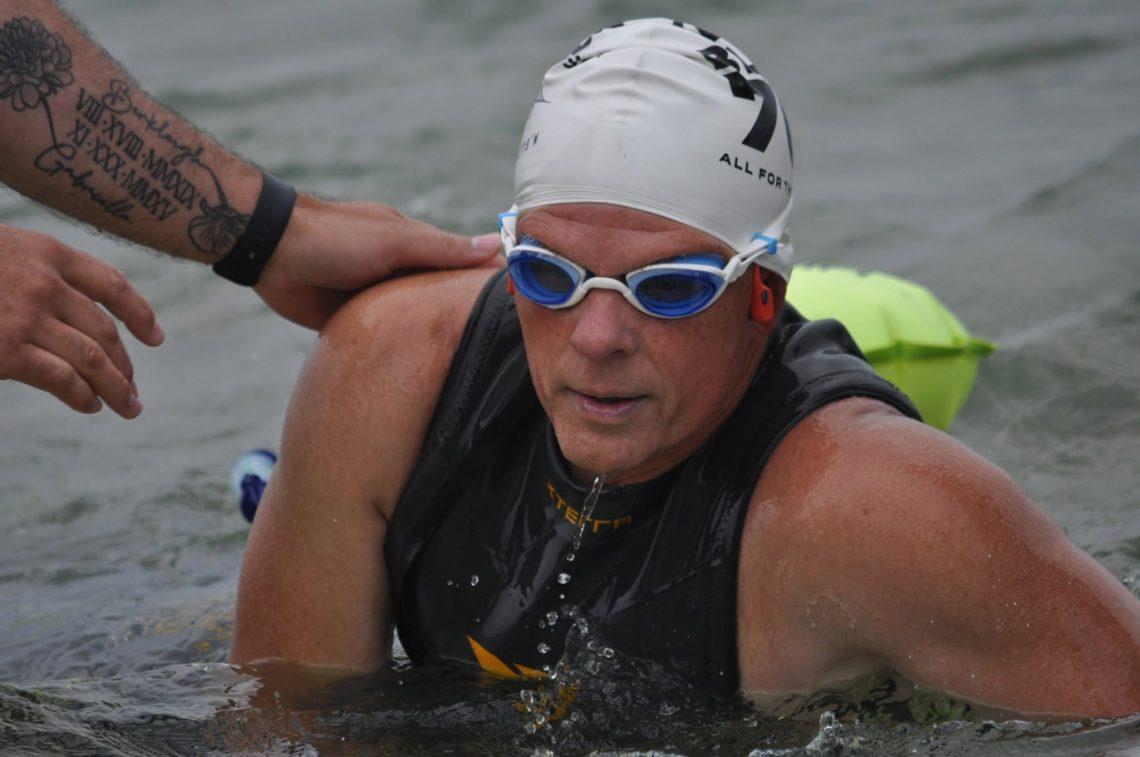
As I waded into the Mackinac Straits for the annual Mackinac Bridge Swim on an overcast July morning, I wasn’t sure what kind of performance I was in for. My first organized open water swim was at an inland lake a year earlier. Now, I was one 309 swimmers from 33 U.S. states and Canada. We had come together for what has grown into a destination swimming event in the North American Great Lakes region.
The bridge, which connects the U.S. state of Michigan’s two peninsulas, is officially listed as a five-mile span. Swimming under it is considered 4.5-miles. But that assumes you are swimming a straight line in this famously temperamental stretch of water where Lake Michigan on the west comingles with its eastern neighbor, Lake Huron. On this particular day Lake Michigan was in a bullying mood. But we’re getting ahead of the story.
Eric Hansen, who calls himself the Spash Director, created the event in 2022 for multiple reasons. It gives open water swimmers a safe and supportive way to accomplish a bucket list item. Hansen goes out of his way to let people know this is not a race. There is no official timekeeping. The end is not called a finish line. It’s the “I did it line.”
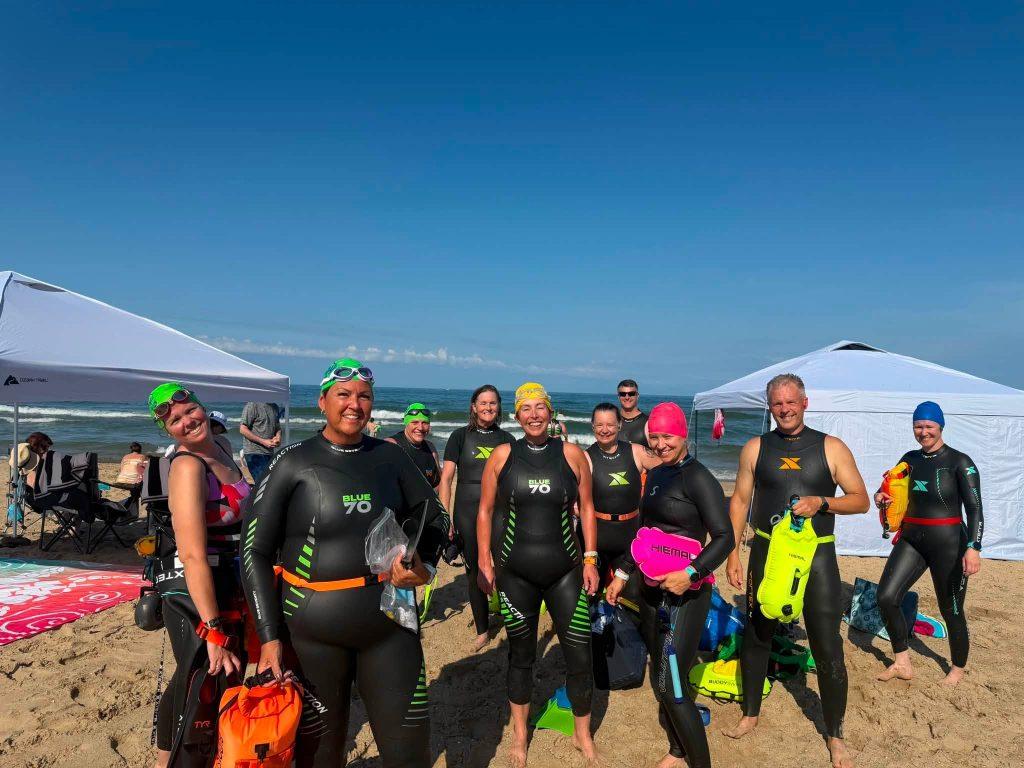
In addition to the health benefits, Hansen has fostered a strong community element. The cost of signing up and other fundraising efforts go to first responders via a nonprofit organization. This year the event pulled in $120,000, which Hansen split between the agencies that serve the two cities on either side of the bridge. From its modest start in 2022 when 30 stalwarts took part, Hansen said more than $375,000 has been raised and donated.
Why open water?
Other than being vaguely aware of those adventurous types who swim the English Channel, I hadn’t paid much attention to the world of open water swimming. My swimming history is casual at best. I was lucky to grow up with a built-in pool in our Northern California backyard and live an hour from the Pacific Ocean. I was never on any school teams or clubs. I started swimming at our local recreation center pool a few years ago to break the monotony of COVID-era home exercise.
But endlessly following the black line at the bottom of the pool got tedious. When I saw a video of my friend Martha churning her way toward the I Did It Line at the 2025 Mackinac Bridge Swim, I was intrigued. Could I actually last nearly five miles in open water? I had never swum more than 1,000 yards at one time. And that was in a pool. But I decided to give it a go. I’m 63 years old. Better try this while the body is still holding up.
A teacher, a nurse, a firefighter and an engineer go for a swim
For 15 years Curt and Poranee Penland have organized one of the more distinctive Sunday summer outings on the Detroit River. They transport friends and members of a swim and triathlon club on board Nisa Marie, their 30-foot Wellcraft, to a designated location for a prescribed 2.2-mile swim.
The 28-mile river forms part of the international border between Michigan and the Canadian province of Ontario. It’s an ideal outing for those wanting open water conditions, especially if the wind and boat wakes dish up a bouncy day. Not only do you get the novelty of swimming into Canadian waters (perfectly legal as long as you don’t get out), but you might glimpse the top of a passing freighter as you swim along the outside of the Livingston Channel, the river’s deep-water shipping lane.
The vibe is casual as people gather at the Penland house that sits on a canal in Gibraltar, Mich., on the southern end of the river. Some are old friends. Others have never met before. People often bring baked goods and cookies for the post-swim ride home. As we change into wetsuits and figure out if the June water temps require extra layers, the conversation turns to tips and gear advice. It’s something I would find throughout my venture into the open water swimming community: There’s no shortage of extreme friendliness and a willingness to help.
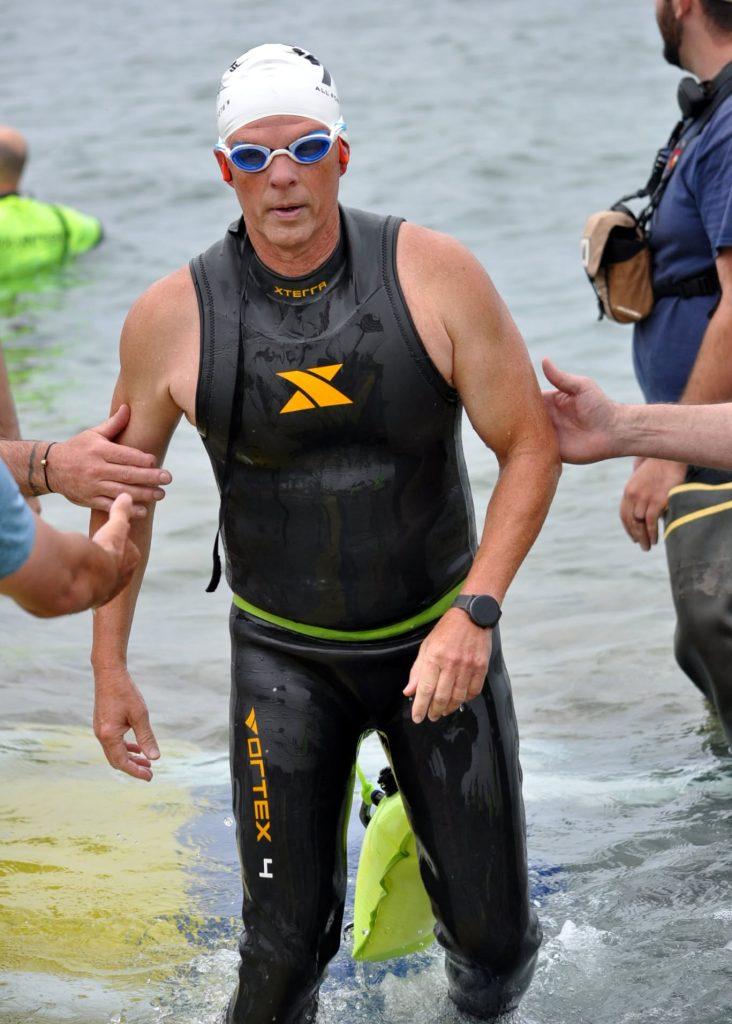
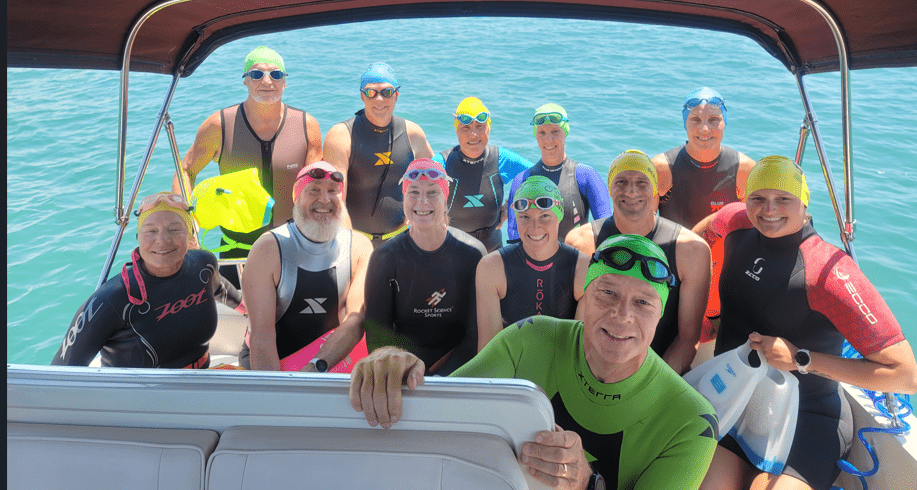
On the boat this past summer I happened into several others who were also training for the Mackinac Bridge Swim. While their reasons varied, they were alike in a determination to take on something big.
There’s April, a fifth-grade teacher in Detroit who matches her disciplined exercise routine with an infectious positive attitude. A car accident thwarted her plans to take part in last year’s Edmund Fitzgerald Memorial Swim.
“After that, I made my mind up that I was going to complete the Bridge swim,” she said.
Jess is an oncology infusion registered nurse. Her experience with cancer is also deeply personal, having lost a family member to the disease.
“I thought it would be a good challenge to push myself to do something out of my comfort zone, and do things for people who can’t anymore,” she said.
Monica, an electrical engineer by training who grew up swimming in her native Romania, is the elder stateswoman.
“I am a very slow swimmer and getting slower, so I thought this was my last chance,” she says in her usual matter-of-fact way.
Heather works as a 911 dispatcher and firefighter when she’s not being a mom to two boys. When she cheerfully showed up one Sunday afternoon with her freshly mangled bloody big toe in a bandage, you got the sense that, for Heather, acknowledging pain isn’t worth the bother.
April and Heather quickly bonded over the fact they were also both training for the Mackinac Island Swim, in addition to the Mackinac Bridge Swim. The Island swim is an 8.2-mile water trek (some might call it a slog) around the state’s tourist crown jewel in Lake Huron each August. Many people do it as a relay, swimming two-mile legs. April and Heather were each doing the whole thing. Of course they were.
“My husband thinks I’m crazy,” Heather says as Curt guns the engine and we head to the launching point.
Ten minutes later we’re ready to start. Curt gives out the instructions. The Nisa Marie will be tracking all swimmers. If you decide today is not your day, or you want to stop early, signal that you’re done and the boat will come get you. If you reach the end when a freighter is passing by, don’t panic. Hang out on your inflated swim buoy. The ship’s wake may initially pull you into the channel. Wait a bit and there will be a reverse current that sends you back to where you were moments earlier. Curt speaks from experience. He was in the water when a 1,000-footer sailed by and sent folks on the eddying round trip.
Curt steers the Nisa Marie so its aft is facing the start point. A photo is taken and Curt gives his signature instructions. “The pool is open!”
And with that, we jump off the back deck and enter our individual swim worlds.
Smoke on the water, plus waves and current
The days before this year’s Mackinac Bridge Swim brought uncertainty. Eric Hansen put a video on the swim’s Facebook page showing the bridge stretched atop calm water but obscured by thick wildfire smoke. A go/no-go decision would be made by 5 p.m. Friday before the swim in consultation with the U.S. Coast Guard. (The Coast Guard plays a key role in the event, in part because they close the Mackinac Straits to shipping traffic for two hours.)
I thought about all the physical training and mental gymnastics that had gone into preparing for this. I incorporated swimming into personal travel for nine months. From Wisconsin to Iowa, Hawaii and Long Beach, Calif. On two trips to my hometown of Los Gatos, Calif., I returned to same outdoor high school pool where I first took swimming lessons more than 50 years ago. In addition to the Detroit River, I swam off South Bass Island in Lake Erie. I joined the incomparable Chubby Mermaids club out of Kalamazoo, Mich., for a memorable four-mile July 3 swim in Lake Michigan.
By Friday afternoon the smoke was clearing. The swim was on. As the Star-Spangled Banner played Saturday morning, I looked at the people in wetsuits and colorful caps around me and marveled that I was among them.
I’d like to say that this memorable moment gave way to my best swimming day. It didn’t. Maybe it was adrenaline, but I started too fast and couldn’t settle into a relaxed breathing pattern. Then came the conditions. On this day, the waves picked up from the west. Some estimates would put them at four feet. Lake Michigan became the aforementioned bully. A strong current kicked in and pushed people further into Lake Huron.
Volunteers in power boats earned their non-pay giving rides to myself and dozens of others past rough patches so we could get back in and finish. Bridge swim veterans said it was the roughest conditions they had seen since the event began.
You won’t be surprised to learn that each of my Detroit River boat comrades gutted things out and were happy with their results. Although a rogue wave claimed April’s phone during the crossing, her joy would not be denied. “I couldn’t care less because I did it!!!” she beamed afterwards.
The next morning, I walked back down to the official start line and stood at the water’s edge. The sun, blue sky and a fresh north breeze had replaced clouds and smoke. It was surreal to watch a freighter easily glide under the bridge where I had battled the Straits the day before.
Someday, I thought, I want to try this crossing again. The water is addicting. It calls you to think about – and beyond – yourself. Even if the play’s ending is not what you expected. And maybe that’s what it’s all about. Like Curt says: The pool is open. But it’s on us to take the plunge.
Todd Nissen is a former news reporter and corporate communications director who lives outside of Ann Arbor, Michigan in the United States.

Outdoor Swimmer
Outdoor Swimmer is the magazine for outdoor swimmers by outdoor swimmers. We write about fabulous wild swimming locations, amazing swim challenges, swim training advice and swimming gear reviews.