

The art of endurance
Does swimming imitate art for Katie Pumphrey, or vice versa? Rowan Clarke finds out
Her recent trip to England to swim the English Channel and visit London’s Royal Academy tells us a lot about Katie Pumphrey. Not just that she’s an endurance swimmer and visual artist, but that these two threads of her life are entwined.
Newly returned home to Baltimore, after her third successful English Channel crossing, Katie balances her recovery with preparing for her upcoming exhibition entitled ‘Swimming Pool’ at Baltimore’s Creative Alliance. Katie tells us how she explores art, adventure and environment through endurance swimming.
What lurks beneath
Looking at Katie’s incredible large-scale paintings, you can immediately see the influence that swimming has had on her art. It’s not only that she uses imagery of swimmers and marine life, suggestions of water and waves, but also that she evokes the feelings you get when you swim in open water.
“My paintings are deeply influenced by my experiences in the water,” she says. “It’s a mix of abstraction and imagery, but it also looks at that teetering balance between chaos and calm, or anxieties and control that we all feel, and the ways that our imagination plays tricks on us.”
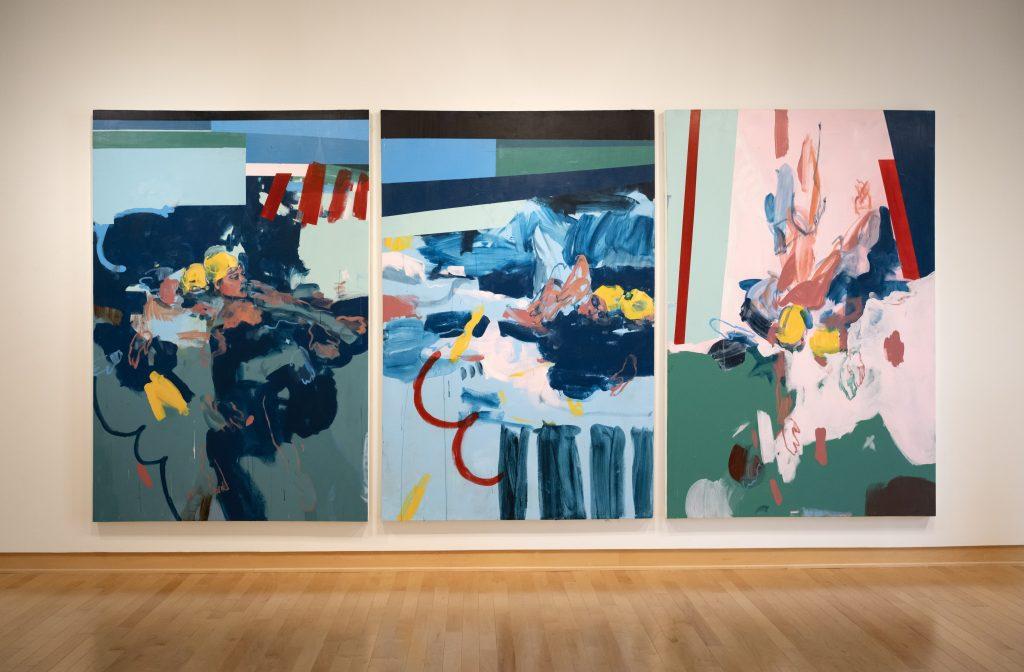
Spending hour after hour submerged in deep, often dark water, Katie has certainly experienced tricks of the imagination. She draws on this, depicting suggestions of sea monsters, of what lurks beneath as an allegory to describe our anxieties, fears and stress.
“I want that threatening feeling, that little bit of anxiety in the work,” she says. “But because that can be really overwhelming, I try to pair it with playfulness and humour, which I feel is often our go-to move to get through difficult things. I certainly use humour during swims.”
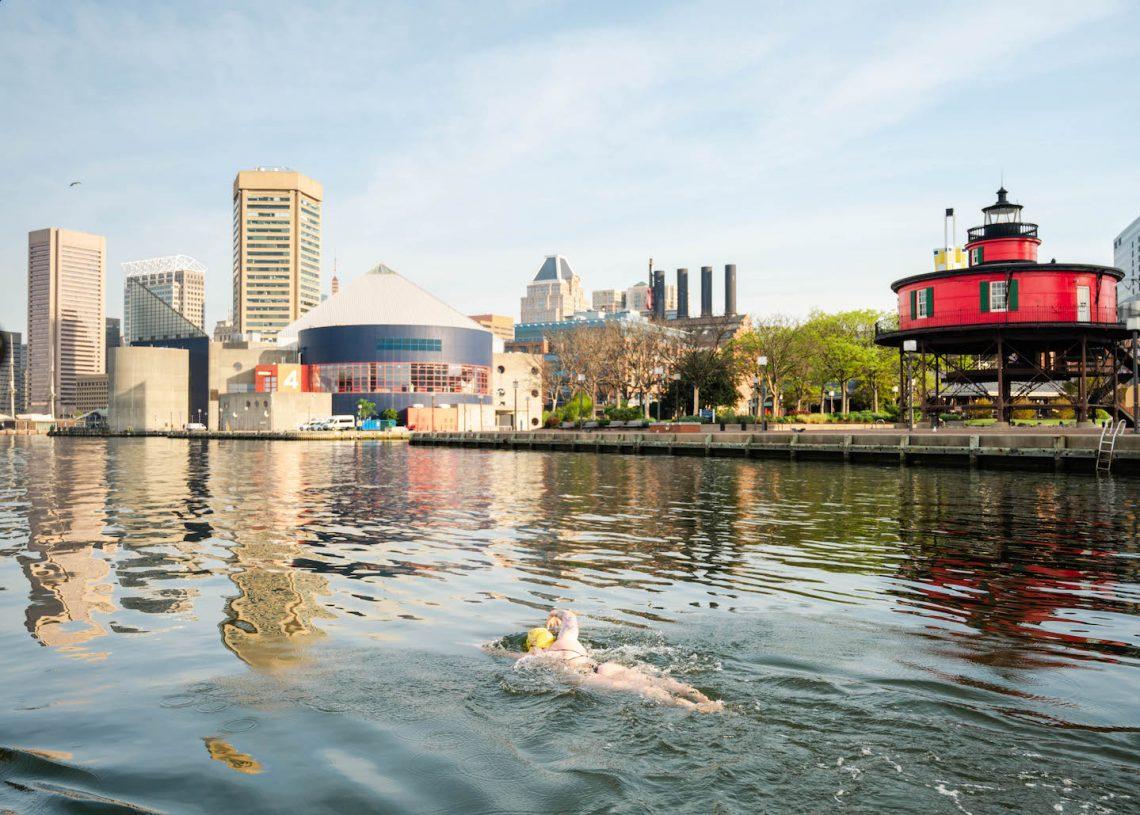
One particular painting, Watson and the Shark, is connected to Katie’s extraordinary June 2024 Bay to Baltimore swim, a 24-mile swim from the Chesapeake Bay Bridge to the city’s inner harbour.
Drawing its composition from a 1778 work by John Singleton Copley by the same name, her large-scale painting features her, her crew and a small, lurking shark as a metaphor for our anxieties and fears. While Copley’s shark was clearly painted by somebody who’d never seen a shark, it was also a representation of people’s fears. It’s this reflection of history as well as her own swimming experience that particularly characterises Katie’s work.
“The call and response with a historical painting is another form of repetition,” she says. “A lot of my work has the repetitive hands of swimmers, strokes over and over again.”
Repeating swims
Repetition is important to Katie’s swimming, too. Not only the repetitive action of swimming long distances, but also repeating specific swims. Her third English Channel swim is unlikely to be her last.
“Every swim is so different, but I also try to compare them,” she says. “Like with my recent Channel swim. Did I feel stronger than I did in my second swim? Were the conditions harder? Was it mentally harder?”
Katie did her first Channel swim in 2015. As a new endurance swimmer back then, she says that she had a lot more fear. But despite a decade of experience and feeling much more relaxed, especially with swimming at night, she still found her 2025 crossing brutal.
“I think that’s why I like repeating and revisiting something I’ve done before. You’re swimming in the same stretch of water, but it’s a totally different feel,” she says. “You have those familiar moments to pull from, especially when your anxiety or stress spikes – I always call it my emotional metre, and when that tips towards the negative side, I’ve been there before, so I know how to get it back to neutral. I always try to keep my emotional metre at neutral, not too excited and not too hard on myself.”
A world first
Unlike her English Channel swims, two Catalina Channel swims, and her 2017 circumnavigation of Manhattan Island, which made Katie the 194th person to achieve the Triple Crown of Open Water Swimming, Katie’s Baltimore swim was a complete novelty.
This spectacular swim was special for many reasons. The geography was both new and familiar, the water was warmer than anything Katie had experienced before, and being the first person to charter this route presented all kinds of practical challenges.
“Swimming at home was unique. I was swimming through a much narrower waterway where I could see land the entire time, and passing landmarks, so I know exactly where I was”, she says. “The planning side of things was wild, because you don’t have the system in place with a boat captain who’s accustomed to piloting a swim, and it’s also weird to ask them to be available for a week because we didn’t know which day the weather would be right for the swim.”
Plus, the swim had personal and environmental significance as it represented positive changes in Baltimore’s harbour driven by a project to clean up the water.

Like many city harbours, Baltimore’s waters are prone to collecting rubbish and debris, especially after heavy rain. There were boats which skimmed rubbish off the water, but then a local Environmental scientist and shipbuilder, John Kellett, invented Mr. Trash Wheel, a trash interceptor who scoops up rubbish in his mouth. Soon, John Kellet had partnered with local nonprofit, Waterfront Partnership, whose idea it was to add googly eyes, name him and give him a character – with no idea how he would become a Baltimore icon along with his small family of trash inceptors, Professor Trash Wheel, Captain Trash Wheel and Gwenda, the Good Wheel of the West.
“Because he’s doing good things for our water and because he’s so iconic, cool and cute, people pay more attention,” says Katie. “They have an event every year on his birthday where they exhibit all the fun things that he’s collected – a rocking horse, or someone’s pet Python.”
A personal quest
Led by the Waterfront Partnership’s healthy harbour initiative, work over the last couple of decades made the city harbour Patapsco River swimmable and fishable. A milestone that Katie’s epic swim would celebrate.
But then the swim’s start was delayed by the tragic collapse of Baltimore’s Francis Scott Key Bridge that cost six construction workers their lives.
“That waterway is the entry to our port and our city, and so much changed when the Key Bridge collapsed,” says Katie. “It changed the community, our skyline, and impacted a lot of people. So the swim felt really important because it felt like it could be this huge positive thing for our city at an important time.”
Delaying the start meant that Katie would be swimming in the summer. During a heatwave, as it turned out, when the water reached almost 28°C. “It was the hottest I’ve ever been,” she says.
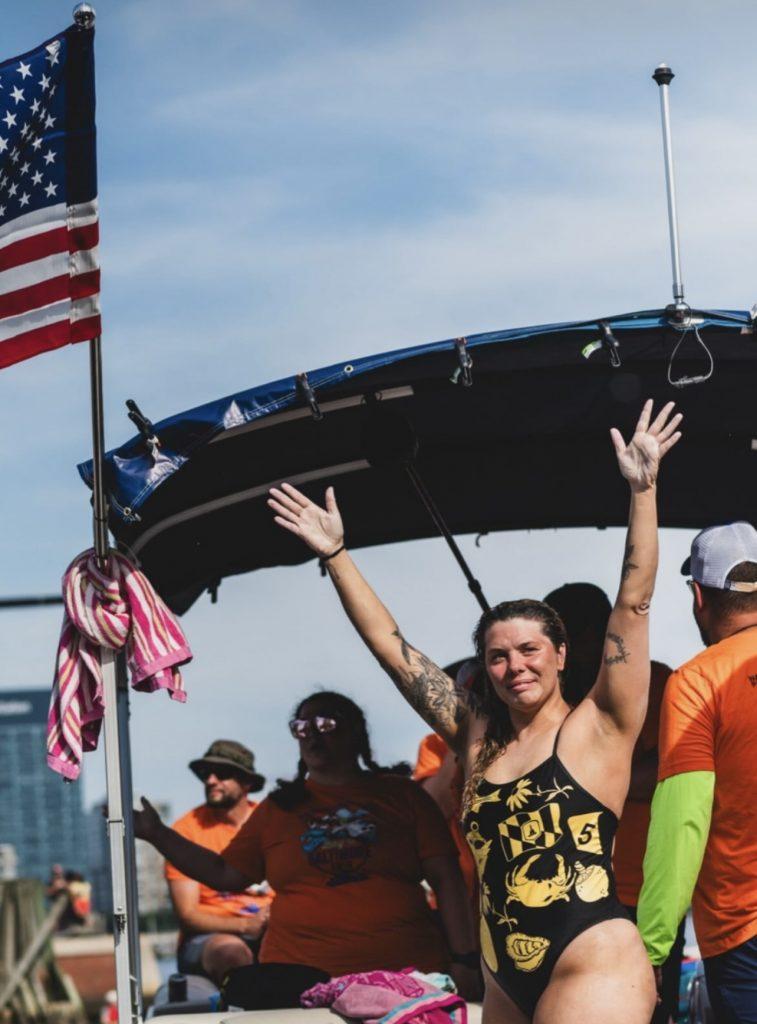
She started in Chesapeake Bay, where one of the East Coast’s biggest open water swim events takes place each year, and finished through the Patapsco River into the city’s inner harbour.
“It felt like this lovely connection, starting in water that people are positive about swimming in and finishing in Baltimore City waters where people have a lot of feelings, and rightfully so, about swimming in our harbour,” says Katie, who partnered with the Watership Partnership who has been doing water quality testing in Baltimore five days a week. “Those feelings come from decades of abuse to our waterways, mistreatment and mistrust. It’s going to take people a long time to come around to the idea and trust the science.”
Katie finished her swim with a cavalcade of supporters, including Mr Trash Wheel, boats, kayaks, paddle boards, news helicopters and hundreds of supporters.
“Mr Trash Wheel joined me for the last mile. Because he’s floating, they can move him, so he followed behind, looking like Pac-Man,” she says. “When I did the English Channel last week, I finished into a rocky edge – nobody was there, obviously. So, the Bay of Baltimore was one of the wildest experiences I’ve ever had in my entire life.”
Creative swims
Over the last decade, Katie has refined and perfected her formula for amazing feats of endurance swimming. From her training and feeds to her crew led by her ultimate supporter, her husband Joe, she has in her wheelhouse all the tools she needs to continue to conquer oceans.
But ultra marathon swimming is so much more than physical feats of endurance. For Katie, her swims give her space to be creative, problem-solve her artwork, and help support environmental causes. It’s sport that she loves deeply, both doing it and how it’s woven into her work and life.
“When you’re an endurance athlete of any kind, especially a swimmer, you’re pretty comfortable with being alone with your thoughts,” she says. “But, that ends up being a great time to problem solve, and I think that’s one of the biggest tools needed for creativity. I problem solve paintings a lot while swimming. During the Channel swim, at twilight and sunrise, I was yelling out to my husband to write down different colours and a few keywords – I’m pretty sure I problem solved a whole painting!”
Whether it’s painting or helping make more cities swimmable, we can’t wait to see where Katie’s endurance swims take her next.
Katie’s exhibition ‘Swimming Pool’ will be showing Creative Alliance in Baltimore from 5 September to 11 October. Find out more at katiepumphrey.com