April 2023,  COACH,  EXTRA,  Premium,  Top Tips,  Training and Technique

Pool skills: underwater dolphin kick

Register to get free articles

No spam Unsubscribe anytime

Want unlimited access? View Plans

Already have an account? Sign in

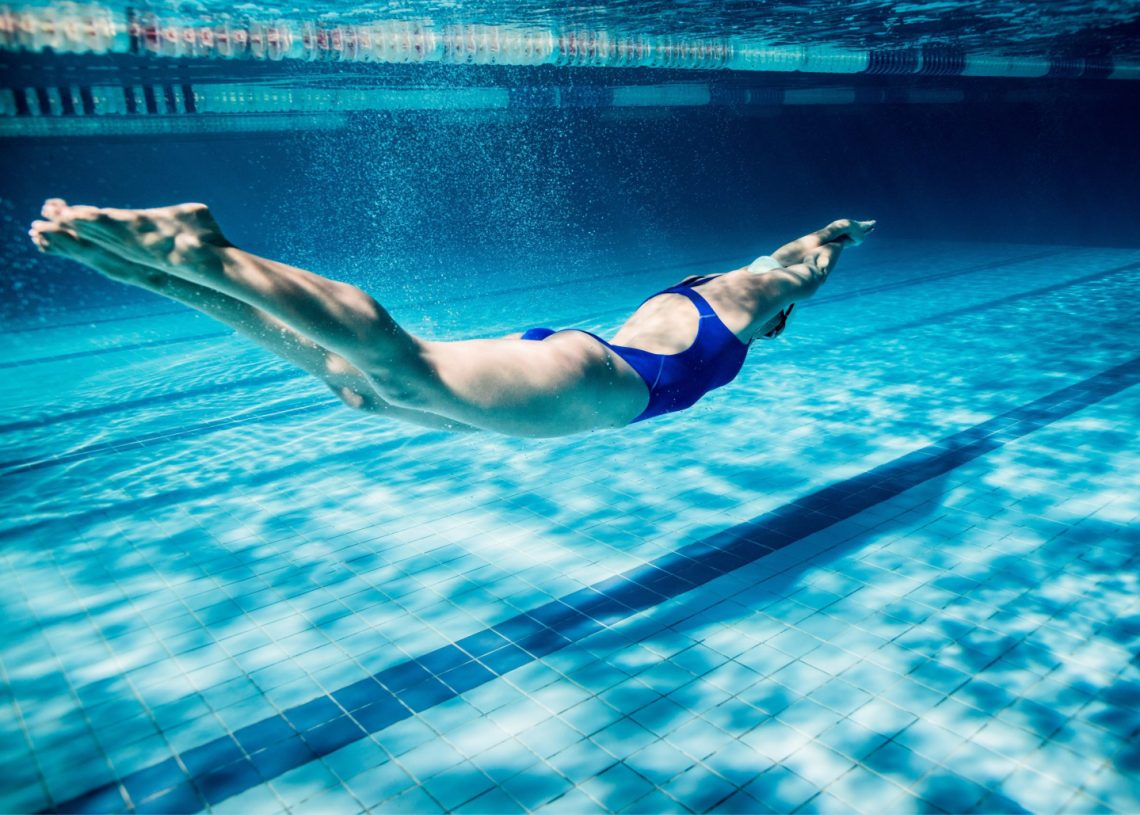
Improve your swimming with an underwater dolphin kick, says Simon Griffiths.

As a club swimmer in the 1970s, we were taught to get to the surface as soon as possible after starts and turns. Back then we thought that was the fastest way to swim. Then during the 1980s and 90s, elite swimmers started experimenting with underwater dolphin kicking after starts and turns. Michael Phelp’s underwater skills played a big part in his eight gold-medal haul at the Beijing Olympics in 2008.

Learning this skill as an older swimmer can be frustrating. You need flexible shoulders to get into a streamlined position and great mobility in your spine to allow that powerful undulating motion. Plus, you need good core strength and flexible ankles. But it’s still a skill worth practising even though it’s of little practical use in open water. First, as it helps your flexibility, mobility and core strength it is good for you and your swimming in general. Second, swimming like a dolphin feels amazing.

Underwater dolphin kick practice

  1. On land, lie on your back with your arms above your head. Place one hand on top of the other and lock them together by using the thumb of the one hand to clasp the other hand. Keep your head in a neutral position (looking straight up towards the ceiling) and press the inside of your arms against your ears. Tighten your core, straighten your legs and point your toes. This is the starting streamline position you’ll need in the water.
  2. Now try getting into the same position while in the water. You may sink (I do) but it doesn’t matter. Just try holding the position for a few seconds, then come up for air. Try the same thing on your front.
  3. Once you’re comfortable with the position, try pushing off from the wall and getting into it for an underwater glide. Start by sinking about half a metre. Get your arms and head into position first, then push off the wall, straightening your legs and body into the glide. Practise on your front, back and side. Stand up as soon as you need to breathe.
  4. See what happens to your body. Do you gently float towards the surface or sink? Does it change as you breathe out? Can you control it by adjusting the angle of your hands? Just relax and get used to gliding in this streamline position. Aim to stay about 50cm below the surface for now.
  5. Now do the same thing, but this time, at the point where you feel yourself slowing down, try some gentle dolphin kicks to maintain momentum. The motion starts around your midriff, moves through your hips and ends in your toes. However, excess undulation of your hips will slow you down so don’t go crazy. Again, try on your front, side and back.
  6. Focus on your feet and see if you can feel the water pressure on both the up and down kicks. You should be able to generate propulsion with both.
  7. You can now experiment. Try varying the depth, how much you undulate, how fast you kick.
  8. Finally, work on the transition from underwater dolphin into your regular swimming on the surface. Use dolphin kicks to power back to the surface and switch to swimming without losing speed.
  9. Initially you might just do one or two dolphin kicks before surfacing but with practice you can add more. However, don’t push your breath holding to its limits (read about Shallow Water Blackout in this month’s View from the Water).
  10. If you suffer from water going up your nose, try breathing out gently through your nose or using a nose clip.

This article is from the April 2023 issue of Outdoor Swimmer. Click here to subscribe to the magazine.

To see all the online content from the April 2023 issue of Outdoor Swimmer, visit the 'Underwater' page.
Stay up to date with The Dip, our free weekly outdoor swimming newsletter.

I started Outdoor Swimmer in 2011 (initially as H2Open Magazine) as an outlet for my passion for swimming outdoors. I've been a swimmer and outdoor swimmer for as long as I remember. Swimming has made a huge difference to my life and I want to share its joys and benefits with as many people as possible. I am also the author of Swim Wild & Free: A Practical Guide to Swimming Outdoors 365 a Year, I provide one-to-one support to swimmers through Swim Mentoring and I'm the creator of the Renaissance Swimmer project.