


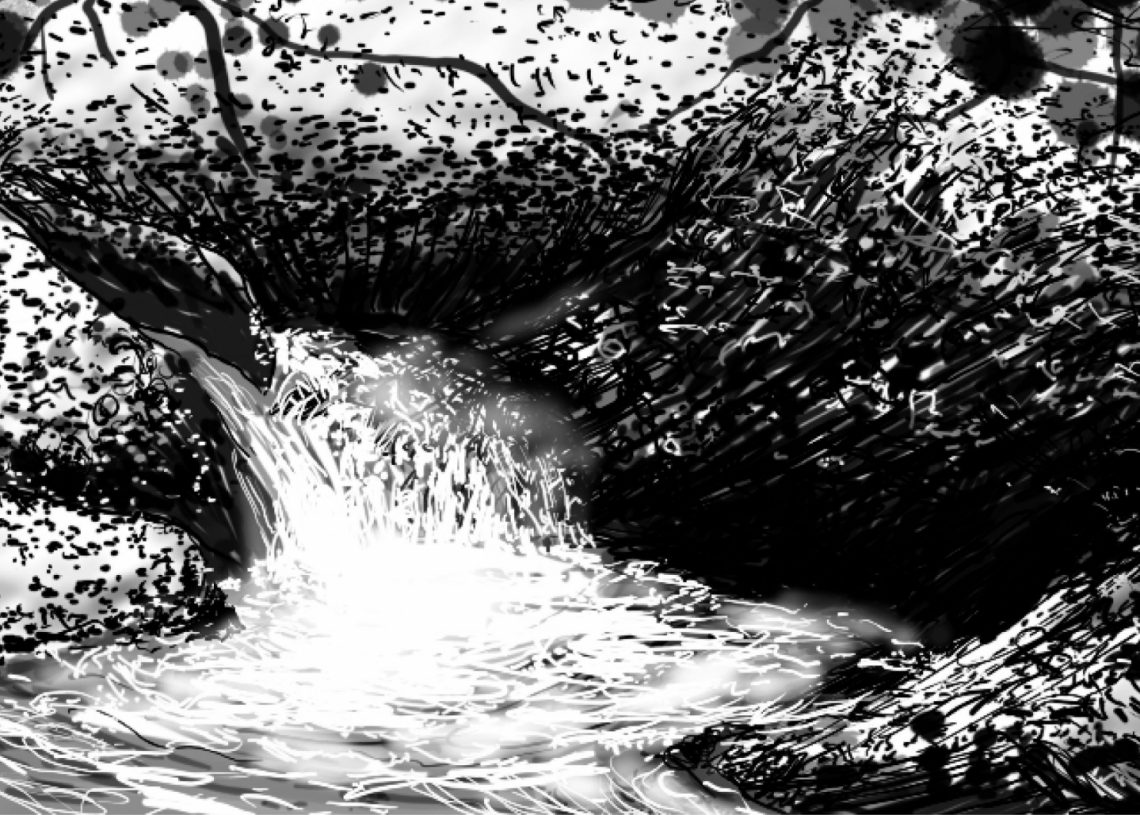
The Green Hill: Letters to a Son
In 2017, Sophie Pierce’s life changed forever when her 20-year-old son Felix died suddenly and unexpectedly. Thrown into a new world of loss, she had to find a way to keep on living. In her book, The Green Hill: Letters to a Son, Sophie writes a series of letters to Felix – composed during walks and swims taken close to his grave on the Green Hill in Devon – while learning to live in the landscape of sudden loss, navigating the weather and tides of grief. Here Sophie shares an extract from her book…
22 March 2020 – Mother’s Day
Oh my darling. This is such a strange day. Amid strange, strange times. Mother’s Day is always so mixed for me. Joy that I am mother to two amazing young men. Terrible sadness that you are not here. I still can’t believe you’re not here. I love you.
And now the country is in the grip of a plague. The Coronavirus. It feels biblical, apocalyptic. From tomorrow we will be confined to barracks in unprecedented times. Pubs, restaurants, cinemas will be closed. No socialising. Life will go on pause.
When it first started, my thoughts immediately turned to you. How would it have affected you? This is another major thing you are not part of, not experiencing. Eventually it will pass. But not for some time, I suspect. For the moment, life is on hold. We have to appreciate the small things, the little things, find beauty in them, solace in them, even.
We are confined to home and our immediate vicinity. I’ve been having to walk to my usual swim spots, which is certainly making me realise how lazy I am usually! The two nearest are each about forty-five minutes’ walk, which does mean that what is normally a ‘quick dip’ now takes at least a couple of hours. But in this new world, does that really matter? Luckily the weather is so beautiful – it seems to be permanently sunny, so walking is a pleasure.
Yesterday I went to the Queen of the Dart. You remember it, that pool to the south of town, named after a copper mine that was there in Victorian times? I schlepped up the road towards the moor, then diverted down that old track opposite the tatty farm. The roads were wonderfully empty. It was so quiet and peaceful. As I walked down the final stretch, Summerhill Lane, I saw a host of spring flowers growing out of the high Devon banks: clouds of white stitchwort, violets like little purple jewels, blackthorn blossom and primroses. There were lots of shiny, green wild garlic leaves bursting through too. Then, alongside the river, there were great swathes of wild daffodils, and wood anemones – little white stars clustering under the trees.
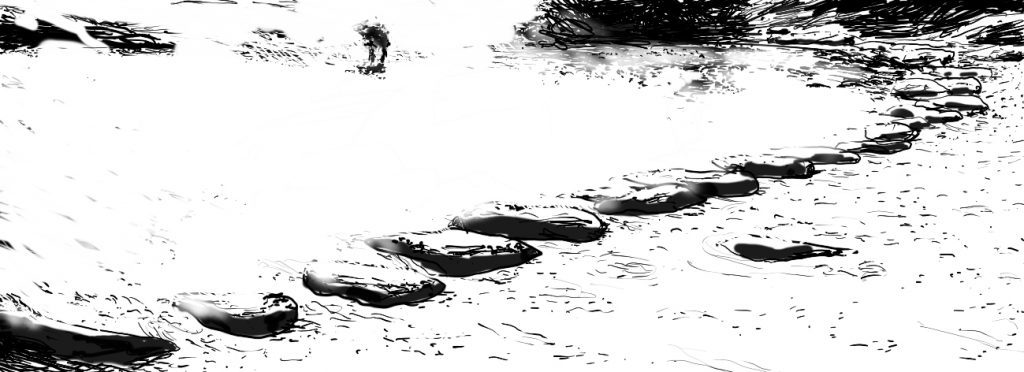
Beside the river, as I stood on the sandy bank avoiding the large cowpats, contemplating the water, I thought about you. How, in this time where I’ve suddenly been freed from various constraints, I may now have more time for you. And yet, it doesn’t really change anything. I suppose it has removed external pressures, which is a good thing. Anyway, I found great solace in wading slowly into the clear, clean river, launching my body into the cool, dark centre of the pool, and swimming over to the young beech tree that overhangs the other side. I lay on my back and looked up at the tree’s branches spreading above me, about to come into leaf. I was alone, but I didn’t feel alone; I felt you were there with me, somehow present.
Watch the sunrise
I wake early and feel restless. What shall I do? I don’t feel like going back to sleep. Then I have an idea: watch the sunrise. It always makes me feel better. I check the phone and the weather is clear. Quickly, I dress, and Tarka and I head off to the moor. We cross the cattle grid with its habitual rumble and I drive along, unsure where to go. I have a tradition of watching from the old firing range, but I want to go somewhere different. Then it strikes me: Saddle Tor. It faces east.
We often used to go to Saddle Tor with the children. It’s just by the more famous Haytor, beloved by thousands of Dartmoor tourists. It’s a good climbing and sledging spot and is conveniently near the road for small legs (and lazy adult ones). Its twin grey granite outcrops are linked by a smooth, grassy plateau – the saddle.
It is already light, with a pinkness over in the east, as I start climbing the tor. There is a cold wind and, as I reach the top, the sun is not yet risen, though there is a glow forming where it should be. There’s a few more minutes until sunrise so I walk down the other side of the tor, to kill some time, and then retrace my steps back to the top, to find somewhere to settle in and watch the spectacle.
I find a perfect niche in the northerly outcrop, sheltered from the wind. I sit, enclosed by three walls, looking out to the east. I focus on the point on the horizon that is lightest, by the Teign estuary and the sea beyond. Suddenly, I see a gleaming pink-orange dot in the distance. Gradually it expands, molten, and, before my eyes, the sun rises up, a burning ball of power and energy. It is magical, mysterious, reassuring and frightening all at the same time. It draws me like a moth to a flame.
Why do I find it so compelling? It is like God, or an absence of God, or the presence of something, whatever that might be – something bigger than me, at any rate. It is always there, whether I am or not, rising and setting, every day, eternal. It is both of our world and apart.
Somehow, it reeks of time. It drips with time, and also with immortality; with our incapability of understanding or beating time. We, in our little, parcelled-up lives, try to challenge time. But nothing, and no one, can. Is Felix in that burning ball, rising and falling every day? I feel connected with him at these moments of transience, of liminality, when night is turning into day. The threshold moments of dawn and dusk feel like momentary portals into eternity, or, at least, into a world where life does not have physical form in the way that we know it.
Everything around me is bathed in gentle, pink light. The heather and bracken are glowing. I turn and look behind me, and as far as the eye can see there is pink light. I continue to watch the sun as it gets bigger and bigger, filling the sky until eventually it loses its form and is just light.
“A maze of channels and gullies”
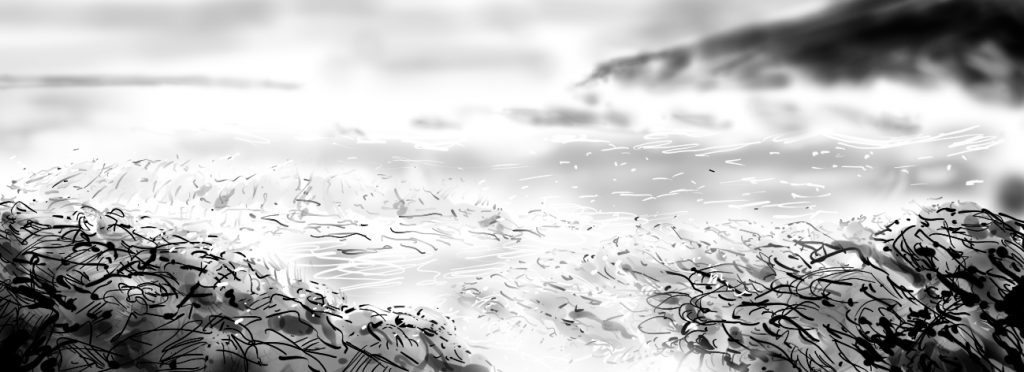
I am down by the sea at Thurlestone. It is an overcast and febrile day. There is blue sky in the distance, but over the sea there are grey, oppressive clouds. The wind is strong. White horses and kite surfers are scooting about on the surface of the sea, being blown this way and that.
Alex is collecting seaweed. It is low tide. I am swimming among the rocks, where I am exploring a maze of channels and gullies. The water is grey and murky and still. Beyond, out in the open water, the sea surges and rages. I feel calm, engaged, moving past curtains of seaweed hanging at eye level, watching them suddenly glisten, transformed, every time the sun comes out. And then equally suddenly, they retreat back into murk when the sun goes in again. It’s as though someone is turning the lights on and off.
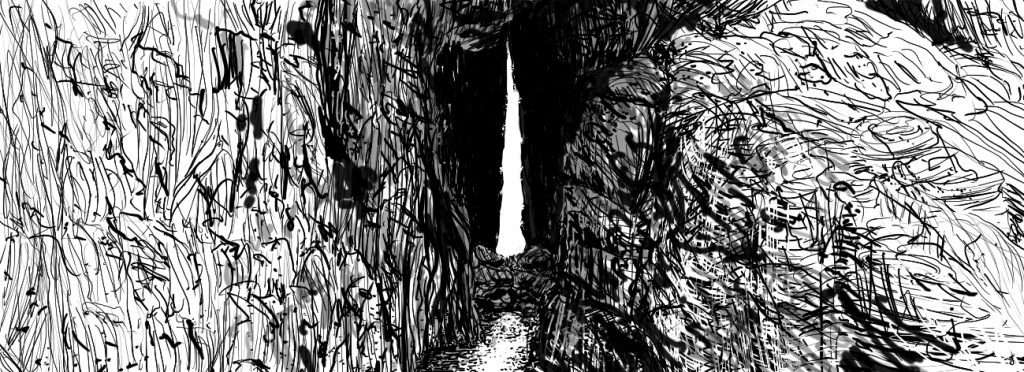
I swim through and alongside fat strips of purple dulse, rubbery wracks, bright-green slimy weed. I see circles on the rocks, the homes of limpets, temporarily vacated while they are off hunting. I see a snakelocks anemone exposed out of the water – fat, shiny and greeny-grey with its purple tentacles tucked in. I enjoy quietly swimming among the weed, feeling the rocks and sand beneath me, meandering aimlessly, following the gullies into dead ends and out again. Eventually I follow one channel towards the open sea, where there is moving water and swell. I let myself be sucked out, pulled and pushed by the waves. I am consumed by the sea, immersed in its shapelessness.
Afterwards, I sit among the rocks and remember a trip to this very beach when Felix’s paternal grandparents, Lesley and Paul, were visiting. It was a very hot, sunny day. The boys wore their wetsuits and played in and around these rocks where I’ve been swimming today, except it was high tide. They jumped and dived off the rocks into the pools and gullies. They were here. Felix and Lucian were here. It seems so strange now. Are they somehow still here?
I remember another occasion, a very long time ago, when we visited another beach, just round the corner, when the boys were about ten and seven. It was an incredibly hot day, so hot we could hardly walk on the sand. That is the only time I’ve ever experienced sand as hot as that in Devon. It was roasting and we all spent a lot more time in the water than usual.
If Felix had lived, I probably wouldn’t be dredging up memories like this as I sit on this beach. He would still be physically present in my life so I wouldn’t need to do that. However, alone here today, I actively try to mine those happy times from the past. It is good to remember, almost to try to conjure up his presence.
In some way, am I closer to him now than if he had lived? Hardly – that’s wishful thinking. But I feel he occupies a greater part of my mind and heart than he would have done if he were still alive. If he were still here, making his own way in the world, earning a living, having a family, he would not preoccupy me to the same degree or indeed in the same way.
Looking at my feet in the sand, I feel the grains between my toes and think of the millennia that this sand has existed in this world, in different forms perhaps – as rocks in different places, as shells, all being moved around by the sea and ground down into what it is today. Matter is neither created nor destroyed. So, are we all still somehow alive when we are dead, but in a different form? I think, somehow, we are – but not ‘alive’ as we know it. If we are ash and dirt, we are no longer sentient. But, somehow, we continue to exist.
Not far from here – about 10 miles – is the Green Hill. Beside it flows the Dart, which comes out into the sea at Dartmouth, just along the coast. Felix’s remains in the earth on the Green Hill will, perhaps, travel down the river and out to sea, and eventually, perhaps, to this spot, in some form.
There are young families all over this beach reminding me of past times. The story didn’t turn out as it was supposed to. All these families have expectations, as indeed did we. There is nothing wrong with expectations, except they should never be the focus. The focus should be the precious present, and yet here I am thinking about the past. Back then, I don’t think we were really thinking much about the future. In fact, maybe we didn’t really have expectations, as such. We just assumed life would turn out a certain way. But it didn’t.
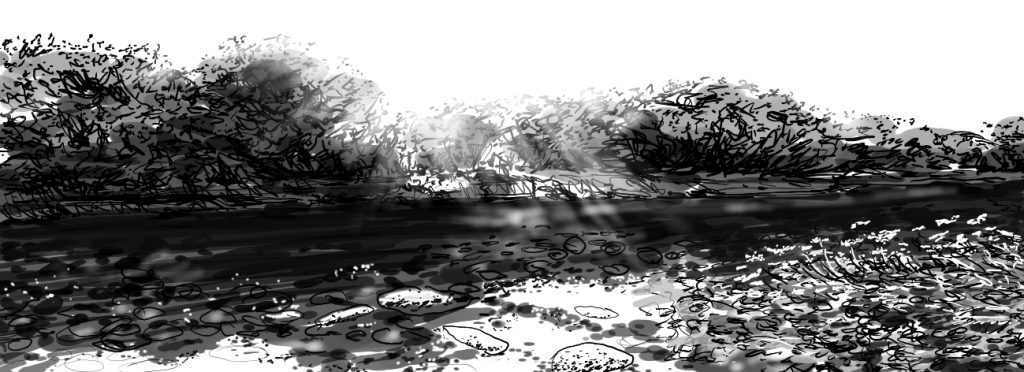
The Green Hill: Letters to a Son, by Sophie Pierce, is available to buy now. The book is illustrated by Alex Murdin, Felix’s dad. They are of the landscape and water that holds their grief.
This article is from the March 2023 issue of Outdoor Swimmer. Click here to subscribe to the magazine.

Outdoor Swimmer
Outdoor Swimmer is the magazine for outdoor swimmers by outdoor swimmers. We write about fabulous wild swimming locations, amazing swim challenges, swim training advice and swimming gear reviews.