


Risk and reward in winter swimming
“There is no space for either bravado or cold-shaming in winter swimming,” says Simon Griffiths.
A few years ago I created this chart for a blog. It was part in fun but also meant to raise a serious point about a dangerous issue in an easy-to-visualise way. I’ve seen it resurface several times on various social media posts since then, which I hope means swimmers find it useful.
As we’re heading into winter in the northern hemisphere, I want to share it again. Here’s how to read it.
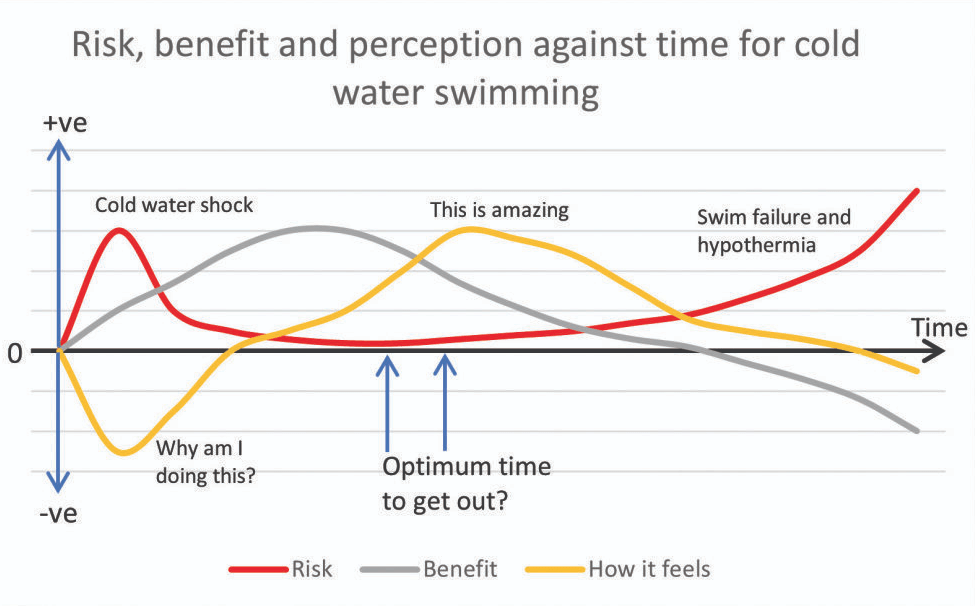
The vertical axis, marked “+ve” and “-ve”, has three measures: risk, benefit and how it feels. There is no scale. This is intentional as there is huge variation between individuals. How you feel about cold water swimming is subjective and our tolerances vary widely. The aim is to show how these things change with time in the water, which is measured on the horizontal axis. The time axis is also not scaled as the range depends on both temperature and individual factors.
Know how risk changes over time
Look first at the red “risk” line. It shows a peak shortly after entering the water due to cold water shock. The size of this peak depends on the water temperature, your cold water experience, and any temporary or long-term underlying conditions you may have. The strongest effects of cold water shock typically last one to two minutes, making this one part of the chart where we could add a number to our time axis. Stay vigilant for any signs or distress or panic in yourself or fellow swimmers at this time.
Once you’re through cold water shock, your risk decreases – but note that no swim is risk free and you always need to stay alert to potential hazards. As time in the water increases, the risks increase again (and never stop increasing) as first your limbs and then your core and brain get cooler.
More time does not equal more benefit
The grey “benefit” line is the most contentious. However, it’s likely you get most of the health and wellbeing benefits from a brief dip. While longer swims would be better for building fitness, the risk of hypothermia in cold water makes it unfeasible to pursue this. Do your endurance training swims in warmer water, and dip in cold water for the other benefits, and the fun and social side. Getting too cold puts enormous stress on your body that could negate any benefits.
How you feel is not a good guide to risk
Finally, the yellow “how it feels” line, which is the most subjective. The graph maps my experience of cold water: initial pain, a window when it feels amazing, and then increasing discomfort. Yours may track differently. There is a possibility that this line turns positive again when you’re heading into hypothermia – this is definitely something to avoid.
There is no space for either bravado or cold-shaming in winter swimming. While cold water tolerance is trainable to a degree, biological factors play a huge role. Suggesting that someone is soft because they have a low cold water tolerance is unkind and unfair, while bravado pushes swimmers to take unnecessary risks. As the chart shows, stop swimming when it feels good and you’ll get the benefits while the risks are still low. Your point on the line might not be the same as the people you swim with. Find what works for you, don’t be peer-pressured into staying in longer, and don’t pass judgement on swimmers whose tolerance is different to yours.
Keep winter swimming fun and safe and share this chart if you find it helpful.
Read more advice about cold water swimming.

Simon Griffiths
I started Outdoor Swimmer in 2011 (initially as H2Open Magazine) as an outlet for my passion for swimming outdoors. I've been a swimmer and outdoor swimmer for as long as I remember. Swimming has made a huge difference to my life and I want to share its joys and benefits with as many people as possible. I am also the author of Swim Wild & Free: A Practical Guide to Swimming Outdoors 365 a Year, I provide one-to-one support to swimmers through Swim Mentoring and I'm the creator of the Renaissance Swimmer project.