Pond to pool
Simon Griffiths looks at how to adjust to pool racing after a summer in open water
September is a busy month for open water events. I often do a series of long-distance swims and swimruns in late summer. By October I’m exhausted, and my sprint skills and swimming technique have degraded.
But at the end of October in England, we have the National Masters Championships, with pool races from 50m up to 1500m. It’s an event I enjoy and try to get to most years. Many open water swimmers opt for the longer events – the 800m or the 1500m – but my favourites are the 100m and 200m freestyle, and the 200m individual medley.
The challenge is, how to become a pool sprinter in a month after six months of longdistance open water swimming?
In endurance sports like running or triathlon, it’s common to give yourself an end of season break of two to three weeks or more. You need to recover from the rigours of training and racing. However, I don’t think a complete break is either necessary or desirable as a swimmer, especially if you only have a month to get sprint ready.
Nevertheless, you can’t achieve your full sprint potential if you’re fatigued. The solution is to dial down both the intensity and the volume but keep swimming. In the week after my final open water event, I will perhaps do about half my summer training volume and will do the majority of that at an easy pace.
It’s important to continue swimming to maintain your feel for the water, unravel any bad habits you’ve picked up in open water and start flexing your sprint gears.
Technique rebuild
Use the first couple of weeks to concentrate on your technique. Swim slow enough so you can think about what you are doing and keep your heart rate low. Check in on all your technique focal points. Do lots of drills and exercises, and swim all four competitive strokes even if you only race on front crawl.
Add some speed
You have to remind your arms and legs how to move fast. Make sure you include a few sprints. Keep these short (I often do halflength sprints) and have plenty of active recovery between them. Remember, you still need to recover from the open water season so don’t exhaust yourself with long sprints or insufficient rest.
Refresh your pool skills
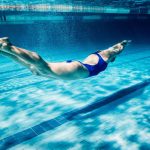
There isn’t much call for racing dives and tumble turns in open water but they are key to achieving fast times in the pool. Make sure you dedicate some time to practising them. Work on your streamlining, underwater dolphin and breakouts too.
Do a pre-event pool race
If you can, enter a low-key competition in advance of the nationals or your main event. It doesn’t matter if you’re not sprintready. The important thing is to get some competition practice and experience what race effort feels like. Don’t worry about your times. Take the opportunity to experiment with pacing strategies and practise your racing skills.
Test your race day kit
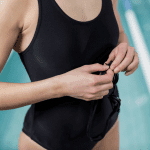
If you haven’t raced for a while, make sure your racing costume still fits. Test your goggles can withstand a racing dive too. At pool events (unlike many open water ones) you usually have to provide your own swimming cap. Make sure you have one.
Putting it together
In a perfect race, you get off to a great start and transition smoothly into swimming. You nail your turns and finish on a full stroke without gliding into the wall. Your pacing is spot on: you start fast and hold the speed to the end. You finish tired but elated. It’s a challenge to get everything right, especially if you don’t race often in the pool. However, with a bit of thought and preparation, you can race in the pool in the winter and open water in summer, and enjoy them both.