


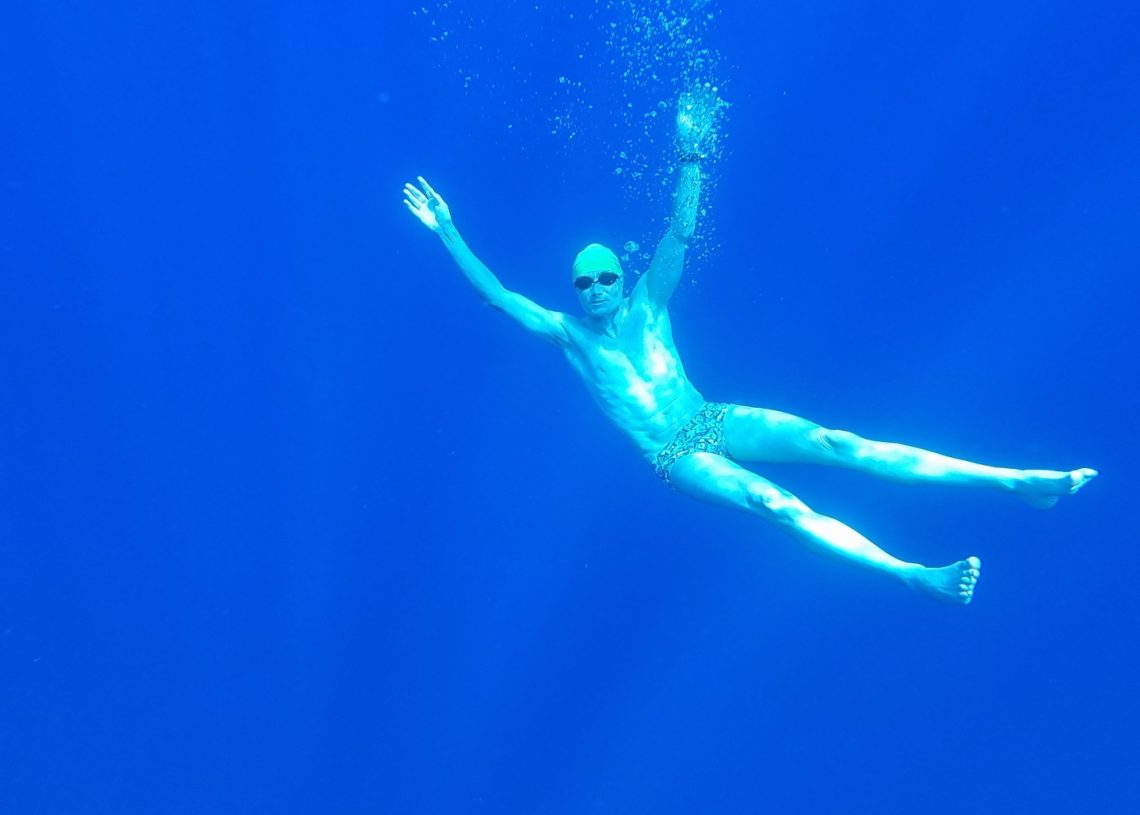
Tips for swimming underwater
Relax and take it slow: Simon Griffiths shares some tips for underwater swimming
Learning to swim is, primarily, about staying close enough to the surface so we can breathe. Yet what child doesn’t delight in diving for coins at the bottom of the pool? The deeper the better. I know I did. And as an adult, I love to swim underwater too.
I enjoy feeling the temperature change as I drop, following blades of sunlight into the depths. In the ocean, I listen for the static crackle of sea urchins or the grumble of pebbles as they are rumbled by waves. I like the peace and tranquility you find beneath the waves, and being gently squeezed as the pressure increases.
While the surface is turbulent, the depths offer serenity.
But deep water can unnerve you, too. Sometimes, like in the Thames, you can’t see anything beneath you. You don’t know if you’re swimming over boulders or bodies. I once lost a phone in the river and went diving for it. By the time I reached the bottom, I couldn’t even see my hands, even when I took a torch. Latera professional diver told me he wouldn’t dive there – too risky!
Alternatively, you can see too far. In a clear ocean, the light fades into an abyss of ever-changing shadows far below you, and every one of them could be a monster from the deep.
Becoming comfortable underwateris a learned skill and worth practising.
I’m not a freediver and can’t offer advice on extended breath-holding or extreme underwater swimming, but just being able to access one or two metres below the surface adds a new dimension to your swimming, literally. And this is something open to any competent swimmer.
Tips for swimming underwater
As a first step, practise holding your breath while swimming. Try taking five strokes with your face in the water, thenseven, then nine. As you increase the number of strokes, you may be tempted to rush them, to get them done quickly, but that burns through your oxygen faster. The trick is to slow down and relax.
You can then try shallow surface dives. Again, start with two or three strokes, then increase. Try going deeper. If you feel pressure against your ears, hold your noseand breathe against it gently.
Most people find a form of modified breaststroke works best underwater but you can use dolphin kicking or alternate leg kicking, too. If you’re going for distance, try a full-length two-armed pull followed by a breaststroke kick and a glide. Stay calm and maximise your glide distance by holding a streamline position.
Watch a video of a freediver and notice how controlled their swimming is.
Slowing down not only helps you hold your breath for longer, it also helps increase your mindfulness of the underwater experience. Allow yourself to notice how it feels and sounds.
As you relax and sink into the water’s embrace, you may feel as if you want to stay there, but please don’t. Stay well within your limits and comfort zone unless you are being coached by an expert, and never ignore the need to breathe.
Breath-holding can result in Shallow Water Blackout (SWB): an underwater faint that will almost certainly result in drowning if you are not immediately rescued.
You should therefore never practise underwater swimming or breath-holding alone. Nor should you hyperventilate before swimming as this can increase the risk of SWB.
Sorry to end on a dampener, but SWB is a real risk. You need to be aware of it, but don’t let it spoil your enjoyment of the deep.
Find out more about Shallow Water Blackout.
Browse more of our swimming top tips.
This article is from the April issue of Outdoor Swimmer. Click here to subscribe to the magazine.

Simon Griffiths
I started Outdoor Swimmer in 2011 (initially as H2Open Magazine) as an outlet for my passion for swimming outdoors. I've been a swimmer and outdoor swimmer for as long as I remember. Swimming has made a huge difference to my life and I want to share its joys and benefits with as many people as possible. I am also the author of Swim Wild & Free: A Practical Guide to Swimming Outdoors 365 a Year, I provide one-to-one support to swimmers through Swim Mentoring and I'm the creator of the Renaissance Swimmer project.