

Swimming watercolours in County Mayo, Ireland
From golden lough swims and yellow flat periwinkles to pale turquoise seas and grey skies, County Mayo’s swims are drawn from a painter’s palette. Susanne Masters explored the region’s sea and freshwater swimming spots
Last year, swimming on the northern edge of Connemara, my attention was caught by distant peaks. Following up on that distant view I came to find out what the landscape was like. But would
it live up to the tantalising glimpse or be disappointing? My partner Myles was up for a venture of exploration with no guarantees. So, over five days we roamed the southern section of County Mayo, stopping for fresh and salty swims. Finding an abundance of swimming spots the main restriction was our time.
Golden water
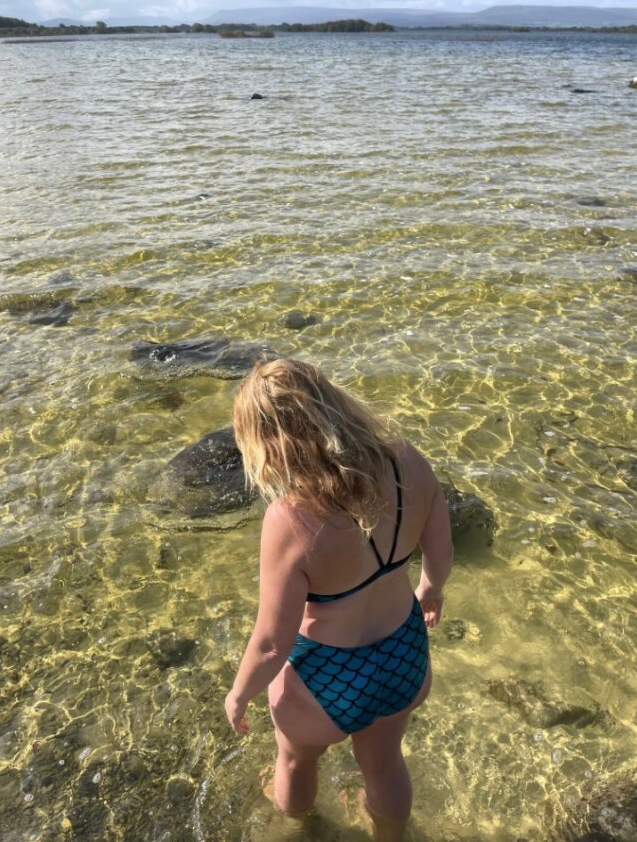
In a luxury hotel in Lhasa Tibet, there is a swimming pool lined with gold tiles. Referred to as a gold energy pool, it’s supposed to be rejuvenating. Lough Carra offers a natural version of this, perhaps more wonderful for the lack of artifice. In October, standing in ankle deep water at the edge of the lough it was golden. Sunshine made it bright, but even when a cloud slipped past the sun the water held its glow.
You might also like
I waded our further; as the water became deeper it slowly shaded towards tea brown, yet stayed clear enough to see ripples in fine sediment on the bottom. Lough Carra’s uncommon golden beauty is the combination of tannic water over limestone. While the view across its surface towards a backdrop of distant hills is beautiful, the water itself is captivating.
Island highs and lows
Achill Island starts softly and then rises into mountains. We had hoped to ride up to the deserted village in the shadow of Slievemore Mountain, to walk across and then down to Secret Beach and Lough Nakeeroge East, a mountain flanked lake only 16 metres above sea level. However, our accommodation on the island had short-notice cancelled because of problems with their hot water supply, and while the morning weather was fine the forecast for the afternoon was rainy.
Since we had a longer than expected journey to the starting point for the walk and didn’t want to be walking back up precipitous slopes in mist and rain we found a different way to juxtapose a corrie swim and salty waves: Lough Acorrymore and Keel Beach.
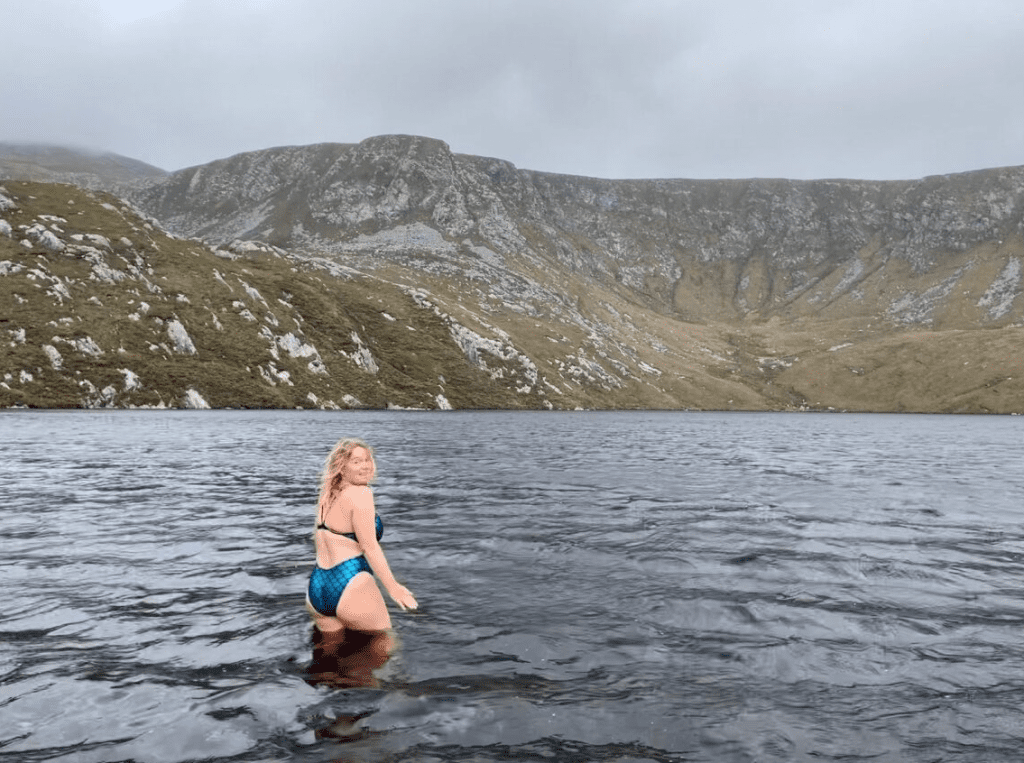
It was a steep ascent from sea level up to 197 metres altitude over a short distance. Stepping into the cold water of Lough Accorrymore felt blissful after cycling to get up there. The lough, which was used as scenery in the film Banshees of Inisherin, offers a stunning backdrop for a swim. We went in at the opposite end from the dam. Stepping from rocks onto submerged turf we could tell that the water level was higher than usual; a textural experience as the water was so dark we could only glimpse the grass underfoot.
From the high water of Lough Accorymore we freewheeled down to Keel where, after a pitstop at the
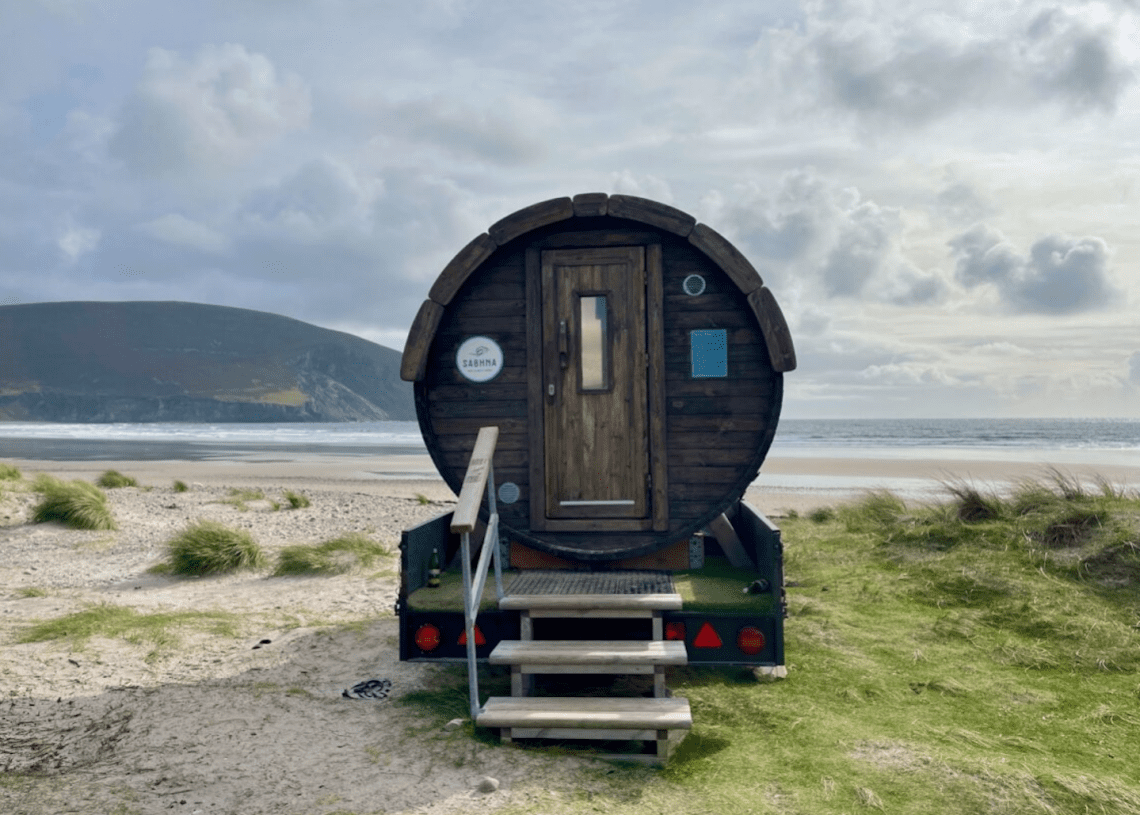
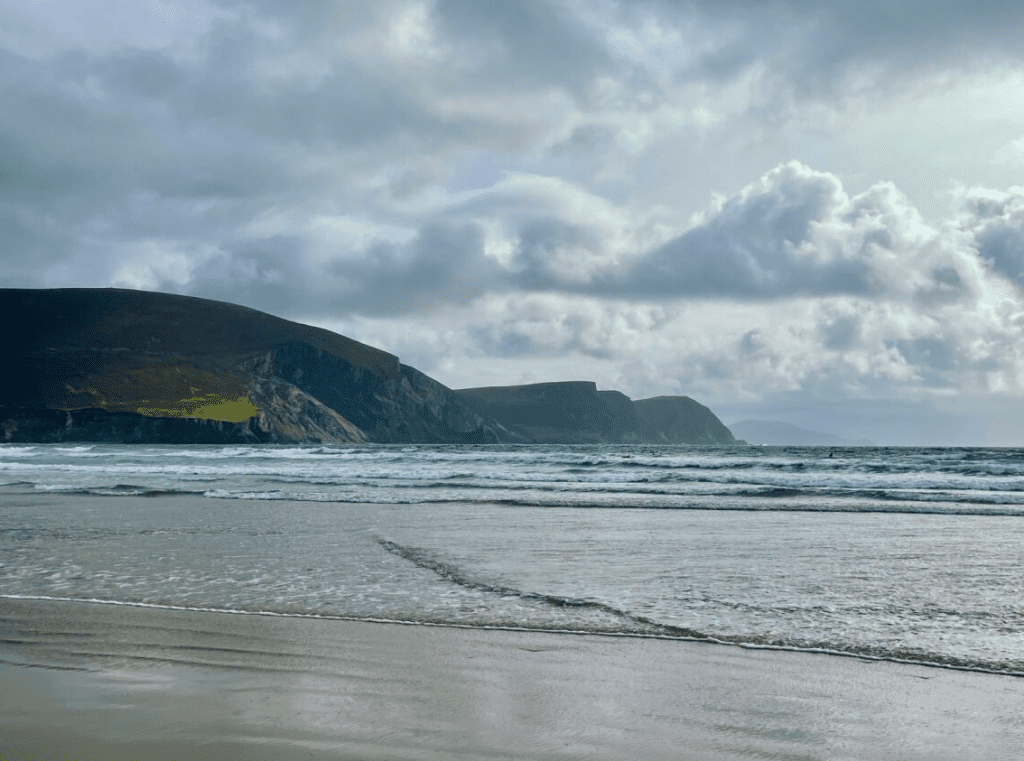
Beehive coffee shop, we headed to the beach. There were two groups of surfing lessons taking place, but plenty of space on the long beach for everyone. Small waves rolled in regularly, enough to froth the sea and make for a bouncy dip. Set up on the grass above the beach is a sauna hut. In summer it is open every day, out of season on weekends only.
Enchanting beach
Back on the mainland on the opposite side of Clew Bay near Louisburgh, Old Head Beach is a sheltered retreat. Arriving at low tide, clumps of serrated wrack had emerged from the sea. They were a distraction from reaching swimming depth. Bright yellow flat periwinkles drew my attention. Looking closely, I started noticing black common periwinkles, and found one stripey flat periwinkle. In small pools of water retained at the base of seaweed clumps there were transparent shrimp that darted at high speed when my shadow fell over them. Shannies took advantage of their camouflage and stayed still. I was so engrossed by these little animals that I missed the big one.

Myles pointed out a seal resting on a rock further out. Even though it was a dull day, water deep enough to swim in was pale turquoise. Croagh Patrick, a holy mountain close to the shore of Clew Bay, broke up the grey sky in the distance. With plenty to see on the foreshore and ammountain backdrop, Old Head Beach was enchanting, a place where time passes quicker than you realise.
A treasure trove for wildlife, Old Head Beach also has plenty of amenities. Again, there is a sauna, as well as car parking and a toilet block. Additionally, it is one of the Blue Flag Beaches where Mayo County Council has undertaken to support access with a beach wheelchair scheme.
A cascade of loughs
Heading south and east from Old Head Beach between mountains we passed a series of connected loughs. Glenullin Lough was a small patch of water. Beyond it Doo Lough stretched into the distance. At the northern end there was a spot where you can park a car and enter the water from a stony beach. A place to float with mountains on the periphery of vision. Doolough Valley’s history is as dark as Doo Lough’s water. During the Great Irish Famine people seeking aid were sent on a 19km walk from Louisburgh to Delphi. On arrival they were turned away. The memorial to those who died and the road winding past Doo Lough are the only marks of people on the landscape in the valley’s northern section.
Ireland’s fjord
We stopped at the small car parking area on the east side of Aasleagh Bridge and took a look at Aasleagh Falls. It was a rainy day and Erriff River was flowing hard and fast. Although this waterfall doesn’t offer much swimming opportunity, being rocky and shallow with deeper water only available when the river is in full flow and too dangerous for swimming, it is a sight to see and there is swimming nearby.
Leave your car or bikes parked, and walk along the road towards Clog. There is a small slipway from the road that reaches into the deep water of Killary Fjord. It marks a boundary between County Mayo on its northern shore and Connemara in County Galway on its southern shore. Forty metres deep at the centre, Killary Fjord is deeper than the sea in Killary Bay.
Islands and leafy shores
Travelling south and inland we reached Lough Corrib, Ireland’s second largest lough. Like Killary Fjord, it is partially in both County Mayo and County Galway. It contains hundreds of islands including rocks just emerging from the surface, to those big enough for a tree to perch on, and Inchagoill Island, which has woodland and the ruins of two churches on it. This lough still offers surprises with Viking swords and axes retrieved from ancient shipwrecks within the past ten years.
Slipping into Lough Corrib, a lowhanging mist made it seem like the water stretched into the horizon. Warmer than the mountain loughs we’d visited, it was also softened by trees along its shore, a lowland contrast to the dramatic waterfalls and loughs of higher ground.
Travelling around a small area of County Mayo at cycle speed, we saw and swam in bodies of water of different colour with contrasting views. It made a five day holiday feel long and exotic.
If you go
Sabhna Saunas Achill Island
€15 shared session, €60 private session
sabhna.ie
Beehive coffee shop
Near Keel beach, warm and dry with generous portions of freshly made food.
@the_beehive_achill_island
Achill Island Hotel
On the mainland side of Achill Sound. Not fancy, but friendly. Breakfast and dinner is simple but well done. achillislandhotel.com
Wild Atlantic Sauna
On Old Head Beach
thewildatlanticsauna.ie
County Mayo beach wheelchairs
Call Mayo County Council on +353 (0) 94 906 4861
Bike hire
We planned our own route, hired bikes from West Ireland Cycling, based in Galway, and cycled with our luggage in panniers. They also offer route plans, accommodation and ferry bookings, and organise moving luggage between accommodation.
westirelandcycling.com/bike-hire-galway
Discover more wild swimming holidays.

Outdoor Swimmer
Outdoor Swimmer is the magazine for outdoor swimmers by outdoor swimmers. We write about fabulous wild swimming locations, amazing swim challenges, swim training advice and swimming gear reviews.