H2O to Hollywood: swimmers turned movie stars
Register to get free articles
Want unlimited access? View Plans
Already have an account? Sign in
Swimmers have lit up the silver screen right from the early days of Hollywood. Michael Renouf shines the spotlight on five stars of the pool who went on to enjoy successful acting careers.
In the 2000s the athletes of choice for movie directors have often been MMA fighters, but in the early days of Hollywood it was stars of the pool who lit up the silver screen. One of the most famous was Johnny Weissmuller, who gave up his swimming career to wow audiences with his starring roles in action-packed adventures.
The man who won five Olympic swimming gold medals made his screen debut with an uncredited role in Glorifying the American Girl in 1929. Three years later, the muscular 6 foot 3 inch actor made his first appearance as the character he was born to play: Tarzan, in Tarzan the Ape Man. Weissmuller portrayed Edgar Rice Burroughs’ creation 12 times and is credited with inventing the ‘Tarzan Yell’.
In a forerunner to the current trend of comic books being turned into movies, he went on to depict Jungle Jim, an Asia-based adventurer, in 16 movies – although in the last three the character’s name is changed to Johnny Weissmuller. He also portrayed the character in a hugely popular TV series that ran to 26 episodes. It seems fitting that the man whose life was so intertwined with aquatic endeavours – he also won an Olympic bronze medal at water polo – passed away in Acapulco, famous for its cliff divers.

Action heroes
Like Weissmuller, Buster Crabbe won Olympic gold in the 400m freestyle (1932) and went on to have a successful career on the silver screen with over 100 acting credits. He started out with several uncredited roles and also starred as the lead role in Tarzan the Fearless in 1933. However, unlike Weissmuller, this was not his defining role, and he would go on to play two other pulp heroes of the era.
First up was the title role in Flash Gordon (1936), which was presented in 13 chapters. He played the saviour of the universe on two more occasions. He was also cast as the lead in Buck Rogers, which was presented in 12 chapters. For movies that are shown this way, the actor only gets one credit so his most prolific role was for his Billy the Kid/Billy Carson films in which he had 36 outings. This was the time of the studio contract system when actors were tied to one studio and features were made in days instead of months. For instance, in 1945 alone he made eight Billy Carson movies.
Queens of the sea
Even before these two made the transition to acting, Annette Kellerman was captivating silent movie audiences with a string of aquatic roles, including playing a mermaid named Merilla in Queen of the Sea.
In the 1916 release, A Daughter of the Gods, she stirred up controversy by appearing in what is believed to be the first full nude scene by a major actress – although in the scene, set under a waterfall, most of her blushes are covered by her long hair.
Her swimming credentials include winning both the 100 yards and the mile ladies swimming championships of New South Wales while still a teenager in 1902. She was also an early advocate of women being allowed to be allowed to wear one-piece bathing suits and she authored several books. Her ashes were scattered on the Great Barrier Reef.
Kellerman herself was portrayed by another swim star turned actress, Esther Williams, in the 1942 release Million Dollar Mermaid. Williams had won three national championships (breaststroke and freestyle) but her shot at Olympic glory was scuppered by the outbreak of the Second World War and the cancellation of the 1940 Games due to be held in Tokyo. Two years later she made her film debut opposite Mickey Rooney in Andy Harry’s Double Life.
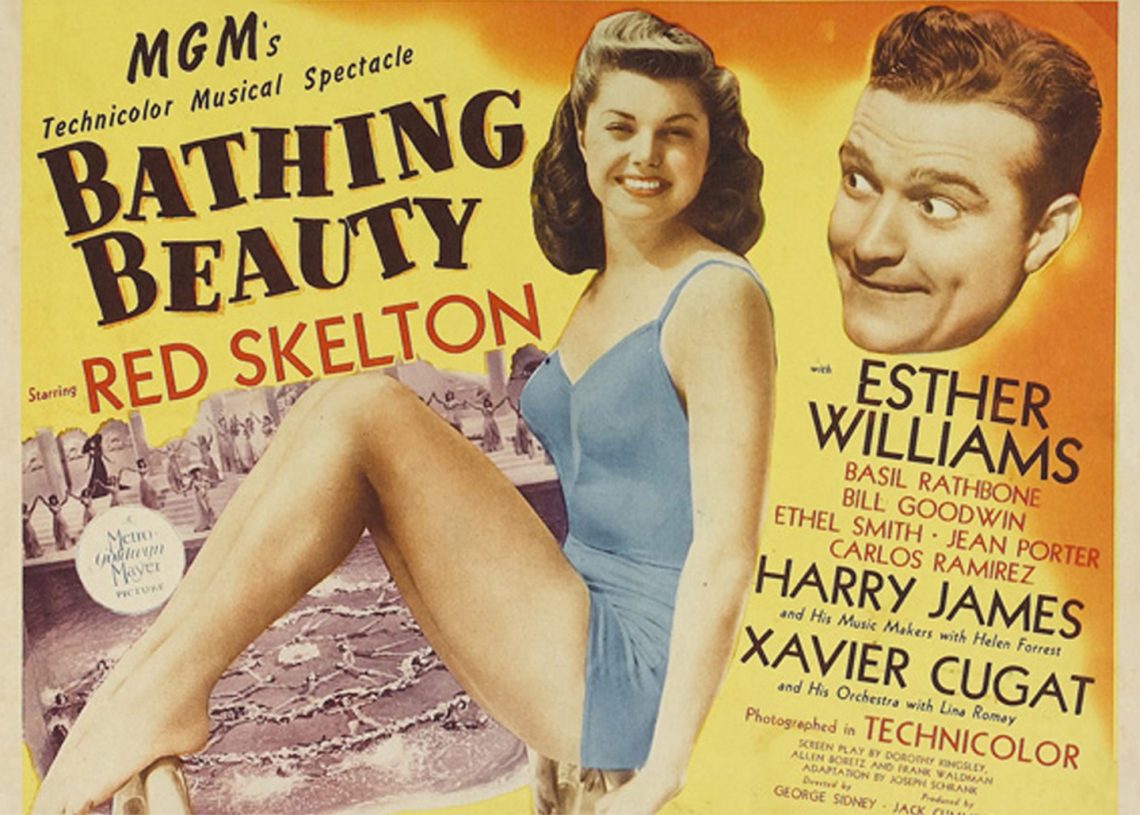
She was catapulted to stardom in Bathing Beauty (1944), a musical extravaganza that showcased synchronised swimming. At the MGM studios they built a 90-foot square, 20-foot deep pool with hydraulic lifts that choreographer Busby Berkeley made full use of. The majority of Williams’ cinematic releases were water-based and unsurprisingly she found herself labelled ‘America’s mermaid’.
Watery Westerns
Bud Spencer was born Carlo Pedersoli in 1929 in Naples, Italy. Before turning his giant size hands to acting he was successful at both water polo and swimming, reaching the semi-finals of the 100m freestyle at the 1952 Helsinki Olympics. Unlike other swimmers-turned- actors he did not use his swimming skills on celluloid but instead was known for spaghetti westerns and action movies.

He started off in the 1950s with uncredited roles, including in the 1951 epic Quo Vadis. It was partnering with another Italian, Terrence Hill (born Mario Girotti), that Spencer found his greatest success. They first met when they appeared together in 1967 in God Forgives… I Don’t and a lifelong friendship was born. Many regard their best joint enterprise to be the 1970 release They Call Me Trinity, in which they play brothers Trinita and Bambino.
All told, they appeared in 18 films together from Hannibal in 1959 through to The Night Before Christmas in 1994, although they never actually met on the set of Hannibal. We all know swimming is good for us and the five swimming actors featured in this article all lived until at least 75 years old. So, after your next swim, why not sign up for acting lessons?
This article is from the January 2023 issue of Outdoor Swimmer. Click here to subscribe to the magazine.