
Lido Guide: The energy crisis
Register to get 3 free articles
Want unlimited access? View Plans
Already have an account? Sign in
The energy crisis that has dogged the first part of 2023 hit the leisure industry hard, and swimming pools in particular bore the brunt. Author of The Lido Guide, Emma Pusill, explores ways we can navigate the challenges facing our pools and lidos.
In a world where there is an ever-increasing awareness of, and focus on, environmental issues swimming pools have serious questions to answer. The energy crisis that has dogged the first part of 2023 hit the leisure industry hard, and swimming pools in particular bore the brunt of that.
The difficulties they faced made national news and shone a spotlight on the sector’s heavy reliance on fossil fuels. There can be no doubt that while that reliance on fossil fuels remains the norm for swimming pools, difficult questions remain about sustainability and environmental impact.
Every aspect of running a pool, from the operation of the heavy-duty pumps to run the filtration system to the heating of the water (whether that be for bathing or showering) is energy intensive. Indoor pools also have air handling systems, climate control and the environmental impact of building and maintaining a large, complex building. The costs involved, in both the environmental and financial sense, are sizeable.
Reasons to be hopeful
But there is some reason to be hopeful, and lidos are increasingly leading the charge towards a more sustainable model. They have the inherent advantage that comes from being uncovered, particularly given that their lifespans are not limited by the lifespan of a pool hall as can be the case with indoor pools – that gives a longer- term benefit from the initial environmental impact of construction.
Pells Pool has been continuously in operation since 1860, and precious few indoor pools can claim that sort of longevity. It is also unheated and spring- fed, further lowering its environmental impact. When it comes to heating lidos there is inevitably some heat loss to the atmosphere, and lidos are becoming increasingly good at managing that to mitigate the financial and environmental impacts. Pool cover efficiency has come a long way, and those who run lidos keep the water covered whenever possible.
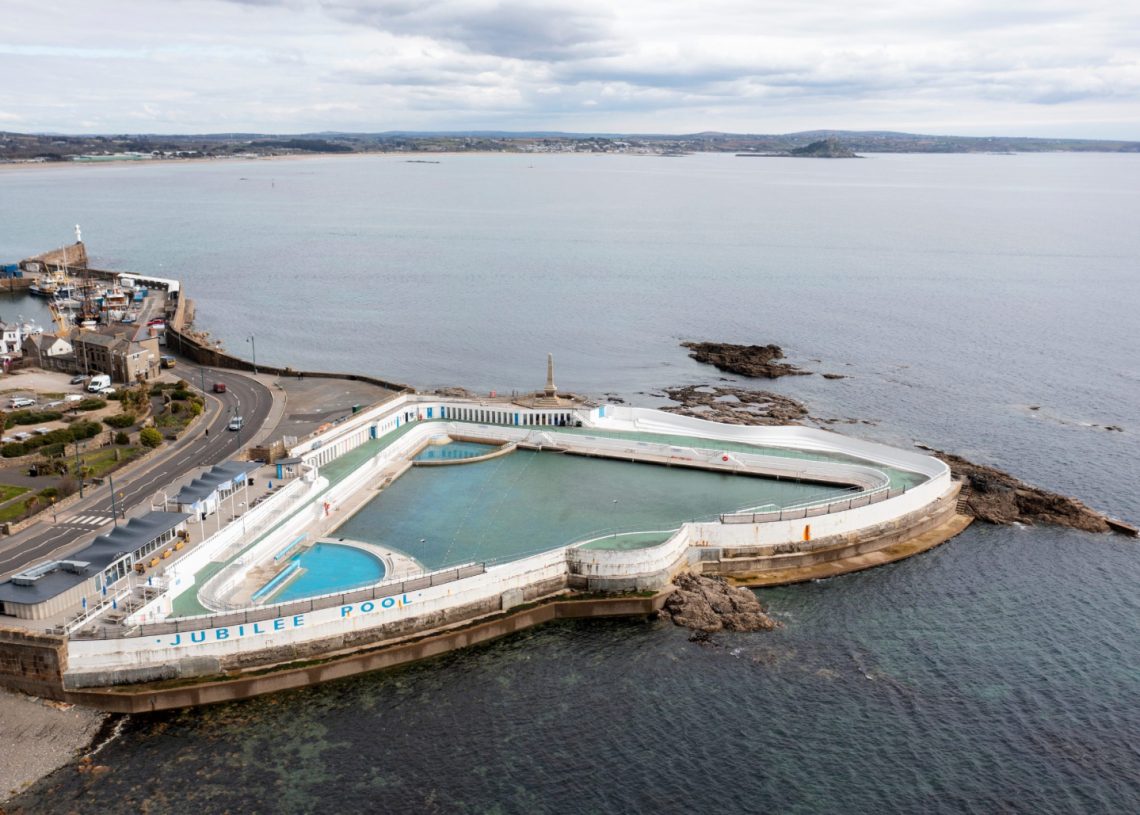
More sustainable energy sources are becoming increasingly common. Stanhope Pool has had solar power for some time, and their sauna is wood-fired. Chagford and Helmsley have been running air- source heat pumps since long before the government began to incentivise their roll out. Portishead installed a biomass boiler over 10 years ago and is now investigating solar thermal. They are not alone in actively looking to solar power, with projects around the country carrying out feasibility studies. And, of course, Jubilee Pool in Penzance now has a glorious geo-thermally heated section of the pool, while the geothermal lido at Matlock Bath has been renovated and is now open to the general public.
Some larger corporations running leisure contracts for local authorities are now making use of an initiative that sees the heat generated as a by-product of computer servers and data processing being used to heat pools. This approach could have huge potential for lidos that are not short of the space to house the servers. All this demonstrates that the lido estate does not stand still. It pushes forward, recognising that its survival depends on better environmental sustainability. And that should give us all reason to hope for a stronger future for the outdoor pools of the UK.
This article is from the May 2023 issue of Outdoor Swimmer. Click here to subscribe to the magazine. Emma Pusill is co-author of The Lido Guide.