
EXTRA,  FEATURES,  May 2023,  Premium

Mami Wata and the Black Mermaids

Register to get free articles

No spam Unsubscribe anytime

Want unlimited access? View Plans

Already have an account? Sign in

Of course mermaids can be Black. Elaine K Howley delves into the mythologies behind Hans Christian Andersen’s enduring fairy tale, The Little Mermaid, exploring a rich aquatic spiritual culture of West African mer-creatures including Mami Wata and many other watery gods, goddesses and powerful swimming creatures. 

Hans Christian Andersen’s enduring fairy tale, The Little Mermaid, published in 1837, gave the Western world a template for the quintessential mermaid: a comely, pale-skinned half-woman, half-fish creature that lived beneath the waves but longed for an immortal soul. 

In Andersen’s melancholy tale, the unnamed mermaid trades her voice to the sea witch for a painful pair of legs and attempts to woo a handsome prince into marrying her to allow his soul to join with her body. Naturally, the plan goes awry, and though the mermaid is offered a last ditch effort to receive a soul in exchange for her beloved’s life, she cannot kill the prince. Thus, she dissolves into sea foam and is destined to spend 300 years as a daughter of the air. If she’s lucky, in time her good works will earn her a soul of her own. 

In 1989, Disney released a blockbuster animated film also titled ‘The Little Mermaid’ and loosely based on Andersen’s tale. The musical film features the flame-haired Ariel as the central character who yearns to give up her fish half and become human to marry her prince charming and commit to a life on land. While Disney’s Ariel is quite different from Andersen’s – the happily-ever-after ending is certainly a departure from Andersen’s source material – the film took its cue from Andersen’s notes about the physicality of the protagonist and codified what it meant to be a mermaid in the cultural consciousness: young, beautiful, wide-eyed, and very, very White with scads of cascading red hair. That image has endured.

However, in September 2022, the entertainment leviathan released a teaser trailer advertising its live action reboot of the movie to be released in May 2023. This time, Ariel is Black and played by singer and actress Halle Bailey. That casting decision received swift and indignant backlash from a vocal White minority who claimed that mermaids could never be Black. 

But this is a patently false assertion. Though both Disney’s and Andersen’s winsomely White mermaids have prevailed for nearly 200 years, they have done so only by crowding out a robust history of mermaids of color. Indeed, Black mermaids have populated folkloric history and popular conception across Africa and its diaspora for centuries.   

The Black Mer-Creatures of West Africa

There is so much to African mer-person history that an article of this length can’t even begin to plumb the shallowest depths of the topic. But suffice to say, the African continent gave rise to a rich aquatic spiritual culture populated with watery gods, goddesses, and other powerful swimming creatures – all with the same dark skin as the people who created them. 

Perhaps the most widely known of these is Mami Wata. The mythology surrounding Mami Wata, also sometimes spelled Mammy Water or Mamy Wota, is vast and complex, with regional and local variations of the goddesses’ purview and powers. 

The pervasiveness of Mami Wata as a cultural phenomenon with many presentations and purposes makes her difficult to quantify or explain. Nevertheless, the overarching template for the water-based spirit also known as Nne Mmiri in the Igbo language is a fierce, decidedly female, half-human, half-fish creature who represents the sacred nature of water. 

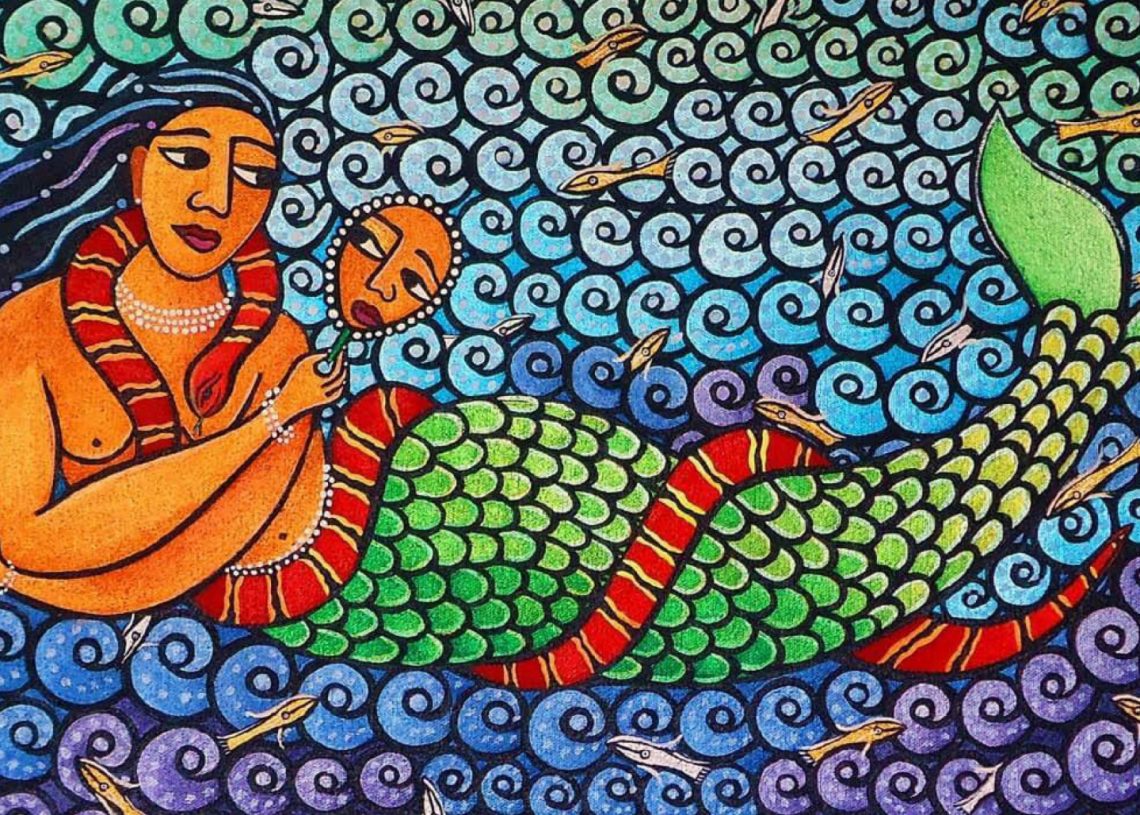
Mami Wata is typically depicted as beautiful and seductive – an integral aspect of her association with fertility and female fecundity. A voluptuous Black or Brown woman with lots of wild, long, dark hair and usually a snake wrapped around her body or breasts, she is a force of both nature and culture.  

The National Museum of African Art (NMAA), part of the Smithsonian Institution in Washington, D.C., notes that “Mami Wata is often portrayed as a mermaid, a snake charmer, or a combination of both,” and while she draws much of her inspiration from indigenous African water spirits, her depiction through the ages has also been influenced by tales of European mermaids, Hindu gods and goddesses, Christian saints, and Muslim wali that filtered across the African continent and the Atlantic over centuries as people churned and mixed. It seems that Mami Wata is as fluid as the realm she rules.

According to the NMAA, Mami Wata’s popularity grew between the 15th and 20th centuries, “the era of growing trade between Africa and the rest of the world.” In an exhibition preview written for a 2008 exhibition of art devoted to Mami Wata at the Fowler Museum at UCLA in Los Angeles, art historian and curator Henry John Drewal writes that Mami Wata “can bring good fortune in the form of money” and terms her a “‘capitalist’ par excellence.” In fact, “her very name is in pidgin English, a language developed to lubricate trade.” 

But as NMAA notes, Mami Wata’s multi-faceted and mutable persona defies pigeonholing and allows for many interpretations as she straddles both earth and water. “Mami Wata is a complex symbol with so many resonances that she feeds the imagination, generating, rather than limiting, meanings and significances.” Mami Water can shift from nurturing mother to sexy siren in the same time it takes her to slip from a giver of riches to a harbinger of danger. 

Mami Wata in the African Diaspora

During the abomination known as the transatlantic slave trade, Mami Wata’s fame only grew as displaced Africans brought her with them. As people were forced from their homelands under brutal circumstances, religious practices helped them maintain their cultural and spiritual identities. Because Mami Wata was often hailed as a healer of physical and spiritual ills, many of the people caught up in this brutal trade prayed to her for deliverance while crossing the Atlantic Ocean.  

By some estimates, 12.5 million African were kidnapped as part of this brutal practice, and we’ll likely never have a full accounting of the human toll of this vast trauma. But in the New World, Mami Wata became a source of hope and strength for those who’d been ripped from their homelands, and she remains an important figure in African-diaspora communities across the Americas from the United States and Haiti to Brazil and the Caribbean.

Various new adaptations of the traditional storylines developed as enslaved people adapted to their new environments. In Haiti, for example, the enchanting La Siréne, an appealing mermaid with a mirror, has taken a prime role in Vodou beliefs. Yemanja, Santa Marta la Dominadora, and Oxum are other names for a few of the New World’s pantheon of mermaid spirits cast in the Mami Wata mould. 

And new art and literary interpretations of this powerful figure keep coming. In November 2021, Natasha Bowen, a writer of Nigerian and Welsh descent released “Skin of the Sea,” an enchanting young adult fantasy novel following the saga of Simi, a young Mami Wata who gathers the souls of the enslaved who die at sea and blesses their journeys home to Africa. 

It’s clear that the presence of Mami Wata is still strongly felt across the African continent and its diaspora, openly contradicting the ignorant bigots who cling to the idea that mermaids can only be White. In 2019, novelist Tracey Baptiste wrote in the New York Times that during her childhood in Trinidad and Tobago, her whole family were mermaids. “My father, in particular, was a surrogate Poseidon. He would strike out into open water, disappearing for minutes at a time behind huge waves, then appear again, hanging off the side of a fishing boat, where he rested, chatted with the fishermen, and then swam back to shore. I didn’t need a Danish fairy tale to tell me that he was part fish. By the time I came across Andersen’s tale, I already knew that mermaids were Black and Brown people: my family. Besides, what happens when you stay out on the sea? You get darker and darker, deepening to shades of black and brown that glow from absorbing the sun.”

This dynamic and evolving understanding of Mami Wata and what constitutes a mermaid continues; thankfully, Disney is finally getting with the program.

Alternative interpretations

While Hans Christian Andersen’s little mermaid has long been considered the go-to vision of mermaids, even it may have roots in African folklore. Trinidadian-American historian Dana White told Zahra Spencer in an article for gal-dem.com that Andersen must have been at least marginally aware of the existence of Black mermaids and African water goddesses. 

“It just isn’t realistic to think that Hans Christian Andersen wasn’t inspired by other cultures, especially African mermaid myths. I mean look at the sea witch in the original The Little Mermaid story – Ursula in the Disney movie – she’s very reminiscent of our Mami Wata or even Tiamat, who is like this amazing primordial sea goddess from ancient Babylonian mythology.”

And there may be even more to Andersen’s story than meets the eye. That’s the stance taken by Gabrielle Bellot, a multiracial, transgender woman from Dominica in a 2019 essay she wrote for Literary Hub. In that piece, titled ‘Dear Internet: The Little Mermaid Also Happens to Be Queer Allegory,’ Bellot deftly elucidates how Andersen wrote his decidedly grim fairy tale out of frustration and sorrow over unrequired love for another man. 

Bellot contends that Andersen pined for his friend Edvard Collin, the son of his patron Jonas Collin. Edvard and Andersen were similarly aged and essentially raised together when Jonas assumed guardianship of Andersen while he was just a child. In time, Andersen’s interest turned romantic, but Edvard was not inclined to reciprocate, despite some steamy letters from Andersen that laid bare the “firmness of his desires,” Bellot writes. 

When Edvard announced his plans to marry a woman named Henriette, Andersen felt betrayed and hurt. He turned to his writing for solace and penned a vaguely autobiographical yet wholly fantastical story about a young mermaid experiencing a similar rejection in his best-known story, The Little Mermaid.

Andersen’s heartache did not have a happy ending, and neither did the unnamed young fish-woman who embodied his emotions in the story. In comparing how Andersen’s mermaid dissolves into sea foam at the end of the story, Bellot writes, “I understand how loneliness pools in someone deep as the sea, how you can hurt so much that you, too, wish to fade, like the turned pages of the waves. But Andersen knew that from despair, beautiful, painful stories and art can emerge, and he transformed his queer frustrations into a fable that has lasted.” 

She continues, “the beauty of Andersen’s story is partly in the story itself and in how it continues to be reimagined today – but also in the way he filtered his hurt through the alembic of his art, and produced something that shines with its own special luminescence nearly two centuries later.”

To see all the online content from the May 2023 issue of Outdoor Swimmer, visit the 'Spring(s)' page.
Stay up to date with The Dip, our free weekly outdoor swimming newsletter.

Outdoor Swimmer is the magazine for outdoor swimmers by outdoor swimmers. We write about fabulous wild swimming locations, amazing swim challenges, swim training advice and swimming gear reviews.