


Bathing season in the Thames Valley
George Townsend explores the lost swimming places of the Thames Valley
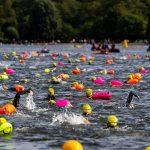
Swimmers often take a dip along the nontidal Thames. In response to pollution, Thames swimming has escalated into political engagement with river users pushing for official ‘bathing water’ status for popular spots in Wallingford and Wolvercote. With the government set to announce new regulations this month, now feels like a good time to revisit the deeper history of Thames swimming places. What were these halfforgotten places like, and how might they provide inspiration for the future?
Eyots and Romans
People have probably swum in the Thames for as long as they have inhabited its banks. Following their first journey upstream, Roman invaders believed Britain was a vast marsh, observing locals who seemed equally at home in water as on land. Evidence of swimmers adapting rivers to their needs came much later: a German visitor making use of purposebuilt steps into the water in 1782, out the back of a Windsor pub; the artist John Whessell including a ladder in his engraving ‘The Bathing Place’, from around 1830.
Readers will be familiar with these sorts of simple interventions. The first river playarea I remember is a tree with a rope swing at Buscot Weir, having grown up nearby in Faringdon. It was between the mid-1800s and the mid-1900s, however, that the bathing place as an institution came into its own.

Many bathing places were built in outskirts, on tributaries and backwaters, and around river islands (or ‘eyots’). Opened by the mayor in 1934, Henley Swimming Baths stood next to Rod Eyot, at the town rowing club’s present site. While Oxford’s bathing spots sprung up on the River Cherwell, and on backwater channels medieval monks engineered to power their mills.
Some bathing areas were built on islands like Abingdon’s Corporation bathing place (sometimes called Tiger Island). Abingdonians recall arriving via a large punt that could carry ‘anything up to 20 children’. With swimming costumes taking decades to catch on among men and boys, these separated areas – supplemented by screens and foliage – added an element of modesty. The seclusion also kept them away from boats, on narrower channels that were relatively easy to lifeguard and control.

Huts on stilts
The bathing places nonetheless contended with variable currents, depth and water levels, whatever the setting. This meant plenty of ladders and steps and, in some cases, ropes and planks running over the surface for swimmers to grab onto. At West Oxford’s Tumbling Bay, attendants controlled water levels manually using a sluice gate, while some sites were specifically chosen for depth. At Odney Weir near Cookham the weir pool provided the extra depth needed for a high diving board.

The river also influenced building design; bathing places usually had dressing huts, some with curtains, mirrors, shelves, seats, hooks and lockers. At Walton there was a bathing pavilion raised up on brick stilts to protect from flooding, with striped walls and steps leading to one entrance at either end. The designs often demarcated gender in this way, like school entrances or public toilets. Today, raised concrete foundations are a tell-tale sign of a former bathing place, as at Oxford’s Long Bridges and Scours Lane Lido near Tilehurst. Both remain good for a swim, though the cubicles have disappeared.

Attendants’ booths and offices have left similar clues, concrete rectangles poking out among the brambles. Attendants themselves once played an essential role, not only lifeguarding but teaching, caretaking, operating ferries, and providing swimming costumes, towels and refreshments.

In the early 20th century, Tiger Island was managed by Mr and Mrs Owen – Mrs Owen overseeing the swimmers, Mr Owen the ferry. “She was awfully good,” reflects one resident, “when we’d finished swimming … we used to throw our swimsuits outside the hut and she used to pick them up … and wring them out and we just collected them from her. It was absolutely marvellous.”
Play and education
Many bathing places were linked to schools. Private schools including Eton, Radley and The Dragon had their own, where their grounds met or encompassed the water. Local authority schools partnered with public bathing places for swimming lessons and end-of-year competitions. Lines of children, swimming things under their arms, were a familiar sight in the Thameside village or town in summer terms. Boys from Clayesmore, a progressive private school in Pangbourne, replaced a rundown shed at the nearby weir in 1912, fabricating an elegant new hut on stilts in the school workshop ‘for the common good’. It remained in use for two decades, till local swimming mostly shifted to Whitchurch Bridge where it continues today.

Public luxury
As well as providing a safe haven for lessons, competition and play, these were important social spaces. People would play games, picnic and sunbathe on the riverside lawns. The bank was also a great place to show off new ‘bathing dresses’, particularly between the wars when trunks for men and stripy, ruched synthetic costumes for women overtook their woollen forebears. Older swimmers describe these spaces as their generation’s answer to the beach – places of public luxury – an idea that regained relevance in the COVID-19 Lockdowns.
What’s largely been lost, and what might be renewed, is much more than official swimming places. As designated, cared-for sites for people to learn and practice swimming, these places were hugely valuable. As a toolbox for imagining future relationships between rivers and their communities, the social and ecological world of the bathing place should not be overlooked.
To find out more, go to georgetownsend.co.uk or follow me on Instagram @time_for_a_bath. Feel free to get in touch with memories on Instagram or via email at gjntownsend@gmail.com

Outdoor Swimmer
Outdoor Swimmer is the magazine for outdoor swimmers by outdoor swimmers. We write about fabulous wild swimming locations, amazing swim challenges, swim training advice and swimming gear reviews.