
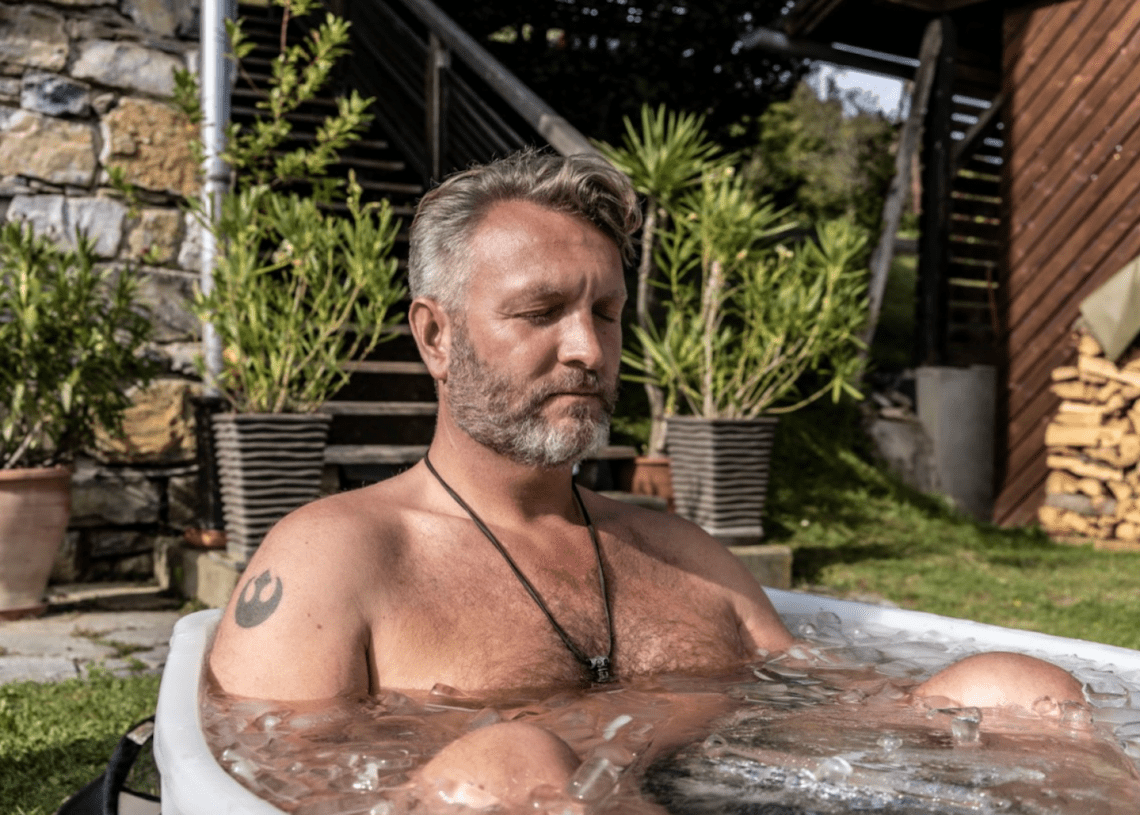
Ice baths
Cold Water Swimming,  EXTRA,  FEATURES,  November 2023,  Premium

The benefits of ice baths

Rowan Clarke finds out why so many swimmers sit in backyard baths, barrels and tubs full of icy water

Remember lockdown when we couldn’t go swimming and so we got in our wheelie bins instead? Aside from making fun Insta photos, those makeshift tubs played a serious role in helping us cope with being locked down.

But even once we were released, our backyard bathing rituals stuck. So much so that specialist companies are now selling more tubs and barrels than ever. Why is this? And how can they support cold water swimming?

Ancient tradition

We’ve been using cold water therapeutically for millennia. The earliest documented use is in the Edwin Smith Papyrus, an Ancient Egyptian medical text from 3500BC. References to cold immersion, often steeped in rites and rituals, can be found in every civilisation and every religion since. Hippocrates, the ‘father of Western medicine’, commended ocean dips as a curative therapy.

But it was 17th-century physicians like Richard Russell and John Floyer who really started promoting cold baths in medical papers. In 1697, Floyer wrote a rather wonderful guide called An Enquiry into the Right Use and Abuses of the Hot, Cold, and Temperate Baths in England. He wrote: “I do not persuade my Reader to change those Errors of living, without having first done so my self; for by leaving off strong Liquors, and all hot Diet, Teas, Coffee, & c. and by Water-drinking, and bathing at Buxton, I have procured to my self better Health, and more Hardiness, than I have enjoy’d for many Years before.”

This rich and ancient history, imbued with rites, rituals and remedies, underpins our approach certainly to wild swimming. But what about ice baths and cold showers, which seem more sterile, more contrived? Often associated with sports therapy, they feel medicalised, controlled and less connected to spirituality and nature. So, what’s the appeal?

Remedies and rituals

The most obvious advantage is exactly what might put you off: that they are controllable environments. Having control over cold water allows creativity, a freedom to play and experiment with it in a way that you couldn’t in the river or sea.

A great example is Luke Roberts’ set-up. On a farm in South Wales with beautiful rural views, Luke has sunk three galvanised tubs into a wooden deck (tanarhew.booksy.com). He offers immersion in the cold, in nature, without the risks that come with getting into the nearby river; in his words, “it’s as close to wild swimming as you can get in a controlled, hygienic environment.”

In this environment, Luke brings new, exciting rituals to cold immersion. While winter swimmers develop their own cold water routines and rituals, the natural environment doesn’t allow much room for experimentation because there are too many variables. On the other hand, ice-bathers like Luke have enough control over things like water temperature to explore different ways of benefitting from cold immersion.

Like so many others, Luke came to cold water through a quest to improve mental wellbeing. And, through extensive research and his own experience, he has developed his own favoured approach using the hot sauna and cold baths. “I think we’ve got it nailed with the contrast therapy. I personally believe that it gets the best out of the cold,” he says. “And there are two other therapies we’re hoping to bring to the area – lymphatic massage and a floatation tank.”

If terms like ‘hygienic’ seem at odds with the joy of swimming in wild water, then bear this in mind: swimming outdoors assumes certain physical abilities; it demands time and usually travel; it’s dependent on environmental conditions from tides and wind to pollution and flooding. The reality is that dipping in natural water can be awash with challenges.

Never was there a bigger challenge than the Covid-19 pandemic. With limited access to outdoor swim spots, we found ourselves not only facing untold stress, but also starved of ways to relieve it. Many of us sought alternative, home-based therapies.

“I needed a really effective stress management tool that would help me to cope,” says Abigail, who switched careers from teaching to law during lockdown. “I bumped into the Wim Hof Method and I really immersed myself in that. One of the pillars is you start off with cold showers. So, I’d have my warm shower first and then, on a weekly basis, you were advised to lengthen your time in the cold shower.”

The beauty of the shower, as Abigail points out, is that everyone has access to cold water within their homes. It’s for this reason that Wim Hof uses cold showers in his programme, making it more accessible and less risky for participants.

Hof-ing and huffing

You can hardly mention ice baths without Wim Hof’s name coming up. If you’re not familiar with the Wim Hof technique, its three pillars are breathwork, meditation and cold immersion. And while his methods are often conflated with dangerous behaviour (we’ll come on to that in a moment), they’re based on the idea that our lifestyles have become so removed from nature that we have lost touch with our ‘inner power’. In other words, the physiology that evolved to help us thrive in the wild make us struggle in a modern era.

Learning to breathe properly is thought to be critical to harnessing this inner power. Again, this isn’t new knowledge – meditation and breathwork have also been practised for millennia.

“I’ve just been teaching breath of fire, Kapalbhati, where you get a lot of energy and detoxing because it works your digestive system,” says Sarah Fyson, yoga and breathwork instructor and open water swimming coach. “When you look into it, it’s bonkers because there’s so much disease in our systems that comes from breathing through our mouths and not breathing through your nose. Knowing how to breathe properly is so important for our health.”

Wim Hof technique instructors teach breathwork before immersion in cold water. Gus Hoyt is a certified Wim Hof instructor, an Oxygen Advantage coach, freediver and author of a new book called Why Breathe?. He starts by caveating the link between breathwork and cold immersion with a serious warning.

“You will see some people on YouTube doing Wim Hof breathing in an ice bath. YouTube should have a policy where they just take all that stuff down. It encourages dangerous behaviour because it looks cool,” he says. “You can momentarily lose consciousness. That’s fine if you’re lying down on a yoga mat, but if you’re in water, or even next to it, it’s really dangerous.”

So, what’s the advantage of a breathing practice that could cause you to black out? The answer lies in the interplay between our sympathetic (fight or flight) and parasympathetic (rest and digest) systems, which are part of the autonomic nervous system (ANS). The ANS controls unconscious activities like breathing and digestion.

Through breathwork and meditation, Wim Hof purports to have conscious control over his ANS. While scientific evidence is still scarce, a study in 2018 looked at Wim Hof’s physiological responses to being exposed to the extreme cold and found that he was able to take conscious steps to allow his ANS to adapt.

Surrendering to the ice

But is Wim Hof physiologically unique or can breathwork help anyone adapt to cold water? While the scientific research isn’t conclusive, experiential evidence tells us that it helps. As winter swimmers and dippers, we certainly understand how important breathing is to getting into cold water.

“When you get into cold water, most people hold their breath and then you’re in your sympathetic nervous system,” explains Sarah. “So, what we need to do is consciously do a long exhalation to get into our parasympathetic nervous system so that our body then goes back into its calm state and we can deal with the stress of being in the cold water.”

By practising breathwork and meditation techniques on dry land, Wim Hof instructors propose that we not only better prepare ourselves for the cold water, but also get more benefits from our cold immersion.

“When you’re in the ice box, if you haven’t got control of your breath, you’re going to carry on in that sympathetic spiral. It’s the people who let their breath control where they are rather than surrendering to it who have trouble,” says Gus. “But it’s when you go in with as calm a mind as possible and just practise really nice, rhythmical breathing that you get the benefits.”

The reason comes back to evolution. Our stress response hasn’t changed since we evolved as humans, but the nature and quantity of the stress we experience has changed. Constant micro-stresses mean that our sympathetic response is triggered all the time. And because the sympathetic nervous system is involved in protecting the body tissues against environmental and internal challenges, including inflammation, nociceptors and the immune system, stress is quite literally making us ill.

The theory is that by triggering a proper, physical stress response when you get into cold water, you’re effectively teaching your body how to deal with stress. “As far as your body knows, you’ve fallen into ice and you’re not getting out, so you get a strong reaction,” says Gus. “By staying in, the body thinks that’s it, so it floods with feel-good chemicals and really nice painkillers, which is part of the high you get afterwards.”

Ready to swim

Having established that you get the same physiological responses to immersion in any cold water the question is, can breathwork, cold showers and ice baths support our winter swimming?

For so many of us, the experience of being in natural, wild water is incomparable. But there are other factors to consider beyond the characteristics of natural bodies of water versus tubs, baths and showers. Everything from water flow to how we approach the dip defines each method of immersion.

For example, if you’re used to sitting still in a bath, you may be surprised by how much colder a river feels even if the thermometer reads the same temperature. When water moves across our skin it has a greater cooling effect; in an ice bath, our bodies warm the water immediately next to our skin and we can sit in a position that lessens heat escape.

“I’ve sat in baths at five degrees and it’s very cold but manageable, yet in a river that’s eight degrees I’ve struggled because it’s literally cutting through you,” says Luke. “I struggle with cold showers too because the water’s flowing.”

Another factor is our interaction with our surroundings. Cold water swimming is usually sociable and even for solitary swimmers, we enjoy our environment. But sitting still in an ice bath is very inward looking.

“There’s community and camaraderie around ice bathing, but the actual act itself is just about you and your response in the cold, which can make it more intense,” says Gus. “That’s very different from swimming and why it can be so good for clearing up trauma and things like that.”

Ice baths and cold showers certainly habituate your body to the cold. They provide controlled, accessible acclimatisation, which can prepare you to swim in cold water. But, sitting in a tub or standing under a shower inside your warm home isn’t the same as swimming in cold water, so you still need to approach your first winter swims cautiously.

“When I had my first dip, I got completely carried away and was in the 8.1 degree water for about 40 minutes. Obviously, I got severe afterdrop and I have no idea how I managed to get my clothes on afterwards,” says Abigail, who went to her local swim spot as soon as lockdown was lifted. “I always say this to people; you lose track of time when you’re in the cold water. Now, I can listen to my body, but that’s after years of experience. In the initial stages, I don’t suggest you listen to your body. Get someone to time you and tell you right, that’s two minutes, you need to get out now. It’s better to be overly cautious than then take any chances.”

But ice baths, cold showers and breathwork aren’t just for newbies. Winter swimmers everywhere are installing tubs in their gardens and adding breathwork practises to their repertoire. For ice swimming event training, for a cold hit when the sea’s still too warm, for when our schedules, transport or injuries keep us from our swim spots, or just because we crave variety, they offer the therapy we love in new and different ways.

Read more guidance on cold water swimming.

Stay up to date with The Dip, our free weekly outdoor swimming newsletter.

Outdoor Swimmer is the magazine for outdoor swimmers by outdoor swimmers. We write about fabulous wild swimming locations, amazing swim challenges, swim training advice and swimming gear reviews.