

In hot water: swimming and climate change
Social scientist and academic, Abi Lafbery has a PhD in outdoor swimming and has been studying how humans connect to the natural environment. Through her research, she discovered that swimmers have an immersive knowledge about the water and environments they swim in. We asked her to share part of her research and how outdoor swimmers are learning about climate change while immersed
To swim outdoors is to swim in the ephemerality of life. In the water, the only constant is change; the ebb and flow of tides, the ‘turnovers’ of lakes and the meandering of rivers are part of already changing landscapes. The fleeting nature of the flora, fauna, weather and seasons bring joy to many outdoor swimmers, and have done for centuries, being documented in the earliest outdoor swimming manual, ‘De Arte Natandi’, or ‘The Art of Swimming’, published in 1587. However, 438 years after its publication, the very same waters are worlds apart.
Lake Windermere has increased in temperature by almost two degrees since the 1950s, and the coastal waters of the UK have increased by one degree since the mid-1980s. These changes are as dramatic as they are devastating, signalling a new epoch of outdoor swimming. My PhD, located on the coast of North West England and the Lake District, has explored what it looks like and what it feels like to be swimming through these changes. It discovered something fascinating: outdoor swimmers, through immersion, come to know the water, flora, fauna and weather in intimate and interesting ways. Furthermore, outdoor swimmers are starting to notice the effects of climate change and are thinking about the possible future effects of climate change on their practice.
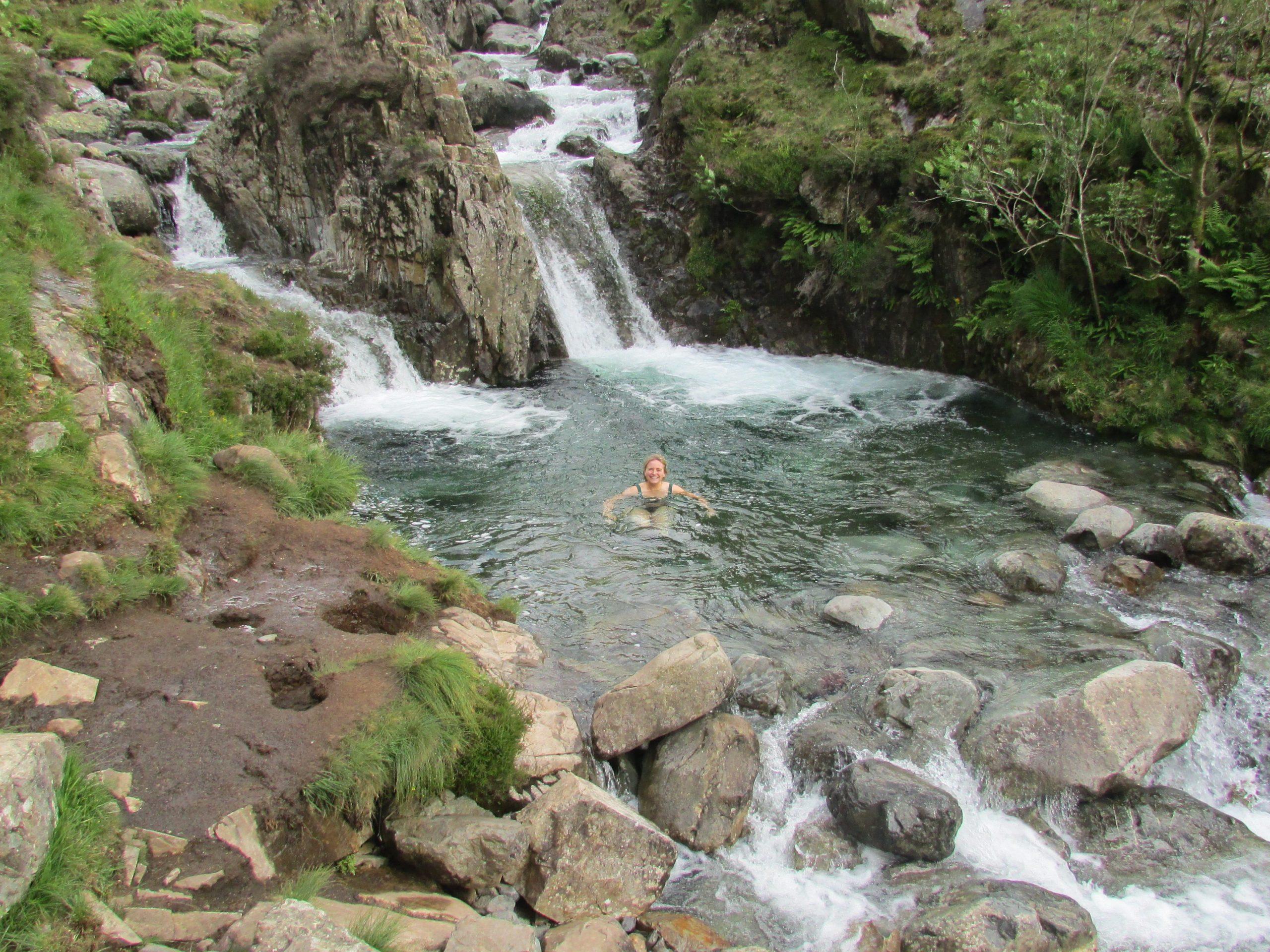
It is already known, and commented upon in a range of outdoor swimming literatures, that to swim outdoors is to be at the whim of the weather. In just 365 days, swimmers move through muted grey sea fret, or past jetties kissed by frost. Wintering wildfowl are replaced by cerulean flashes of kingfishers and swells of frogspawn in spring. Summer is decorated with colourful wildflowers and the looping flights of dragonflies and mayflies, before autumn arrives and aromas of damp earth settle on umber brown and burnt orange leaves.
Amongst it all, the outdoor swimmer is a quiet, yet shrewd observer. Often immersed up to the neck, they can appear to wildlife as a floating head; what the iconic swimwriter Rodger Deakin described as the ‘frog’s eye view’. Suddenly, the swimmer’s presence as a human being is radically altered; their size diminished and their form far from the apex predator that otherwise stalks the banks. This obscurity affords the swimmer a rare window into the rhythms and movements of a lively watery ecosystem through time. One swimmer remarked on hearing the mild bleating of lambs turning into the baritone baas of sheep and how the heron had become a solitary figure once again; his mate and juvenile long since flown the nest.
But let’s not be too romantic! Swimmers are also ‘frog’s-eyewitnesses’ to occurrences far from endearing and captivating. Beyond the natural changes to our waterscapes, swimmers are moving through waters affected by run-off, chemicals and sewage. A plethora of reports and news articles in the past few years have confirmed that outdoor swimmers might, on occasions, be submerged in figurative and literal stomachchurning waters.
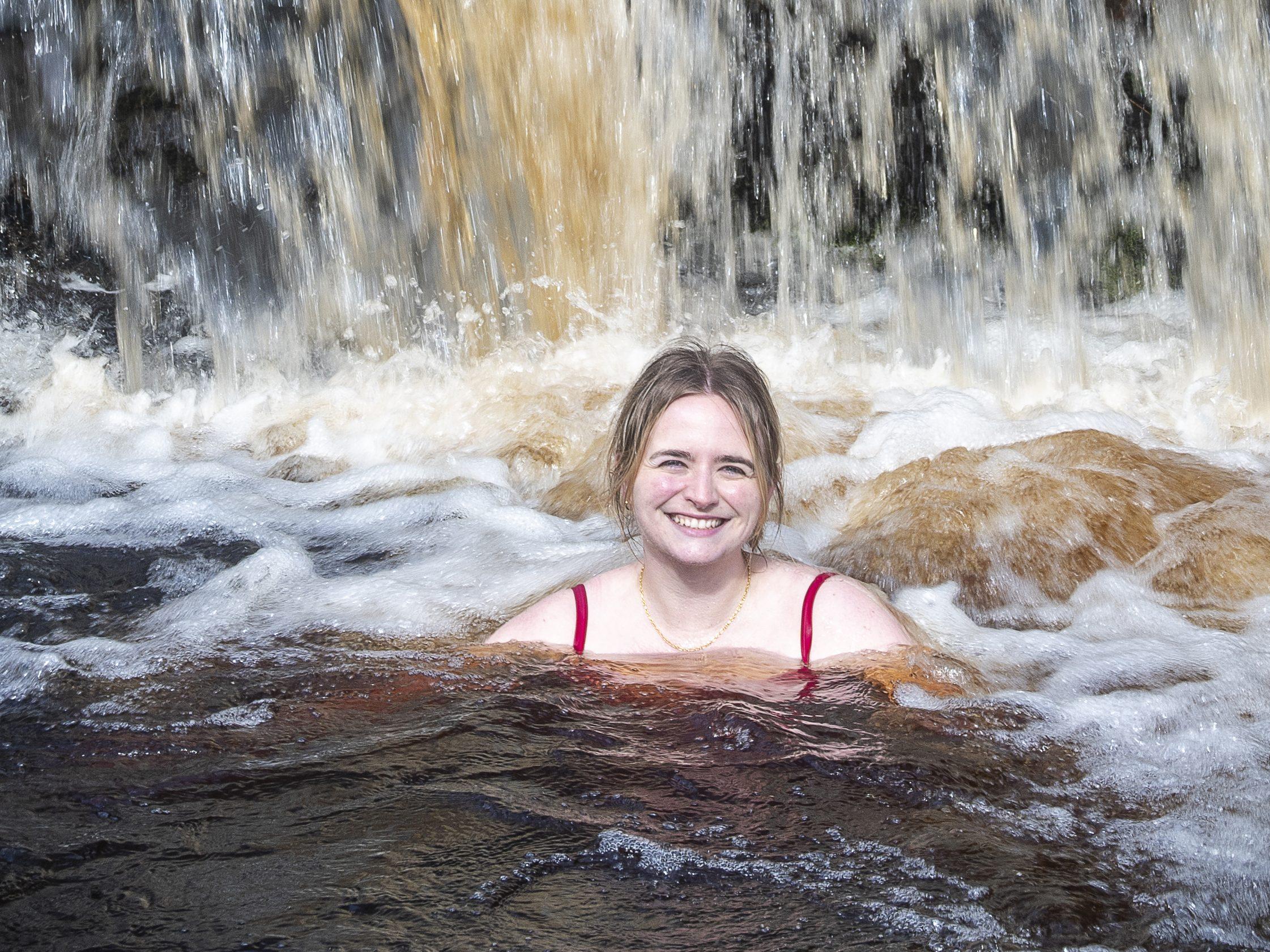
My research indicates that when your skin is the only barrier between yourself and all that the water houses, knowledge of the what you’re swimming through becomes increasingly important. Therefore, outdoor swimmers often develop an alternative and intimate knowledge of their environments compared to every day terrestrial life. In my PhD, I termed this ‘Immersive Knowledges’ to bring attention to how these knowledges emerge specifically through being in the water.
For some swimmers in my study, their outdoor swimming practice had sparked deeper insights into the fields of ornithology, dendrology, phycology and conchology – or birds, trees, seaweed and shells! Other swimmers discussed learning more about the hydrology and geology of their favourite swimming haunts. One swimmer commented on feeling attuned to how the rain falls in the local fells and how this water becomes the river she swims in every day. Another swimmer in my study discusses how she has learned about the bedrock of her river, which in turn has changed her perception of herself in space and time.
For many swimmers, there is a correlation between the sensory and embodied nature of being in the water, and the subsequent acquiring of knowledge. One swimmer described this process as:
“We have the frog’s eye view of what’s happening in the water to the riverbanks, to the lake shore. When we swim, we are affected by the water temperature, the quality, the smells, the sounds. All of that. I think it does automatically bring you closer to nature and the environment… you’re just soaking it all up literally”.
My research has identified that this front row seat can encourage an awareness of a changing climate. One swimmer suggested that becoming an outdoor swimmer has made them:
“More inquisitive, more observant and aware of changing conditions and changing weather…you can feel it around you. You can see it all around you. You can feel that’s a bit later, that’s a bit earlier, that’s warmer, that’s cooler, a bit windier or rainier.”
A different swimmer felt that whilst swimming, she can:
“Physically see, touch, feel, smell that the world is changing and that there is a climate situation going on.”
This swimmer discussed how some ponds had disappeared in times of drought, that river levels had decreased to the extent that weeds interrupted their swims, or that they had noticed when blossom comes out or birds hatch earlier than expected:
“It’s that kind of thing that we notice, that if you aren’t swimming outdoors, you wouldn’t necessarily care or notice at all… You notice the natural cues of cycles when they’re not right, they’re all skewed and so it makes us think, okay, this is something we really need to pay attention to.”
Earlier issues of Outdoor Swimmer (April 2022) speculated that outdoor swimming events may be threatened by flooding and the associated risk of contaminated water. The swimmers in my work voiced concerns about whether and how climate change might increase incidents of algal blooms, heavy rainfall or how warming waters might affect what species they are swimming with.
On the North West coast, swimmers have been commenting on the rise of jellyfish and wondering if this could be linked to the rising sea temperatures. One swimmer reflected that a bout of lion’s mane jellyfish could be related to this, stating:
“The instant thing I thought was climate change, could it be climate change?… Were there such numbers of these species 30 years ago… I guess there’s some consciousness to climate change when I am in that water and thinking about it”.
Observations such as these are not against the grain of scientific thought. Despite the UK’s relatively temperate climate, recent research by Couce et al., (2025) and Matthews et al., (2025) has identified that the seas of the British Isles are among the fastest warming and fastest rising on earth in the past 50 years, compared to the global average. Many fish species are already responding in kind by becoming more or less abundant and by migrating to new waters. The BBC (2025 ) documented that previously rare sightings of bluefin tuna and the otherworldly chains of salps are becoming more frequent on UK coasts, whilst other species like the common whelk are experiencing mass die-offs.
So, where do outdoor swimmers fit into this conversation? One might look to Lewis Pugh, a maritime lawyer turned swim campaigner, who has drawn attention to the effects of climate change on oceans during his series of highly publicised swim endurance events. Pugh has swum in every ocean of the world, including crossing the Red Sea and the North Pole, and tells the stories of a warming ocean including glacial retreat and coral death. Pugh’s activism, coined ‘speedo diplomacy’ by The Guardian, is targeting the protection of 30% of the worlds oceans by 2030, a movement supported by over 100 global nations, including the UK.
Whilst most of us in the outdoor swimming community don’t have the means, the body or the exceptional drive to accomplish such extraordinary feats in the name of the climate, we can still do our bit to help to stem the tide. As our awareness of the effects of climate change on our practice increases, outdoor swimmers might consider how their own practice is contributing to said change, and what may be done about it.
This might, for example, look like swapping out petroleum based wetsuits, carpooling, cycling or walking to swim sites, rewilding and protecting the flora and fauna at these swim sites, or joining environmental advocacy campaigns, as many of us already are! Whilst these individual actions might feel like a drop in the ocean, collectively we become the ocean.

Outdoor Swimmer
Outdoor Swimmer is the magazine for outdoor swimmers by outdoor swimmers. We write about fabulous wild swimming locations, amazing swim challenges, swim training advice and swimming gear reviews.