


Into the inky depths
Endurance training or sensual submersion, Rowan Clarke explores night swimming
Romanticised by songs, poetry, art and literature, night swimming is a popular motif for serenity, intimacy and the subconscious, and also the sinister and uneasy. Somewhere between dreams and nightmares, it can stand for the deeper, secretive side of being human. But, for outdoor swimmers, it has completely different associations.
While we may experience both serenity and unease while swimming outdoors in the dark, it’s also a necessary part of endurance training, and a magical way to heighten our connection with nature. From the benefits and practicalities to the unique encounters we have in the dark, we ask how and why we swim at night.
Deserves a quiet night
The theme of night swimming is ubiquitous in arts from across the ages. Because it’s seen as mysterious, covert, rebellious, scary, exciting, sensual, and intimate, it’s used to convey many meanings. Historically, it served as a metaphor for escapism, intimacy, a loss of innocence, and the power of nature, often inspired by stories like the mythological Greek tragedy of Hero and Leander.
More contemporary arts use night swimming as a symbol of youthful liberation (think REM’s 1992 song Night Swimming), psychological depth, transformation and identity – as in Peter Rock’s autobiographical novel, The Night Swimmers. The ocean at night also stands for our fears in contemporary films like The Life of Pi (2012) and Open Water (2003) – of loneliness, monsters, and the darker parts of our personalities.
These contemporary themes are very relevant to outdoor swimmers, particularly endurance swimmers who spend a lot of time alone with their thoughts. One such long-distance swimmer, Katie Pumphrey, is also an artist. She explains how her experience of crossing oceans, often in the dark, influences her paintings.
“A lot of my paintings are deeply influenced by my experiences in the water,” she says. “Our imagination plays tricks on us swimming at night, which I think is a way to describe our anxieties, fears and stress, which can get loud and scary. So, my work contains a lot of suggestions of sea monsters, whether that’s sharks or alligators, or a suggestion of something lurking below, very much like how our anxiety is always there.”
Enduring the dark
This theme threads through the powerful, moving film Don’t Be Prey about Mark Sowerby’s attempt to complete the Ocean’s Seven. Watching Mark’s night swims, the added psychological and physical challenges of crossing oceans in the dark are glaring. It’s not simply that it’s colder at night, but that the lack of visible horizon can induce terrible sea sickness, and that those titular demons can so easily creep in – Mark describes how the phrase, “don’t be prey,” plays over and over in his mind.
“Swimming at night isn’t particularly difficult, but it does exacerbate everything,” explains Mark’s coach, Tim Denyer. “If you feel like you get touched by something in the middle of the night, it’s a lot worse than if it was in the daytime, so it’s more about controlling the mind than anything else.”
As an experienced coach of Channel swimmers, Tim recommends training in the dark to perfect the practical side of night swimming like navigating by the lights on the support vessels and combating seasickness, and to help manage those fears.
For distance challenges, night swimming is often unavoidable. The Catalina Channel crossing, for example, starts between 10pm and midnight to avoid the afternoon Californian surf waves. You may be swimming for longer than daylight hours, or the tides might dictate your start time – as they did for Colin Hill’s English Channel crossing.
“Some people are nervous about swimming in the dark, so it’s a good idea to get used to swimming next to a kayak, practising wearing your green light on your goggles and following the lights on the side of the support boat,” says Colin. “I don’t train for night swims anymore, as I know how I cope in the dark and what instructions to give my support team, but for those who haven’t done it before, then you don’t want to wait until the big swim to find out how you and your team cope.”
Colin touches on a very important point, and that’s the role of the support team. Learning how to put all your trust into your team, knowing that they’re there to keep you safe is critical – especially at night in waters that might hold jellyfish and sharks.
“I have quite a few fast swimmers who have been significantly slower in the open water at night,” says Tim, who is exactly the kind of coach you want backing you from the support boat. “I got one guy through Catalina who had a horrendous time at night with sickness. I said to him, look, this is the moment we train for, we hope it doesn’t happen, but it’s happening, and it’s ok. Don’t think about reaching the mainland, just focus on getting to dawn. If you get to dawn, you’ll get the swim finished.”
A transformational experience
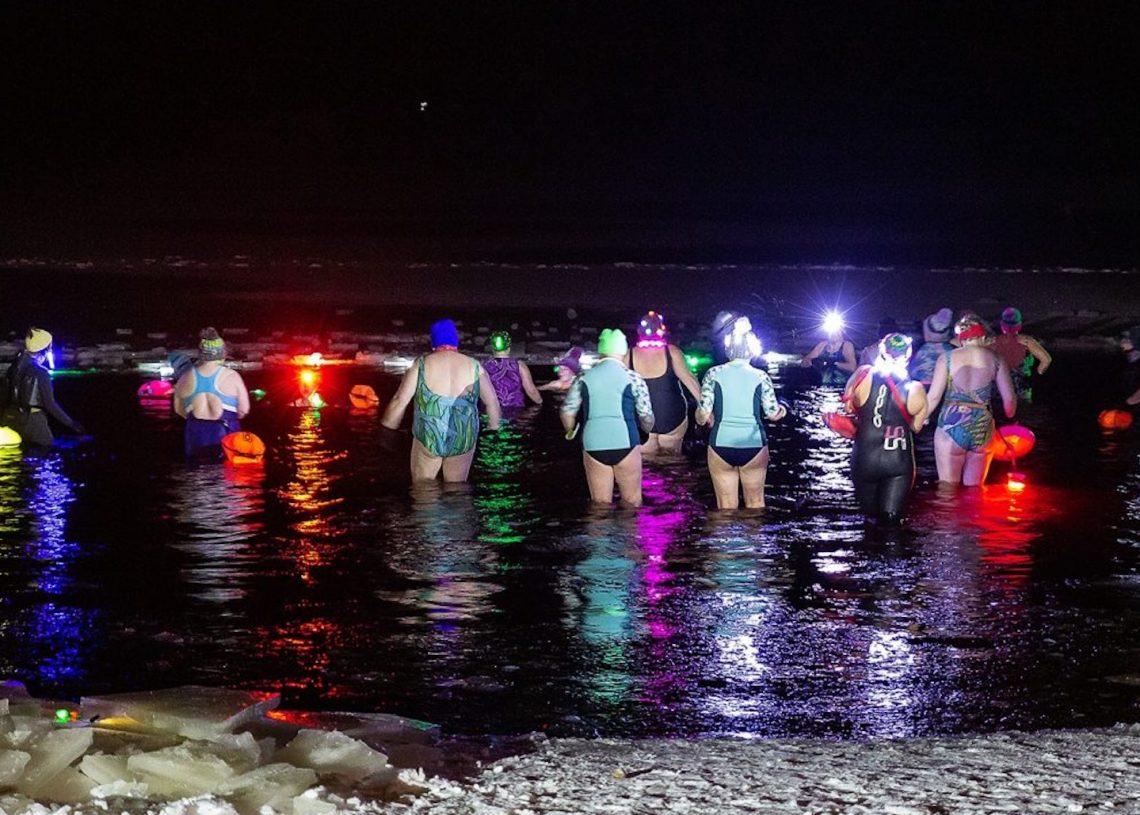
The important thing, says Tim, is finding the fun in night swimming. His advice is to find a relatively safe body of water and a group of friends, light yourselves up with glow sticks in your tow floats and enjoy the experience.
With this approach, night swimming has become a popular experiential activity. More and more outdoor swimming venues offer organised night glows, swim groups meet under full moons, and swimmers join guided night swims with companies like Colin Hill’s Ullswater Swim Place.
“For me, night swimming for the sheer pleasure started with my wife Steph, who used to have a group of friends going for a full moon dip. I wanted to share this experience with my swim guests, so I started running regular stargazing swims,” says Colin. “We swim head-up breaststroke with lots of chat, floating on our backs, and I point out the constellations if it’s a clear night.”
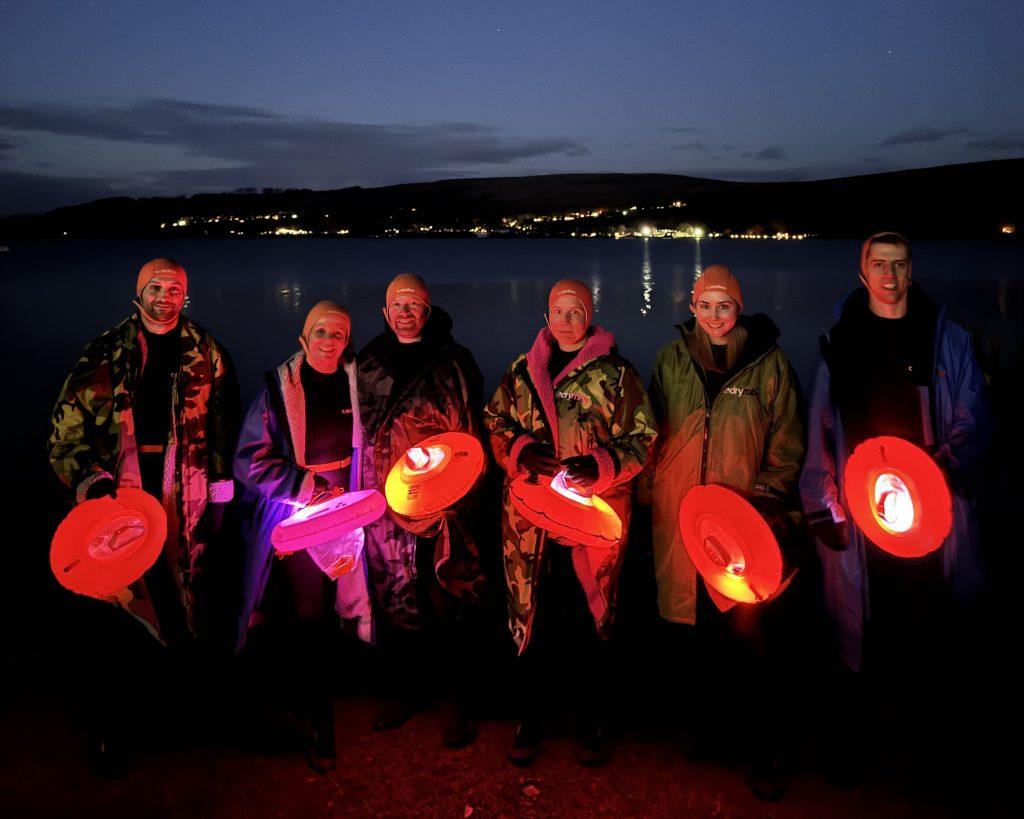
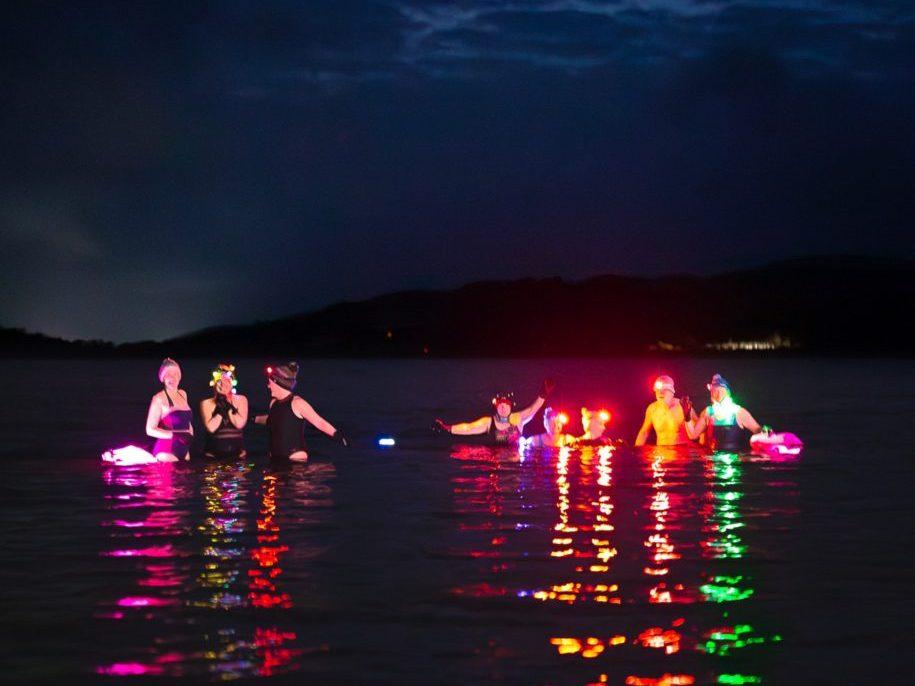
While stargazing is wonderful, you don’t need a clear night to find the magic. With lights in their tow floats and laughter across the surface of the water, Colin says his guests love the night swims even when it’s cloudy.
However, with a little luck and good planning, you could hit the outdoor night swimming jackpot and experience swimming in bioluminescence. These are minuscule single-cell organisms called dinoflagellates, which sparkle on the surface of the ocean when disturbed. Like plants, they get their energy from the sun and store it as a lightbearing protein. When we agitate them, a chemical reaction breaks down this protein and releases light. The result is magical.
“It felt like we were in the middle of nowhere, between the galaxy above and the bioluminescence in the dark water,” says Alice Goodridge, founder of Swim Wild in Scotland, which offers guided night swims. “I always thought you would see colour, but it’s actually almost like a silver spark. I’ve described it before as like swimming through a galaxy – you get all these little sparks coming off you, which are really concentrated where you’re agitating the water, like little fireworks.”
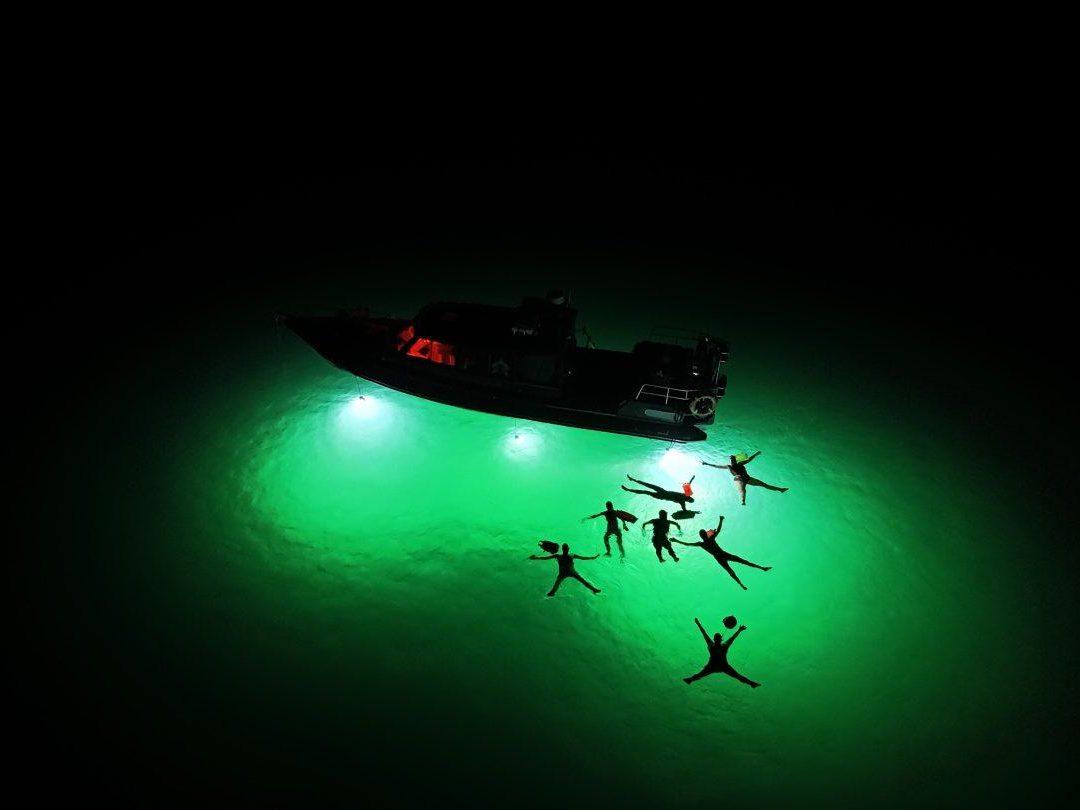
Alice paints a vivid picture. This magical swim near Oban under the stars with their colourful, glowing tow floats bobbing like lanterns across the surface, glimpsing fish underneath, culminated in turning off all the lights to immerse in the bioluminescence, and then rolling over to take in the Milky Way and shooting stars above.
Regardless of whether you’re an endurance or experiential swimmer, encounters like these can be profound. Challenging your fears, pushing your boundaries, and opening your senses to swimming at night piles benefits on top of those you already get from swimming outdoors in natural water. With fewer visual distractions, a greater focus on the feel of the water induces a meditative state, which helps alleviate stress and promotes mental clarity. It’s sociable, too, requiring greater trust in one another, promoting a deeper, more intimate bond with your friends or team.
“This swim really transformed my relationship with swimming in the dark,” says Alice, who started her English Channel solo at 3am, and swam through the night on Loch Lomond. “Some of those experiences were good, others absolutely terrifying, but all of them were framed as part of a much bigger challenge. This time was different. To simply slip into the water at night, with the floodlights glowing around the boat and the incredible stars scattered across the sky, felt utterly transformational. I think I’m actually going to enjoy my next long-distance night swims.”
Finding the fun at night
Reading about the magic and beauty of night swimming, you may still be terrified of deep, dark water. It’s hardly surprising – all those stories and films permeate our subconscious, tapping into our deepest fears, so it’s understandable that the prospect of swimming in the dark at your regular swim spot – let alone crossing an ocean where sharks live – fills you with horror.
So, how do you tackle that fear? The main obstacle is getting into the water in the first place. Signing up to an event or guided swim is one way to experience night swimming in the safest, most controlled way possible. Adding a challenge, such as Level Water’s 24-hour Wild Swim Relay, brings accountability and focus.
“Instead of focusing on what might happen, focus on the positive outcomes – we’re doing this 24-hour swim, raising money for charity, being a part of the team, getting my hour done,” says Tim. “If you’re prepared to get in, you should be focusing on the next bit, which is completing the challenge.”
This doesn’t mean you can out-think those feelings of fear or unease; our brains respond to emotions over rational thoughts. But you can distract yourself. And, by focusing on what motivates you, and what fills you with joy, awe and wonder, those positive emotions help banish your anxieties.
“I’m not going to lie, I only agreed to swim from two to three in the morning because nobody else would do it – I was really dreading it,” says Romola, who took part in the Wild Swim Relay at Shepperton last year. “I was irrationally scared of what was in the water and being alone. But as we swam together, chatting, laughing, watching the pretty lights, gazing up at the sky, I kind of forgot to be frightened. It was amazing – I was so proud of myself.”
Serene, scary, delightful, fun, exciting, or all of the above, night swimming is both a necessary part of endurance training and a magical way to enhance your experience of swimming outdoors.
Find out more
Watch: Don’t be Prey dontbeprey.film
See: Katie Pumphrey’s art katiepumphrey.com
Swim: Ullswater Swim Place ullswaterswimplace.com
Swim Wild swimwilduk.com
Level Water Wild Swim Relays levelwater.org/24hr