
Is urban swiming really more accessible than wild swimming?
Adaptive swimmer Sophie Etheridge shares the surprising obstacles she encounters in purpose-built urban pools
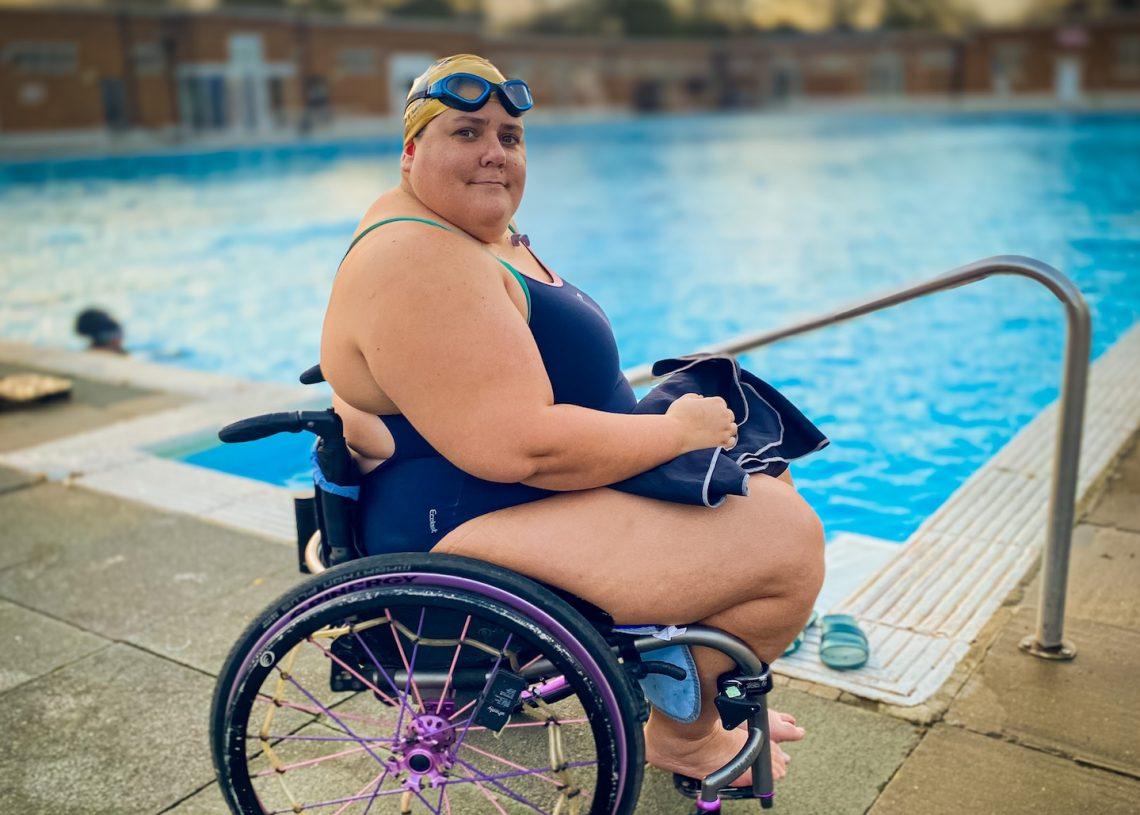
When people ask me for accessible swimming spots, they usually assume the answer will be a lido or another urban venue. It sounds logical: the Equality Act 2010 requires public services to be accessible, so you’d expect leisure centres to be designed with disabled swimmers in mind. But that assumption often falls apart the moment you arrive.
As a wheelchair user, I’ve found that many regulated, staffed, purpose-built urban pools are actually some of the least accessible places to swim. To show what I mean, here’s a simple comparison between a typical lido and one of my regular wild swimming spots, based on my own needs and experiences.
The lido experience
You arrive full of anticipation… and immediately hit your first barrier. The turnstile. It’s obviously not wheelchairfriendly. There is a side gate, but you can’t open it yourself. You’re already dependent on someone else before you’ve even reached the changing rooms.
The changing rooms. Frequently the disabled changing is used as storage or doubles as a baby changing room so is often in use. You can get into the ‘normal’ changing rooms but a deep, uncovered drainage channel runs around the entire space. To enter, you have to wheel over it – a perfect trap for wheelchair castors. Misjudge the angle and you risk tipping forward. The doorway is barely wide enough for a chair, so even getting inside requires precision.
The route to poolside. To reach the water, you have to wheel through the showers. That means waiting until no one is using them so your chair doesn’t get soaked. You’re also expected to shower before swimming, but there’s no seated shower available, so you simply can’t.
Finally, the pool. You’ve made it, well, almost. Now you need to work out where to leave your chair and how to get into the water. I prefer ladders (great practice for boat entries), but this lido only has a flight of stairs. I can manage them carefully, but it’s a struggle. If I needed a hoist, I’d be out of luck: it’s not kept poolside, and none of the lifeguards on duty today are trained to use it.
Eventually, after navigating every obstacle, I’m in the water. And yes – the freedom is worth it. But it shouldn’t be this hard.
Wild swimming: a different kind of accessibility
Now picture this. You arrive at a riverbank. You change under a towelling robe. You wheel down a boat slipway to the water’s edge. You transfer to the ground, do a few bum shuffles, and you’re in.
No turnstiles.
No narrow doorways.
No inaccessible showers.
No waiting for staff.
Just water, space and choice.
So, is urban swimming accessible? For many disabled swimmers, the answer is complicated. Purpose-built venues often create barriers through design choices that were never tested by the people who rely on them, while wild spaces can sometimes offer a smoother, more dignified route into the water.
But this isn’t an argument against urban swimming, it’s a call to improve it.
Urban venues should be the most accessible places to swim. They have the staff, the funding, and the legal duty. What they often lack is lived-experience design. With input from disabled swimmers, turnstiles could become independent entry points, changing rooms could lose their hidden hazards, and hoists could be visible, available, and confidently used.
Urban swimming has the potential to lead the way in helping more people access outdoor swimming. It just needs to be built with all swimmers in mind.
Photo by John Weller

Outdoor Swimmer
Outdoor Swimmer is the magazine for outdoor swimmers by outdoor swimmers. We write about fabulous wild swimming locations, amazing swim challenges, swim training advice and swimming gear reviews.