

Poet of Penzance
Accidental poet Katrina Naomi shares her creative practice and how swimming helps her out of her head and into her body
I’m writing this mid-November with a hot water bottle stuffed inside my cardy. It’s the first time this season that I’ve noticed my fingers fumbling with the zip of my anorak after a swim (yes, sea swimming in winter is a highly glamorous business) and I need my fingers for writing, as well as for swimming. But I’m here to talk about the positives of sea swimming, year-round, as far as creativity is concerned. I find a lot of benefits to sea swimming, not least that I enjoy it, that it puts me in a very good mood, and that I’m dead keen to get to my writing desk as soon as I’ve swum.
I’m a poet, it’s my job – a strange sort of job I’ll grant you, but then a lot of people think sea swimming outside of August is a strange thing. I’m quite happy to fit into both categories of oddity here.
I haven’t always written. I got into poetry by accident. I hated poetry at school. There was nothing I could relate to. I found it pompous, elitist and dull. It wasn’t until I was 30 that someone read me a poem by the US poet Sharon Olds, which they followed up with a Mark Doty poem, and I found myself thinking, if that’s poetry, then I’m in. A bit like the sea.
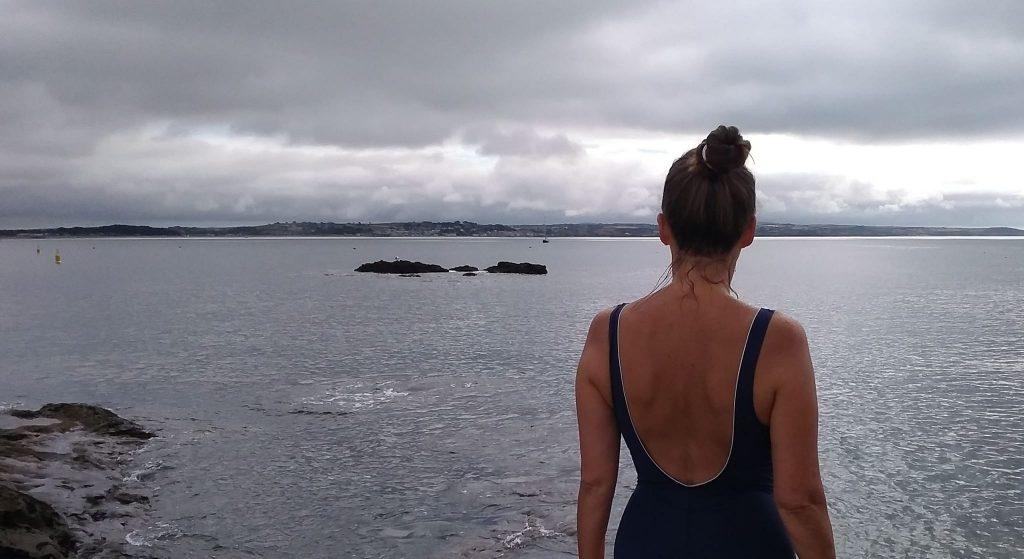
So what’s the link between creativity and swimming for me? Being a poet, I spend a lot of time inside my head, which isn’t always the healthiest of spaces. Swimming has enabled me to reconnect with my body and this has really freed my poetry up. I could give you a lot of scientific stuff about sea swimming and creativity, talk of synapses and the like but I’m a creative nerd, whenever I meet another writer or a visual artist, I want to know what their process is – what makes them write, paint or bash clay around. So here’s my process.
After a cuppa first thing in the morning, I step into my cossie and pull on some layers before strolling to my swimming spot, Battery Rocks in Penzance, Cornwall. You might remember an Outdoor Swimmer feature on swimming in Penzance, a few issues back? This morning there was a yellow warning of rain. I ignored that, it rains an awful lot in West Cornwall, more than the likes of Instagram might suggest.
The sea at Battery Rocks this morning was like the insides of a washing machine, with a heavy load. I’ll confess that I thrive on stormy swims but it was too rough with a strong Northerly, so I swam in the nearby harbour. I only saw a couple of other swimmers, who were drinking coffee from a flask. They looked snug in their bright dry robes. I don’t have a dry robe and make do with my trusty anorak. It’s really cold today, they chorused. Cheers.
I got in, sliding on the algae of the aptly-named slipway. The sea was a muddy green, (it’s been raining for days), waves slapped me in the left ear, gulls were crazying above the dry dock. The sort of swim where it’s best to keep your mouth shut. I do sometimes question why I’m doing this. As I swam, I felt my skin tightening around my body, it’s the cold, of course; and then the waves slapped me in the right-ear on the way back.
Don’t ask me how long I swim for in the winter or what the sea’s temperature goes down to, I’ve no idea. I just swim until it feels like time to turn around. It’s easier in the Summer, the buoys are laid out in a row towards Newlyn, I set myself a goal, 3rd buoy, 4th buoy, but mid-October the buoys get taken up before they blow away, so I swim out to align myself with a building from the sea front, or swim until I sense I’m getting too cold. It’s not very scientific but it works for me.
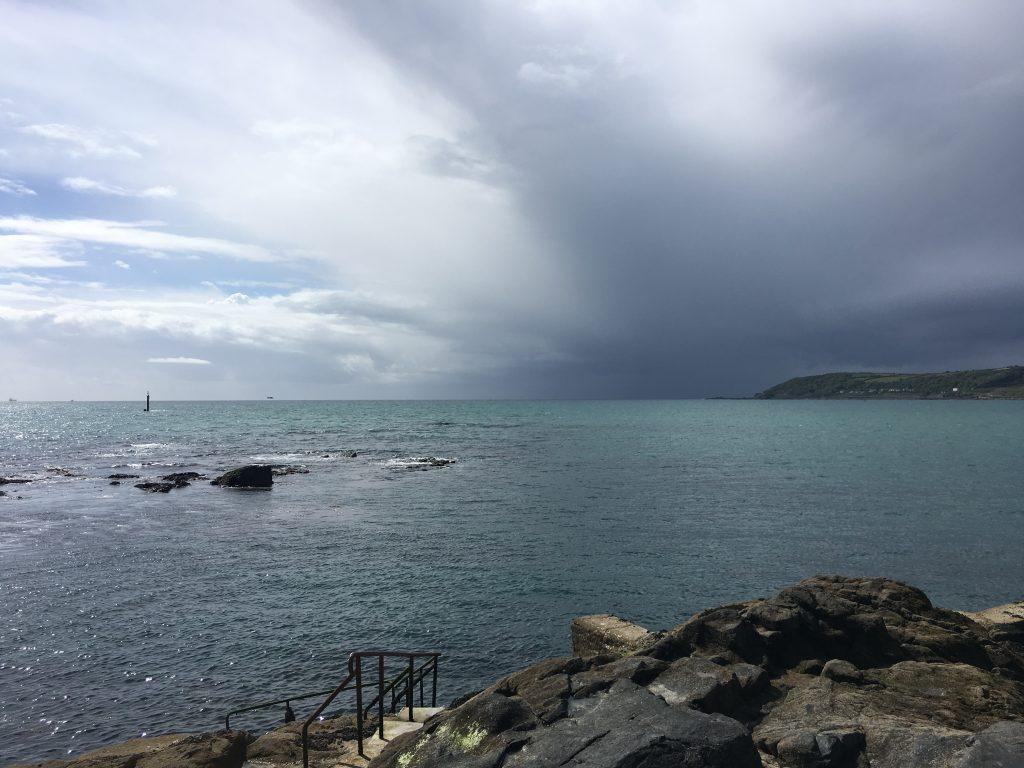
And all the while on this swim, whether it’s November or June, I’m thinking of my senses: the smells, what the sea feels like on my body today, whether it’s slapping me about or languidly stroking me, I think about which animals, weeds and birds I see, and what my mood’s like. Will that huge seal pop up? I’m scared of seals. Then I think about what I can hear. Some of these thoughts are conscious, like when an oystercatcher screeches past and I tell myself, I’m going to remember that, or when I stop mid-swim for a chat with someone, there you are both treading water and talking about what’s on at the cinema, like we’ve bumped into each other in the street. All of this will go into a poem – well, maybe not all of this but the most interesting bits, the bits that feel like they really want to be in a poem.
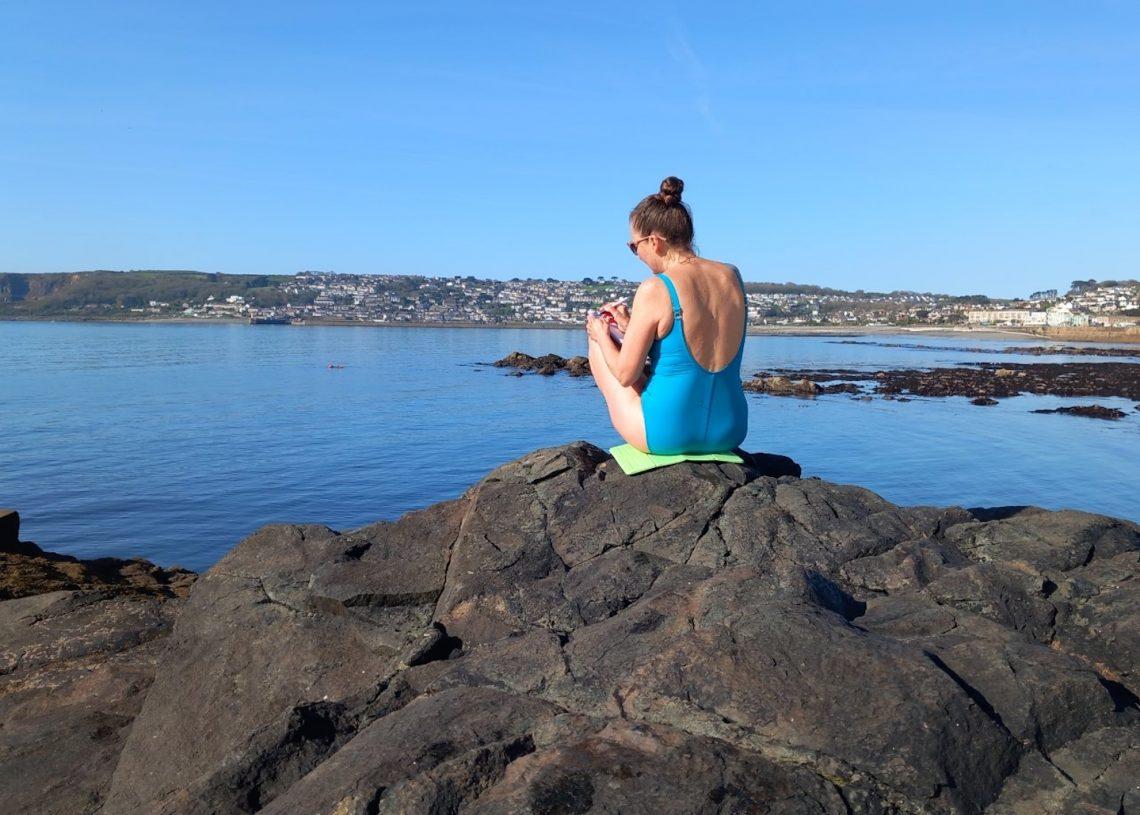
If it’s warm enough, I’ll sit on the rocks and write straight after my swim in my cossie, or in a towelling shortie robe. This time of year, I hurry home to my writing room – I’m lucky enough to have a room of my own – with a slightly obscured view of the harbour and The Lizard beyond. (In Winter, The Lizard can disappear from view for weeks on end, as if it’s floated off someplace). I go straight to my desk after some toast and scribble everything down. This is how I start to write – and if you feel inspired you might like to have a go too.
I often begin with a freewrite, that is I write for 10 minutes. I like to time this. There’s only three rules to a freewrite (some people call this automatic writing). The rules are:
- Write by hand (I think there’s a connection, a flow if you like, from the brain to the hand. Once we get on a computer, we’ve already got half an eye on publication, on professionalism, on ‘proper writing’) and that’s not what we’re about here, we want some writing that’s a bit out there, a bit bonkers.
- No crossing out. You’re not allowed to censor yourself, otherwise we probably won’t allow the slightly bonkers to come in to our writing.
- Don’t stop writing until the timer goes off and don’t think about what you’re writing. If you can’t think of what to write, write ‘I can’t think what to write’; something will come. Honest.
I like a big A4 notebook for doing this. I think the bigger the page, the bigger the ideas. Just get it all down. Then you’re allowed another cup of tea. Then go back to the page, with a different coloured pen, and highlight everything from your 10 minute scrawl that surprises you (all the bonkers bits) and/or all that you (secretly?) rather like. This is where the poem starts for me.
I look at all those highlighted bits, I think again of my senses – the taste, touch, smell, sound and sights from my morning’s swim. What have I noticed, what have I felt? What do I want to focus on today, who or what from today’s swim is demanding to be at the centre of the poem. And then I write. I write the poem for as long as it takes. It might be a haiku of three lines, (of just 5 syllables, 7 syllables and 5 syllables, if you’re interested), or it might be several pages. Then I write the poem out a second time, making minor (and sometimes major) changes, then I write it out a third time. Then I put that draft poem away for a month or more. Only after a good break from the draft poem will I type it up and begin to edit it, trying to read it as if it were written by someone else.
I did this every day for a year. I’ve chosen the best of these poems for my forthcoming poetry collection, Battery Rocks, which will be published in July 2024 by Seren Books.
I would never have written Battery Rocks without swimming. And I’d never have written the poems with such enthusiasm and something approaching ‘ease’ – that’s a difficult word to use, ask any writer. But many of these poems came swimming towards me. This includes the poem ‘in the kelp forest’ which won the Keats-Shelley Prize. I’m still amazed and very grateful for this.
All of the poems are written of sea swimming but they’re not all necessarily about swimming. Many are, of course. Others are meditations on nature, the sea, risk, vulnerability and the wider world. I’m approaching the climate emergency from aslant. There’s a poem on Palestine and Israel, others on how I often feel safer in a storm in the sea than I do on dry land (I’m a survivor of sexual violence but that’s another story) and there’s poems in response to what I like to term ‘swimmers’ brags’, you’ll know the sort of thing. I’m guilty of them myself.
Battery Rocks, the collection, has plenty to do with synapses fizzing, blood pumping, cold biting and numerous cups of tea and hot chocolate. But without the sea, there’d have been nothing.
Let the sea speak to you, and then write it down.
And if there were no sea?
no shushing of the pull / no shimmer of summer / no knowledge of splash / no repetition of clouds / no clouds / no splendour of kelp / no fish / no study of scales / no silhouette of oystercatcher / the moon on repeat / no islands / no need for ships / storms would laze in their beds / no Speedos / no coastal erosion / all of us living inland / no salt / no shells / no need to row / no Jaws / no glamour of rock pools / nowhere for the sun to swim / no rivers / rain unknown / no place to drown

Outdoor Swimmer
Outdoor Swimmer is the magazine for outdoor swimmers by outdoor swimmers. We write about fabulous wild swimming locations, amazing swim challenges, swim training advice and swimming gear reviews.


You May Also Like
How to calm first event nerves
Swimming from Denmark to Germany