Lake Powell
EXTRA,  FEATURES,  February 2023,  Premium

Vanishing lakes

Register to get 3 free articles

No spam Unsubscribe anytime

Want unlimited access? View Plans

Already have an account? Sign in

The challenge of finding swimmable water is getting harder in some locations, no thanks to climate change and human industry. Elaine K Howley investigates.

A key challenge in open water swimming is finding safe, swimmable water. From the potentially deadly suck of dams and weirs to the perilous swirl of whirlpools offshore, there’s a wide range of hazards that abound in open water.

But there’s another danger associated with water that’s becoming particularly pronounced in certain parts of the world: there’s just not enough of it to keep some bodies of water intact and safe for swimming.

And as the global climate continues to change, this challenge is only going to grow and could threaten our ability as swimmers to enjoy a good soak like we always have.

Dwindling waterways

Take for example the mega drought currently parching the American West and the Colorado River Basin, a 1,450-mile river and watershed area that spans seven US states (Wyoming, Nevada, Utah, Colorado, California, Arizona, and New Mexico) and two Mexican states (Baja California and Sonora) and includes several water sources for major metropolitan areas including Las Vegas, Nevada and Los Angeles, California. The region has been crippled by drought in recent years, and those effects are now highly visible in several areas of the watershed, as the water has quite visibly disappeared from lakes and reservoirs.

Given the dire news coming from the area, it’s difficult to imagine that just a few years ago – in July 2016 to be exact – Sarah Thomas swam 80 miles in Lake Powell, a large reservoir in Utah and Arizona that’s a key component of the Colorado River Basin.

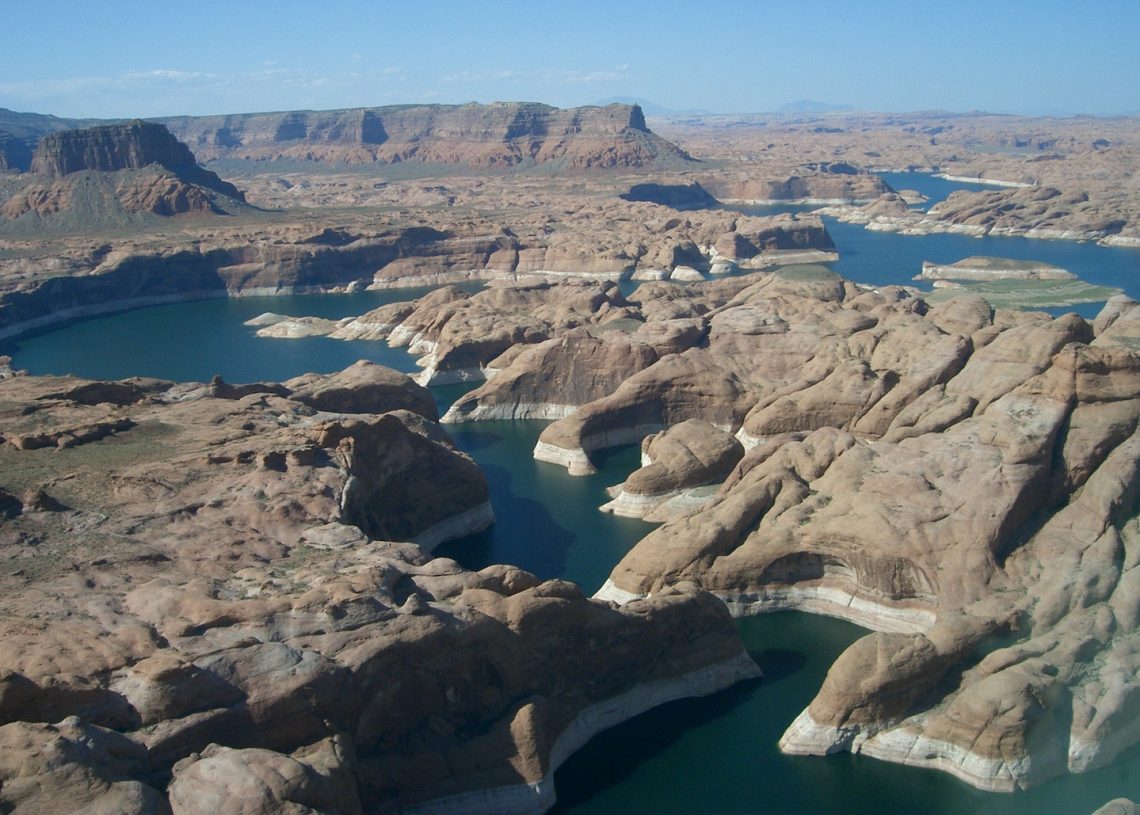
In the past few years, a shrinking Lake Powell has revealed a desert landscape that hasn’t been seen since the reservoir was first created in the 1960s when the sinuous orange walls of Glen Canyon were drowned by the completion of the Glen Canyon Dam.

Source: NASA

But further loss of water from America’s second largest reservoir could mean crippling shortages of hydropower in the region. In October 2022, the lake was just 24% full and had lost 16 feet of water over the preceding 12 months.

Another waterway that depends on the Colorado River for its existence but has also suffered major water loss is the Great Salt Lake. This small, inland ocean is getting saltier by the day as water is diverted for agricultural and residential use.

The lake is now 19 feet below its natural average and in January 2023, Brigham Young University released an alarming report noting that “the lake is in uncharted territory. It has lost 73% of its water and 60% of its surface area.” The lake is currently “on track to disappear in five years.” That’s potentially very bad news for the Great Salt Lake Open Water Swim, an annual 1-mile and 10K event held in Magna, Utah.

But it wouldn’t be the first time a Salt Lake swim lost its venue due to dropping water levels. According to Dale L. Morgan’s 2002 book The Great Salt Lake in 1919, professional swimmer C.S. Leaf swam from Antelope Island to Saltair, which was measured at 8.12 miles during a 1927 survey.

An annual marathon race was staged on that course from 1930 through 1933, but was curtailed because of “the receding lake level, which left Saltair high and dry,” Morgan writes.

But in 2010, Triple Crown swimmer Gordon Gridley revived the crossing and many other swimmers have since enjoyed the Utah brine. But the future of such races seems as cloudy as the salty water in which they transpire.

More than 400 miles to the southwest, Lake Mead, the largest reservoir in the United States and site of many open water races over the years, has also seen alarming drops in water levels in recent years.

Since 1983 when Lake Mead was at its fullest, the water level has dropped an astonishing 52 meters, leaving bathtub rings on the canyon walls that rim the lake. This historic drop has left the lake just 26% full and has exposed at least five sets of human remains that had previously been covered with crime-hiding water.

This gristly evidence of past misdeeds (the lake’s proximity to Las Vegas, the so called Sin City, and its storied 1960s mobster scene made it the ideal dumping ground once upon a time) garnered plenty of headlines, but the environmental disaster that’s led to such revelations is the real story.

The lake has long been the site of Slam the Dam and various other open water swimming events, but as water levels drop, their future seems less assured.

Another 300 or so miles to the southwest lies what’s left of California’s Salton Sea, which sprang up in 1905 when heavy rains overran an unfinished irrigation canal. A 2017 report from the California chapter of the Audubon Society noted that it took 18 months for workers to patch the breach, but in that time period, an inland sea of about 15 miles by 35 miles grew at a rate of a half-inch per day for the most of 1905.

The water was trapped in a natural divot in the landscape that sits about 200 feet below sea level, and with no direct outflow, the sea survived for decades fed by rainwater and run-off from local farms.

Almost immediately after it formed, the sea represented opportunity to local farms as well as swimmers and would-be vacationers. Developers arrived, and by the 1960s, the Salton Sea became a resort playground plopped in the middle of the desert and the go-to place for Rat Pack stars like Frank Sinatra, Dean Martin and their coterie.

The lake’s situation roughly halfway between Los Angeles and Las Vegas meant that it was accessible for many folks of means; its dimensions also appealed to many open water swimmers.

In 1954, Roy Carmassi, a 25-year-old former Marine and swimming instructor from Palm Springs became the first person to swim across the sea, following a 12-mile course, in 11 hours, 10 minutes. He had hoped to make it a round-trip, but poor visibility curtailed the swim at a one-way finish.

Several other high-stakes swims and races followed, attracting a veritable who’s-who of California marathon swimmer during the mid-century golden age of the sport.

But by the 1980s, Salton Sea had fallen out of favour among the glitzy and the lake itself began dying, too. That exceedingly large puddle has since all but evaporated; as the water has disappeared, the salinity has increased and contaminants have become concentrated in a toxic dust.

Lessons from the Aral Sea

The ecological disaster looming for the American southwest as these reservoirs and lakes disappear has already occurred a world away in Central Asia. There the Aral Sea, once the fourth largest inland lake in the world that straddled the Kazak and Uzbek borders, began withering in the 1960s thanks to Soviet irrigation diversion and extensive pollution.

By 2014, the Sea had shrunk to just a tenth of its previous size and was declared all but dead.

During a 2015 Witness History piece from the BBC, King College Professor Denys Brunsden – the geographical geomorphologist who was integral to the naming of the Jurassic Coast as a UNESCO World Heritage site – described a visit he took to the Aral Sea in 1990. He was one of the first Western scientists allowed into the Soviet Union to observe the shrinking of the once vast fishing goldmine.

The Aral Sea is drying up

He witnessed up close the ecological devastation wreaked by the lake’s vanishing.

“As we flew over the Aral Sea, we began to realize there was a severe environmental problem,” Brunsden recalled. Far from being swimmable, the lake had turned into a wasteland of salt, mud, silt and pollutants, all of which could easily take flight at the slightest breeze, creating a toxic cloud that threatens human health and virtually everything else in its path.

The devastation was clear. “This is the greatest loss of water by human beings on the planet,” Brunsden said.

As for swimming there, it’s probably not a great idea. What little water remains is dense with pollutants and salts. “It was very nasty stuff,” Brunsden said.

In fact, travel website Wikitravel notes that “the Aral Sea is not a place for sunbathing or swimming. It is a disaster zone, a scar on the Earth, showing what the human hand can do.”

Indeed, many haunting, Mad Max-esque images of rusted boats, laid bare as the water receded, have emerged over the past 30 years. These hulking remains stand as a testament to a failed state’s relentless pursuit of industrial progress.

However, there is a ray of hope amid so much devastation. While the Aral Sea once was thought to be a completely lost cause, recent changes to water management in the region have helped parts of the lake rebound.

The construction of the Kokaral dam, which was completed in 2005 with £66 million in World Bank money, split the remaining waterway into a North Aral Sea and a South Aral Sea.

Within seven months, the dam increased water levels in the North Aral Sea by 3.3 meters, a recovery that had been projected to take about 10 years, the BBC reports. This has allowed for economic recovery in the town of Aralsk, which used to lie on the banks of the Sea but now sits about 12 miles from the water.

Aralsk now boasts a growing fishing industry, and there’s hope the water’s edge will someday return to the town.

As water and fish return to the once parched Aral Sea, the take-home message is that it’s not necessarily too late to stop the process in other arid areas. If only the will to shift our destructive patterns and make a move against climate change can be enacted.

That is a challenge open to not just outdoor swimmers, but all residents of Planet Earth.

This article is from the February issue of Outdoor Swimmer. Click here to subscribe to the magazine.

To see all the online content from the February 2023 issue of Outdoor Swimmer, visit the 'Challenge' page.
Stay up to date with The Dip, our free weekly outdoor swimming newsletter.

Outdoor Swimmer is the magazine for outdoor swimmers by outdoor swimmers. We write about fabulous wild swimming locations, amazing swim challenges, swim training advice and swimming gear reviews.