

Powered by why
Neil Gilson tells Rowan Clarke how his reason for swimming Switzerland’s 10 largest lakes made it possible
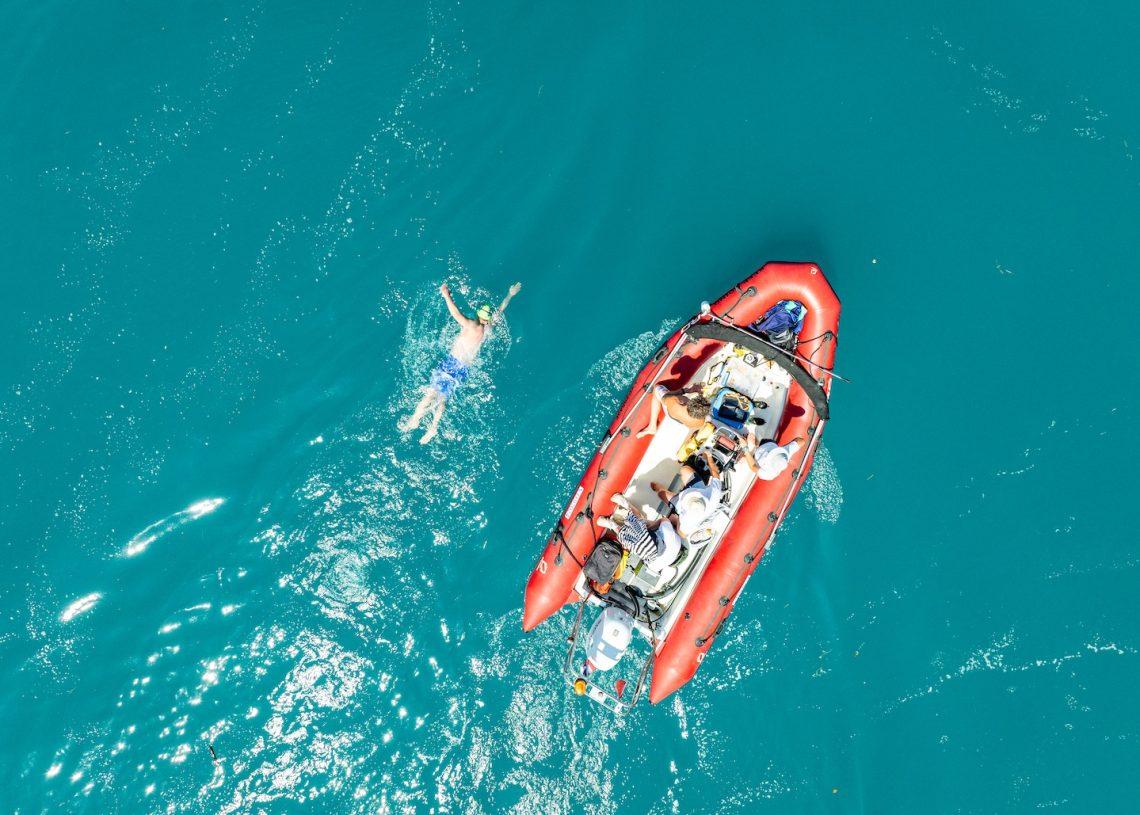
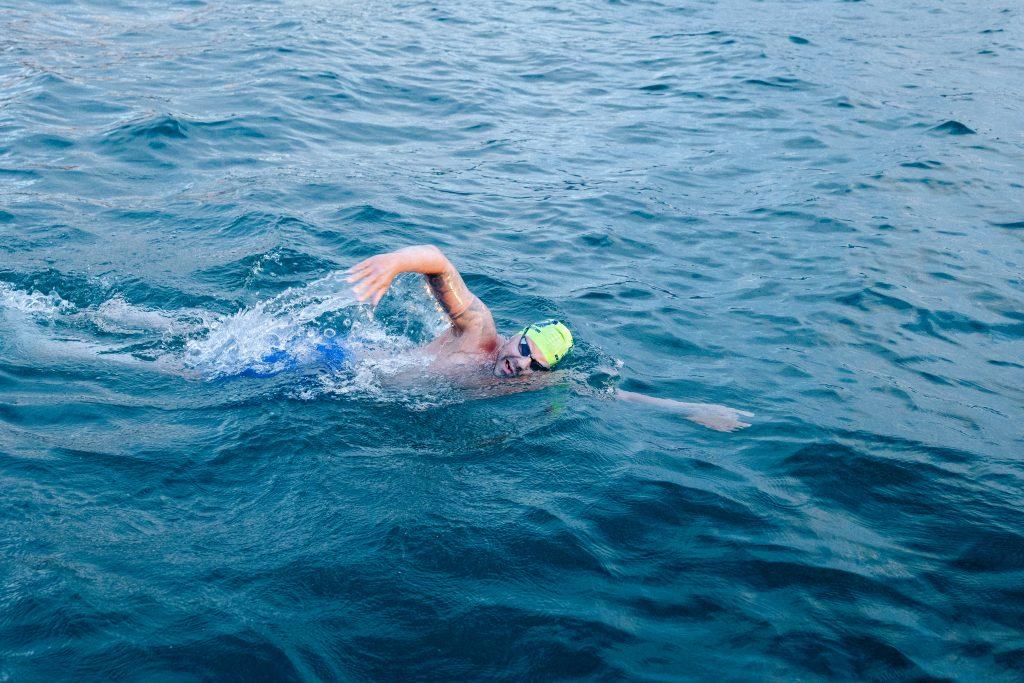
Neil Gilson’s Lake Geneva swim last month was about so much more than speed or endurance. This was the final lake of an epic challenge. And, after 22 hours of swimming through cold, changeable water and relentless head currents, his reason for taking on this challenge was waiting to swim the last 300 metres with him– his son Jack.
Endurance swimmer and father of three, Neil draws parallels between the physical and mental pain of long-distance swimming and navigating Jack’s illness that turned the family’s lives upside down – and how having such a strong reason for completing this 230 mile 10 lake challenge helped him reach the finish line.
The ‘absolute monster’
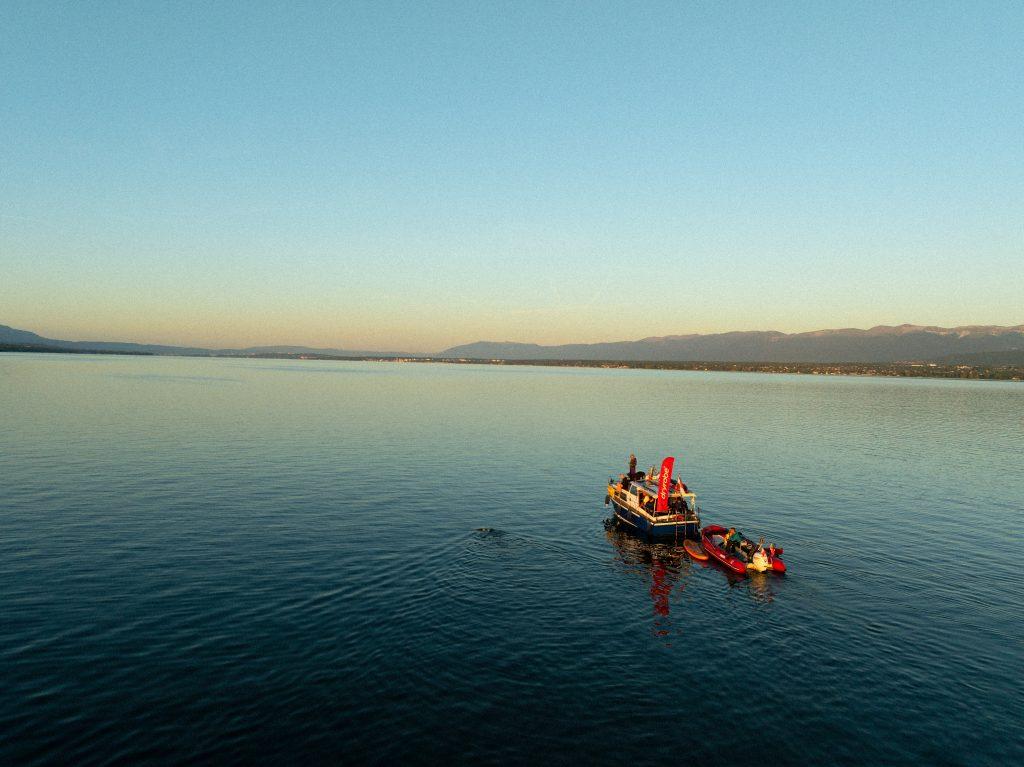
As well as being the finish line, Lake Geneva was where it all started. Back in 2023, Neil attempted to swim its length, getting to about 58km/18 hours when a sudden upwelling of cold water changed everything.
“I hit a wall of cold water,” he says. “It’s a phenomenon in the lake where the cold water comes to the top, and it happened on my swim when everything was going so well. I got hypothermia and was pulled out unconscious.”
You might think that this experience would put Neil off, but he recovered completely, blissfully unaware of how terrifying it had been for his crew and family. But, as he came to understand it from their perspective, it taught him a great deal about himself and endurance swimming.
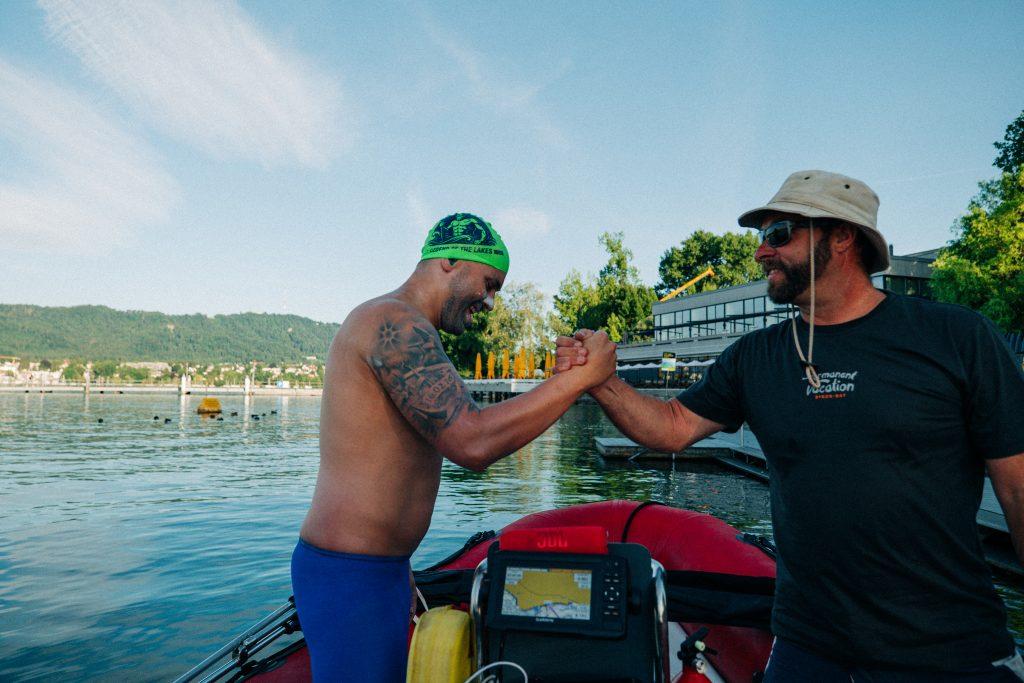
“When you’re in it, you don’t realise how bad it is– I woke up and went, ‘Did anyone get that on camera for the charity?’ And they said, ‘No, we thought you were going to die.’,” he says. “I pushed it way too far. I’ve got family, I’ve got kids, and nothing’s more important. You make bad decisions, and I’ve learnt to recognise those bad decisions. The team have learnt that when I’m making one, they need to tell me it’s time to stop.”
Left with the feeling that he’d been cheated out of completing the challenge, and with a deeper understanding of the “absolute monster” that is Lake Geneva, Neil returned the following year. This time, he not only completed the swim, but also smashed the men’s record that had been set in 1986, the year Neil was born. His time of 22 hours, nine minutes and 38 seconds remains the fastest.
“It wasn’t my body giving up – it was taken away from me. I’d gone past a pain barrier; I was into the final 20k, and I knew I was going to do it,” he says about that first attempt. “So I was on a mission the second time to just go and do it.”
His third attempt couldn’t have been more different, and deliberately so. It was a celebration, a big finale, where he was joined by his friends and family, staying together in a large house ready for Neil to finish his epic challenge.
“I don’t think I was ever in the mindset to go and smash the swim,” he says. “It was just: get through it, get that moment I’d been envisioning, with everyone there.”
A remarkable reason
The scale of Lake Geneva is hard to comprehend. But add the enormity of swimming it after swimming Switzerland’s nine next largest lakes in just two years, and you realise what a staggering challenge this was. It follows then, that a remarkable feat such as this was driven by a powerful story.
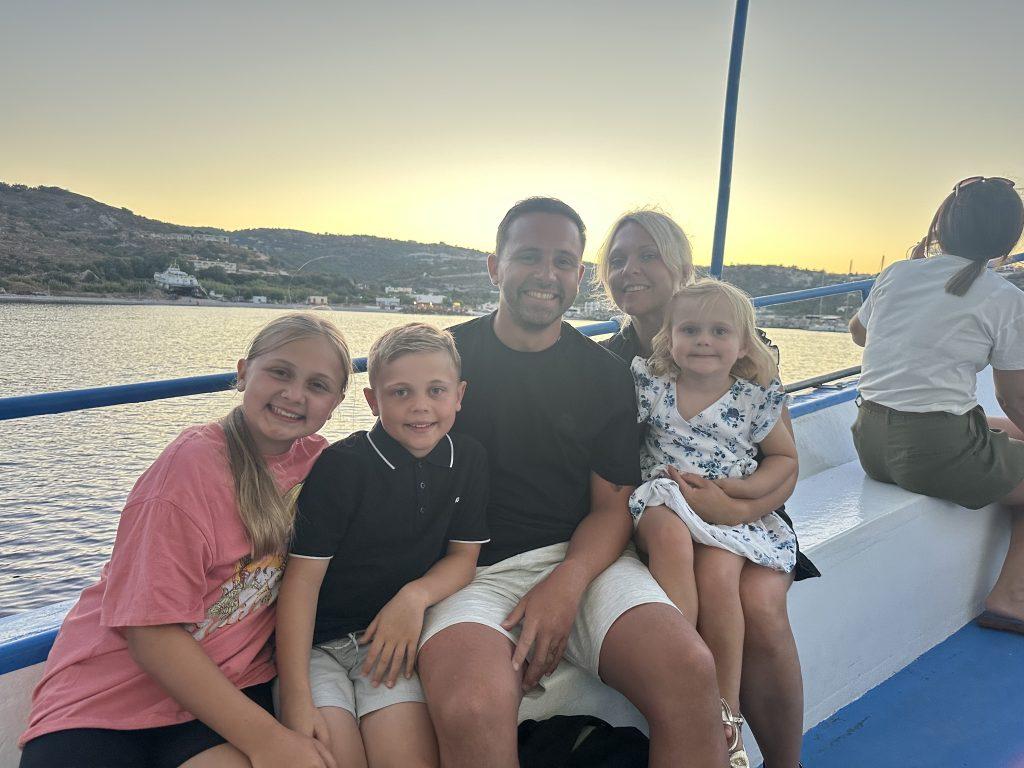
At 18 months old, Neil’s second child, Jack was, in Neil’s words, “a normal, happy, healthy little boy”, when he became ill with tonsilitis. The day after falling ill, Neil and his wife noticed sudden changes in Jack.
“He developed this tic, a really big head movement,” Neil says. “He had OCD and really bad anxiety. He was only young, but he was scared of everything, even leaving the house. You could see in his eyes that he just wasn’t there. Trying to get him dressed was like he was screaming in pain. He stopped eating and lost all his fingernails because he was malnourished.”
Over the following year, he got tonsillitis 11 more times, and his symptoms worsened. Different symptoms suggested different diagnoses, but nothing helped, and by the time Jack was three, the family felt isolated and desperate for answers. Then, one day, a clip popped up online showing parents and a doctor discussing another child.
“My wife and I looked at each other,” says Neil. “I still remember the goosebumps. We said: ‘That is Jack. He’s got this.’”
They tracked down the doctors featured in the programme and Jack was treated for PANDAS – paediatric autoimmune neuropsychiatric disorders, a condition marked by the sudden onset of symptoms such as obsessive-compulsive behaviour or tics following a strep infection. Finally, with a diagnosis, Jack could at last get the treatment he needed.
“It was simply a longer course of a slightly different antibiotic,” Neil says. “His tic was gone within two weeks – completely gone. Then we started getting him back gradually.”
After another flare following surgery to remove his tonsils, Jack improved again. He’s now a normal, judo-obsessed 10-year-old. You can see almost disbelief and wonder in Neil as he relays this story, and while he’s careful not to present their experience as universal, he remains driven by the chance that led to Jack’s diagnosis.
“If we hadn’t seen that family on telly, we wouldn’t have known about the condition,” he says. “The key is getting treatment early. We were really lucky, and I was so grateful to that family that I felt I had a duty to do something.”
Going big
The size of Neil’s challenge reflects the extent of his gratitude. Having been a competitive pool swimmer in his youth, he hadn’t trained seriously for years. Still, when he was looking for a fundraising challenge, swimming was the one. He began with a 24-hour swim in a Scottish loch: one mile at the start of every hour, through a night in 10°C water.
“The response I got was from families saying, ‘I didn’t know about this condition. I think my daughter’s got this; I think my son’s got this.’,” he says. “Then I got the bug for wanting to do more.”
Next, was a swim from Swansea to his home town of Ilfracombe. Finishing with less pain than he’d expected, he wondered why he had worn a wetsuit. This opened up new possibilities, and he started looking for his next challenge. Seeking beautiful scenery, he was drawn to Lake Geneva, where he built lasting relationships with the pilots and crew of the Lake Geneva Swimming Association who shared the emotional investment of each attempt. But, after completing Geneva in record time, he felt he was not finished with Switzerland.
“There are so many beautiful lakes… I wanted to create something that people might look at and say, ‘I want to try the 10 largest lakes in Switzerland,” he says in the hope of sharing this series with other endurance swimmers. “I’m not a professional swimmer; I’m a dad with three kids, probably 20 years past being able to go my quickest. There are people out there who will smash it, and I’d love them to go and do it.”
But he also recognised that a small, practically unheard-of charity championing a little-known condition, needed an extraordinary sporting challenge.
“When people resonate with a more common condition that has touched them personally, you can raise money doing your local marathon,” he explains. “But with this, you’ve got to go above and beyond. It’s like searching for doctors and being in it with your child: you have to go above and beyond when you’re raising the money and awareness as well. Going bigger and crazier was the way forward.”
Organising 10 endurance swims was both big and crazy. Ten different routes, 10 weather systems, geographical formations, and waterscapes, each requiring careful planning and navigating, each presenting their own challenges. Constance – 65km of vast, exposed landscape – felt more like an ocean than alpine lake. Beautiful Lucerne, where the mountains fall into the water. And Maggiore, where he nearly gave up.
“I was only 7km from the finish and I just stopped suddenly,” says Neil. “I thought: I’ve got nothing left, mentally or physically. The team on the boat were amazing. They said all the right things and made me think – you’re doing this for something bigger and more powerful – for love, the love of your family, the love of your son. I lay on my back, took a moment, and all of a sudden I got this second wind. I swam the quickest half-hour I’d swum on the whole thing.”
For love
The force of love, of putting his chosen suffering alongside what Jack endured without choice was Neil’s secret weapon.
“When you’ve got that why and that reason, it’s like a superpower. It’s bigger than any pain you’re going through. You realise it’s crazy what your mind and body can do when you tap into that,” he says. “You think: this is nothing compared with what Jack must have gone through.”
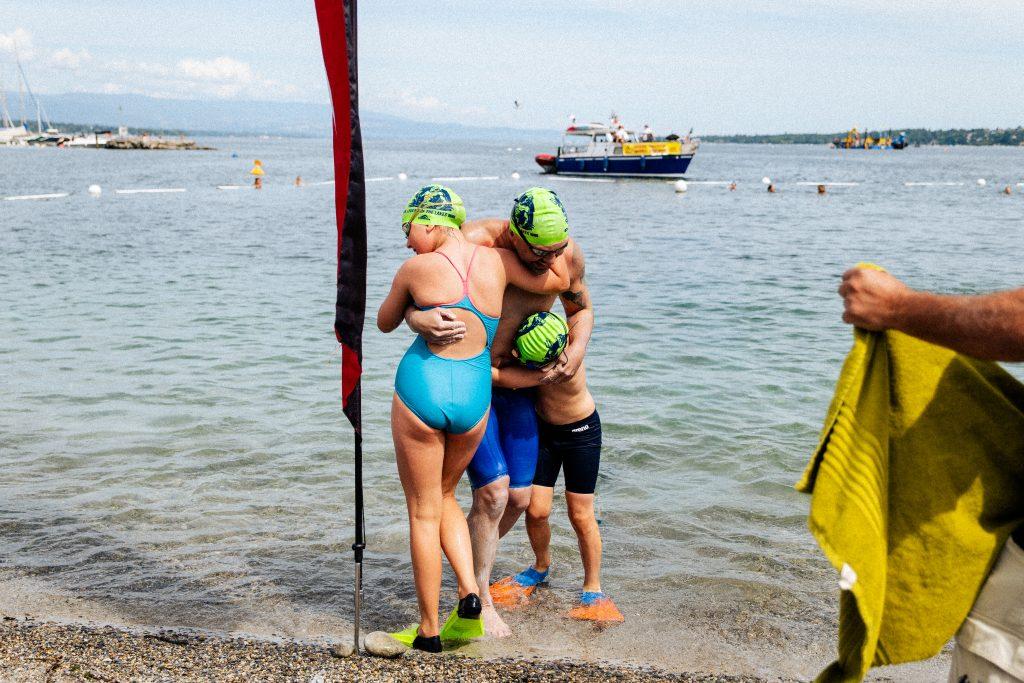
He describes the final stretch of his Lake Geneva Finale as a ‘full-circle moment’ with Jack and his older sister, Neil’s daughter Lily, swimming alongside him. “They actually swam the last bit with me, which was amazing,” he says. “They did about 300 metres, which is a big lake swim. If that’s not a full-circle moment, from where Jack was to now, I don’t know what is. I said to him at the time, ‘Just look what you’ve done. You’ve helped so many people just by swimming.’”
Even more wonderful for Neil is the pride and curiosity ten-year-old Jack has about his Dad’s swimming and taking on open water himself – although Neil does point out that Judo remains his first love.
“When you’ve got a little version of yourself, for him to think his dad’s cool and be proud of you, that’s what you dream of,” says Neil. “He keeps saying, ‘What’s the smallest lake, Dad?’ I told him Zug, 12.7km, and he went, ‘I reckon I might do that one.’ I said, ‘Just wait a bit.’”
While Neil doesn’t want to force swimming on any of his children, it’s important to him that they’ve absorbed the impulse behind the challenge: to do something for other families. “He wants to do something for PANS and PANDAS and help others. Hopefully I’ve inspired him.”